
Most traders do not lose because they lack information. They lose because they enter late, react emotionally, and change their plan while the market is already moving.
Crypto markets are especially aggressive in this sense. Price breaks resistance, pulls back, sweeps liquidity, creates panic, recovers, and then continues. Traders who enter without structure often become part of the liquidity the market uses before the real move begins.
That is why execution matters.
A strong trading strategy is not only about predicting direction. It is about defining conditions before the trade happens, automating part of the process, and reducing emotional decision making.
In DeFi, that logic can become even more powerful. With Olympex, users can combine tools like Limit Orders, Automated DCA, Cross Chain execution and Bridge to turn volatility into a more structured execution framework.
The strategy: Breakout Retest Accumulation
The strategy we are going to use is called Breakout Retest Accumulation.
It is based on a simple price action principle: when price breaks above an important resistance level, that same level can later act as support if the market confirms strength.
The idea is not to buy the first candle that breaks resistance. The idea is to wait for the market to confirm strength, then enter through a structured system of Limit Orders and DCA.
Step 1: Identify the key market level
Every strategy starts with a level. This can be a previous resistance zone, a former support level, a range high, a high volume area, or a psychological level.
For example, imagine ETH has been trading below $3,200 for several weeks. Every time price reaches that zone, sellers appear. That means the market is treating $3,200 as resistance.
If ETH breaks above $3,200 with strong volume, that level becomes important. But buying immediately after the breakout is risky because the market may fake the move, reject the breakout, or return to retest the level.
This is why the strategy waits.
Step 2: Wait for the retest instead of chasing the breakout
A breakout alone is not enough. The cleaner setup happens when price breaks above resistance and then returns to test that same area as support.
Traders commonly use platforms like TradingView to map these zones visually and mark resistance, support, entries and exits.
Example setup:
• Breakout level: $3,200
• Retest zone: $3,100 to $3,250
• Invalidation level: below $3,000
• Target zone: $3,650 to $3,950
The key is patience. Instead of buying only because price is moving, the trader waits for the market to return to a predefined execution zone.
Step 3: Use Limit Orders for precision
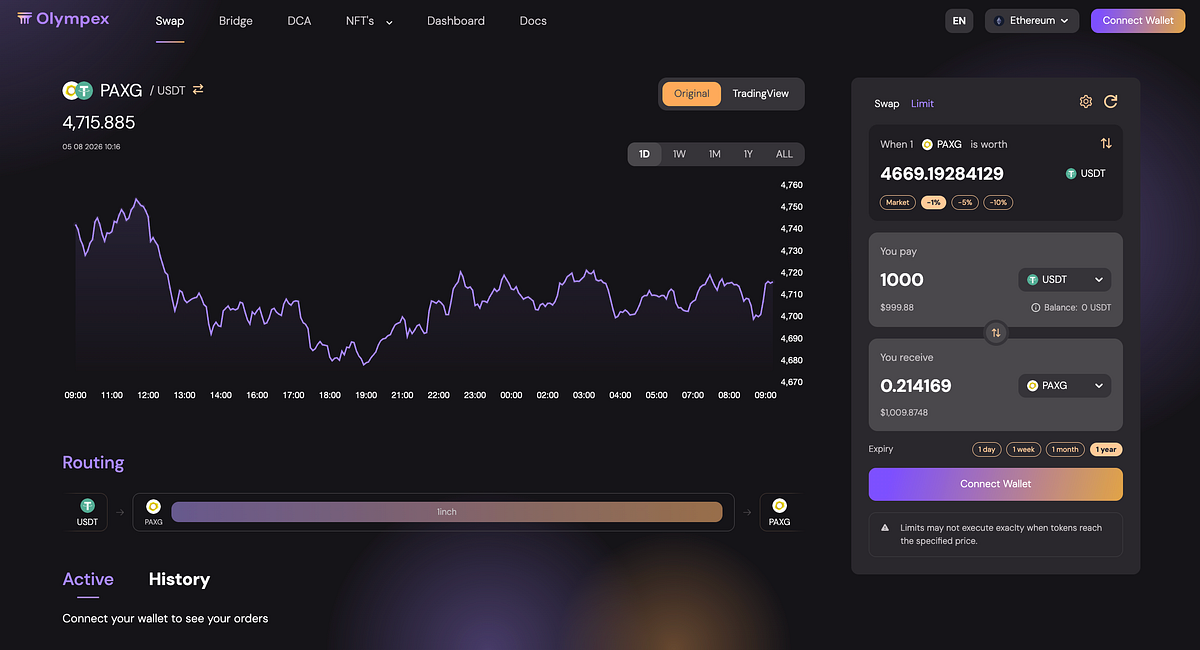
A Limit Order allows a trader to define the price at which they want to buy or sell. The order only executes if the market reaches that price or a better one.
This is useful because the trader is not forced to react manually in the middle of volatility. In this strategy, the user can divide the entry into different levels.
Example entry structure:
• 30% of the position at $3,240
• 30% at $3,180
• 40% at $3,100
Instead of trying to guess one perfect entry, the user builds an entry zone. If price retests the area, the orders can execute. If price never returns, nothing happens.
The goal is to avoid chasing the move, reacting in panic, or entering based on emotion instead of structure.
Step 4: Use DCA to reduce timing risk
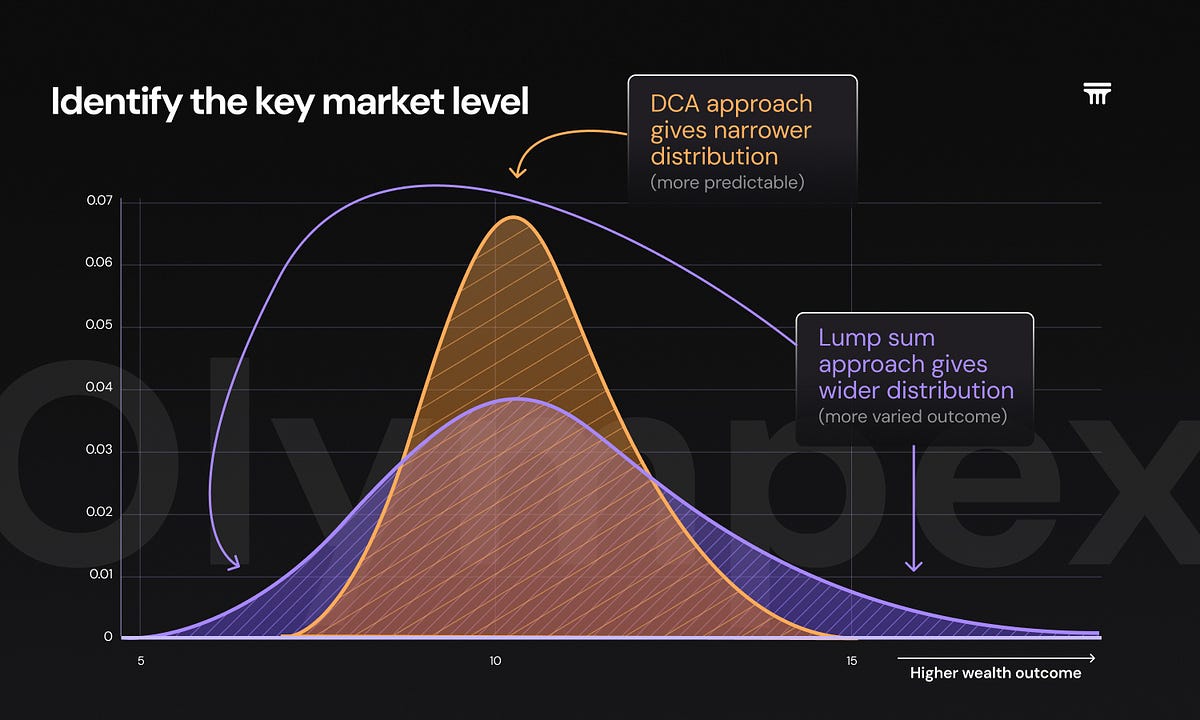
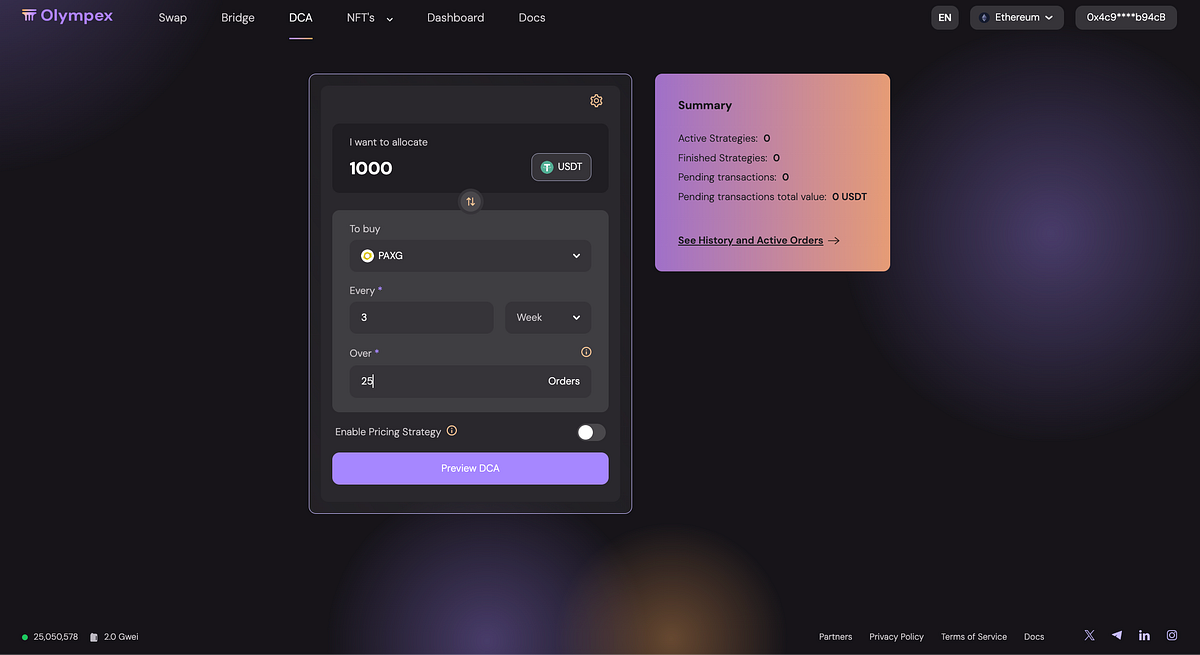
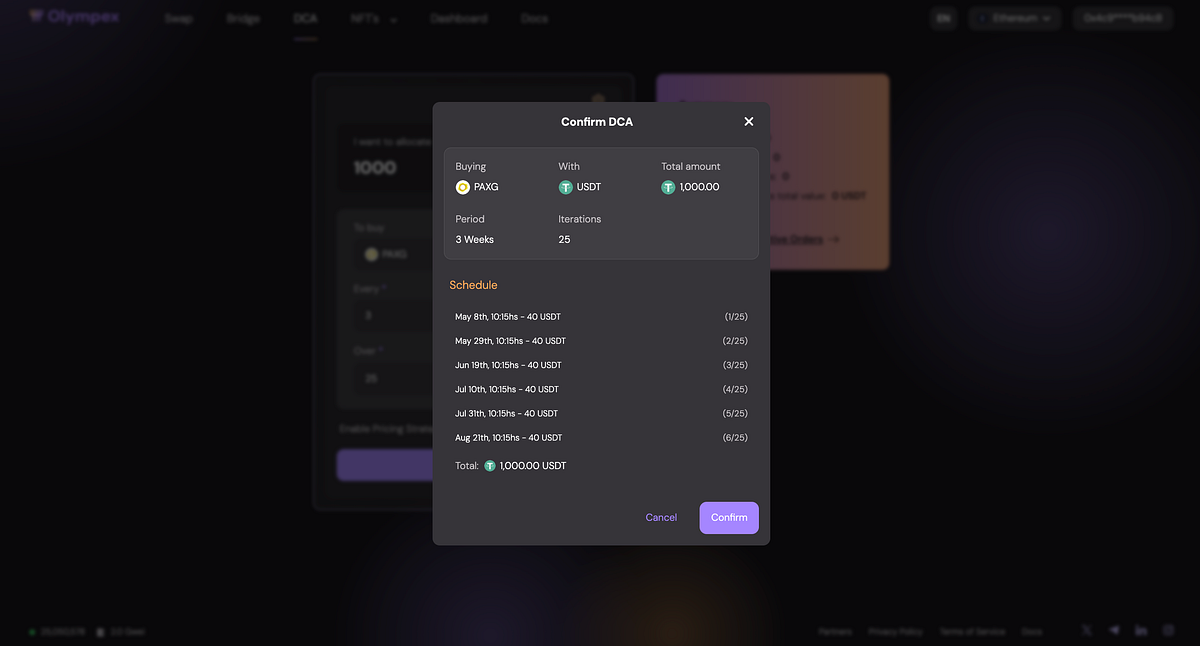
Dollar Cost Averaging, also known as DCA, is a strategy where capital is divided into smaller purchases over time instead of entering all at once.
In crypto, this matters because volatility can be brutal. One entry at the wrong moment can damage the entire position. With Automated DCA, the trader can structure accumulation across time or price.
Time based DCA
The user buys a fixed amount at regular intervals, but only while price remains inside the selected retest zone.
Example:
• Buy $100 every 12 hours
• Only while ETH trades between $3,100 and $3,250
• Stop buying if price closes below $3,000
This helps reduce the pressure of guessing the exact low.
Price based DCA
The user divides entries across different price levels.
Example:
• Buy 25% at $3,240
• Buy 25% at $3,190
• Buy 25% at $3,140
• Buy 25% at $3,090
This approach is useful when the trader expects volatility inside the retest area. The purpose is not to remove risk, because that is impossible. The purpose is to structure the entry and reduce emotional timing.
Step 5: Define risk before entering
A trading plan is incomplete without risk management. Before entering, the trader should define how much capital will be allocated, where the trade becomes invalid, how much loss is acceptable, and where profits will be taken.
This is connected to position sizing, which helps traders define how much exposure they should take based on account size and risk tolerance.
Example risk structure:
• Maximum allocation: 15% of available stablecoins
• Invalidation: daily close below $3,000
• Maximum loss accepted: 2% of total portfolio
• No additional entries if structure fails
This prevents one trade from becoming a portfolio problem. In crypto, “I will just wait” has destroyed more portfolios than bad entries. The market has no mercy and no customer support.
Step 6: Use Limit Orders to exit gradually
Limit Orders are not only useful for entries. They can also define exits.
Instead of waiting for the perfect top, the trader can take profits in stages.
Example exit structure:
• Sell 30% at $3,650
• Sell 30% at $3,800
• Sell 40% at $3,950
This creates a more disciplined exit plan. The trader does not need to predict the exact top because the strategy already defines where part of the position should be reduced.
Step 7: Backtest before deploying
Before applying any strategy with real capital, traders should test how it would have performed in previous market conditions.
This process is called backtesting, and it helps evaluate whether a strategy would have worked historically under defined rules.
For this strategy, a trader could backtest:
• Breakout and retest entries
• Limit Order zones
• DCA intervals
• Profit taking levels
• Invalidation conditions
• Different assets and timeframes
The objective is not to guarantee future results. The objective is to avoid building strategies based only on vibes, screenshots, and the sacred art of Twitter confidence.
Step 8: Use AI as a strategy planning layer, not as a shortcut
AI can be useful when it helps users organize logic, test scenarios, compare conditions, and translate an idea into clear execution rules. The important distinction is simple: AI should not be treated as a magic prediction machine.
The value is not “AI knows where the market will go”. That is the casino version of the story.
The real value is using AI to structure the plan before execution. This connects with the broader concept of algorithmic trading, where predefined rules are used to execute trades systematically instead of relying on intuition.
For example, a trader could use AI to define a strategy brief like this:
Asset: ETH / USDC
Strategy: Breakout Retest Accumulation
Trigger: ETH breaks above $3,200 and retests the $3,100 to $3,250 zone
Entry logic: Use price based DCA across four Limit Order levels
Risk rule: Stop execution if price closes below $3,000
Exit logic: Place take profit Limit Orders between $3,650 and $3,950
Allocation rule: Never use more than 15% of available stablecoins
Execution route: Execute through Olympex using available DeFi tools
In this model, AI helps clarify the framework, while execution can happen through Olympex tools such as Limit Orders, Automated DCA, Bridge and Cross Chain execution.
The user does not simply place isolated trades. The user builds a strategy.
Why this matters for DeFi
DeFi gives users access to self custody, global liquidity and on chain markets. But access alone is not enough.
The next step is execution quality.
Many users still need several platforms to analyze charts, move capital, swap assets, bridge across chains, create orders, track performance and manage risk. That creates fragmentation.
Olympex is designed to reduce that fragmentation by bringing key DeFi tools into one execution environment:
• DEX Aggregator
• Cross Chain execution
• Bridge
• Limit Orders
• Automated DCA
This matters because DeFi should not only be open. It should also become easier to operate strategically.
Market data platforms like CoinMarketCap can help users track asset behavior, while analytics platforms like DefiLlama help contextualize liquidity, chains, protocols and broader DeFi activity. Tools like CoinGlass can also be useful to understand derivatives pressure, liquidations, open interest and volatility conditions before deploying a strategy.
But the execution layer is where the plan becomes real.
Manual trader vs structured trader
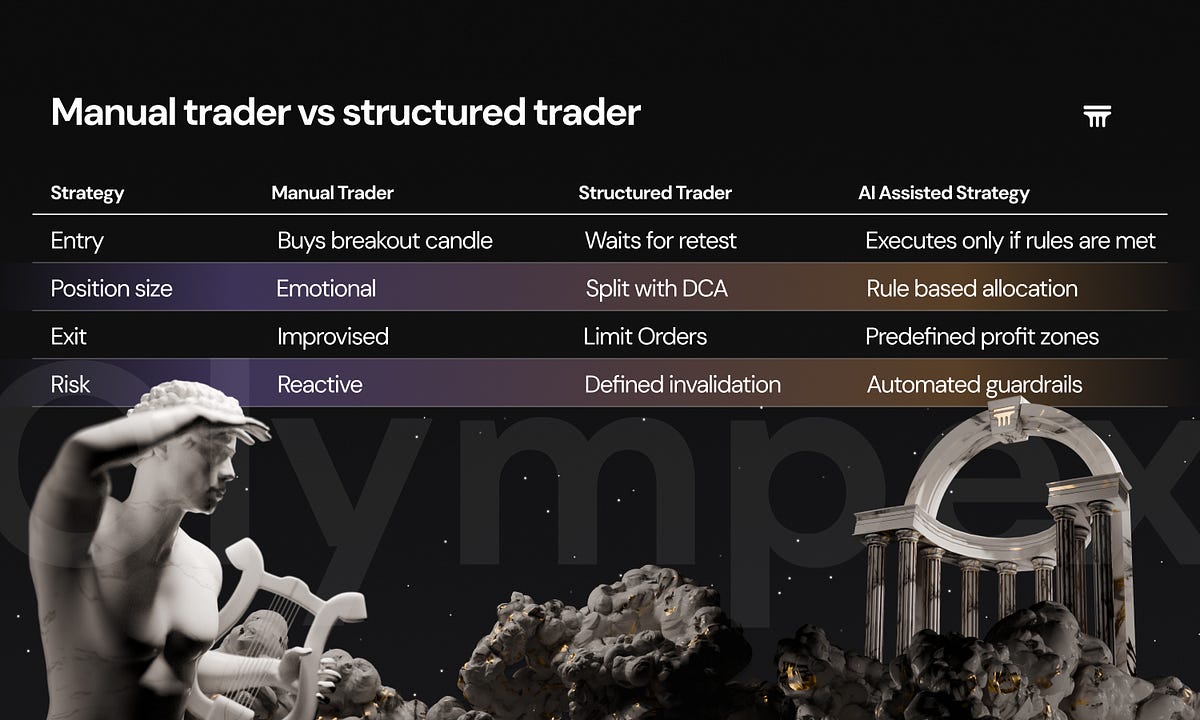
A manual trader reacts. A structured trader plans, defines levels, manages risk, and uses tools that help reduce emotional execution.
The point is not that automation guarantees profits. It does not. The point is that structure can help users execute the plan they already defined, instead of letting fear and greed rewrite the rules mid trade.
Final thoughts
Most traders do not need more noise, they need better systems. Limit Orders can bring precision, DCA can add discipline, backtesting can provide structure, and AI can help users organize strategy logic with more clarity.
Together, these tools create a framework where users can stop reacting to every candle and start building more structured strategies.
The future of DeFi execution is not only about faster swaps or deeper liquidity. It is about moving from manual decisions to better designed capital allocation.
That is the direction Olympex is building toward.





