
Slowing growth, sticky inflation, and rate cuts are reshaping the global currency landscape.
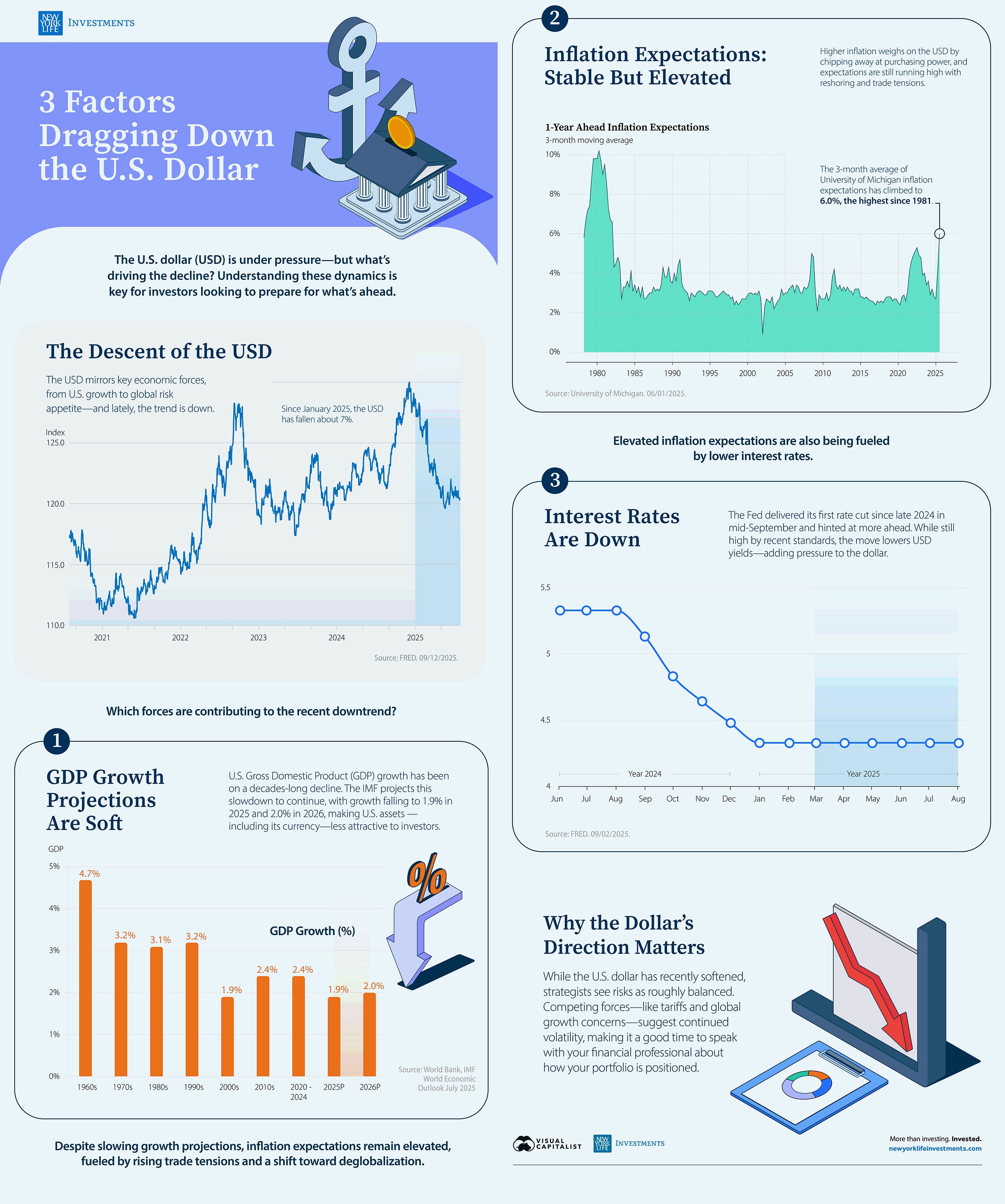
The U.S. dollar (USD) often acts as a barometer for the global economy, reflecting domestic growth prospects, monetary policy, inflationary pressures, and international investor sentiment. As the world’s reserve currency, its value carries implications not only for U.S. households and businesses but also for global trade and capital flows. In 2025, the dollar has come under pressure, falling nearly 7% since the beginning of the year, according to data from the Federal Reserve.
This decline raises pressing questions: What forces are weighing on the greenback? And what do these shifts mean for investors? Recent data suggests that three key dynamics are driving the dollar’s downturn: sluggish U.S. growth projections, elevated inflation expectations, and falling interest rates. Together, these factors are reshaping the investment landscape and signaling a more complex environment ahead.
The Descent of the USD: A Snapshot
The dollar has always mirrored broader macroeconomic currents. During times of robust U.S. growth, rising rates, or geopolitical uncertainty, the USD tends to strengthen as investors flock to its perceived safety. Conversely, when growth softens, inflation persists, or policy pivots to lower rates, the dollar weakens.
Since early 2025, the USD has been on a downward trajectory, reflecting this interplay of economic concerns. According to the Federal Reserve’s trade-weighted index, the dollar is down around 7% year-to-date, erasing some of its gains from the strong-dollar era of 2022–2023. This decline is not occurring in isolation. It reflects deeper trends that warrant closer examination.
1. GDP Growth Projections Are Soft
At the heart of the dollar’s weakness lies slowing U.S. growth. Gross Domestic Product (GDP) expansion has been decelerating for decades, falling from the 4.7% average growth of the 1960s to around 2% in the 2010s and 2020s. The International Monetary Fund (IMF) now projects U.S. growth to remain subdued, at 1.9% in 2025 and 2.0% in 2026.
Slower growth reduces the attractiveness of U.S. assets for foreign investors. When the economy is expanding strongly, it generates higher returns on capital, drawing inflows that bolster the dollar. By contrast, weaker growth forecasts make the currency less compelling. Add in heightened global competition for investment, particularly from emerging markets with higher growth rates, and the dollar’s relative appeal dims further.
This softening outlook reflects a mix of structural and cyclical factors: an aging population, slower productivity gains, and lingering uncertainties from global trade tensions. The result is an economy that, while resilient, is no longer the high-growth engine it once was.
2. Inflation Expectations: Stable But Elevated
Inflation plays a dual role in the dollar’s trajectory. On one hand, persistent inflation erodes purchasing power, undermining confidence in the currency. On the other hand, if inflation leads to tighter monetary policy, higher interest rates can support the dollar by offering investors better yields. In 2025, however, inflation dynamics are tilted against the USD.
Data from the University of Michigan shows that one-year-ahead inflation expectations have climbed to 6.0%, the highest level since 1981. This elevated reading highlights how supply-chain reshoring, geopolitical trade frictions, and sector-specific bottlenecks are fueling sticky price pressures.
Although inflation has moderated from the extreme spikes seen in 2022, it remains high enough to weigh on sentiment. Elevated inflation expectations make U.S. assets less attractive in real terms, particularly when interest rates are falling—a combination that creates a challenging environment for the dollar.
3. Interest Rates Are Down
Perhaps the most immediate driver of the dollar’s recent weakness is monetary policy. The Federal Reserve cut rates in late 2024 after an extended tightening cycle and has signaled more accommodative policy ahead. As of September 2025, the Fed funds rate has settled around 4.25%, down from above 5.5% a year earlier. Lower interest rates reduce the yield advantage of holding U.S. assets relative to other currencies.
For years, higher U.S. rates served as a magnet for global capital, helping sustain dollar strength. Now, as that advantage diminishes, the currency faces downward pressure. The combination of high inflation expectations and lower rates is particularly problematic: investors anticipate diminished real returns, eroding the appeal of dollar-denominated investments.
Why the Dollar’s Direction Matters?
The dollar’s path has wide-ranging consequences:
-
Trade and exports: A weaker dollar makes U.S. goods cheaper abroad, potentially boosting exports. However, it also raises the cost of imports, which could reignite inflationary pressures.
-
Global debt markets: Many emerging markets hold dollar-denominated debt. A weaker USD can ease repayment burdens, supporting financial stability abroad.
-
Investment strategies: For investors, dollar weakness can enhance returns on foreign assets when converted back to USD, encouraging portfolio diversification.
At the same time, volatility looms large. Competing forces—tariffs, shifting trade alliances, and the push toward deglobalization—suggest that the dollar’s trajectory is unlikely to be a one-way street. While growth concerns point to weakness, geopolitical risk could easily restore demand for the USD as a safe haven.
Balanced but Uncertain Risks
While the dollar’s decline in 2025 has raised concerns, many strategists view risks as roughly balanced. On one side, sluggish U.S. growth and falling interest rates argue for continued softness. On the other hand, persistent global tensions, from trade disputes to regional conflicts, could trigger renewed safe-haven demand, lending support to the currency.
For investors, the lesson is clear: prepare for volatility. Diversification across asset classes and geographies may prove especially valuable in this environment. The dollar’s decline is not simply a story of weakness, it is a reflection of shifting global dynamics that demand careful navigation.
Originally Published on Substack.





