
How the world’s largest stablecoin issuer accumulated nearly $15 billion in gold and what it means for global finance?
Deep beneath Switzerland’s mountains, hundreds of Cold War–era bunkers remain sealed relics of a nuclear-age anxiety. Most are dormant. One, however, is anything but. Each week, more than a ton of gold is reportedly hauled into a fortified vault owned by Tether (USDT), the world’s largest stablecoin issuer.
What was once a symbol of state survival strategy has become a linchpin in a new financial experiment: a private company amassing bullion at a pace rivaling national central banks. Tether’s transformation from a crypto infrastructure provider into a major participant in the global gold market signals a deeper shift in how digital finance perceives trust, liquidity, and reserve assets.
Gold’s Expanding Role Inside Tether’s Reserves
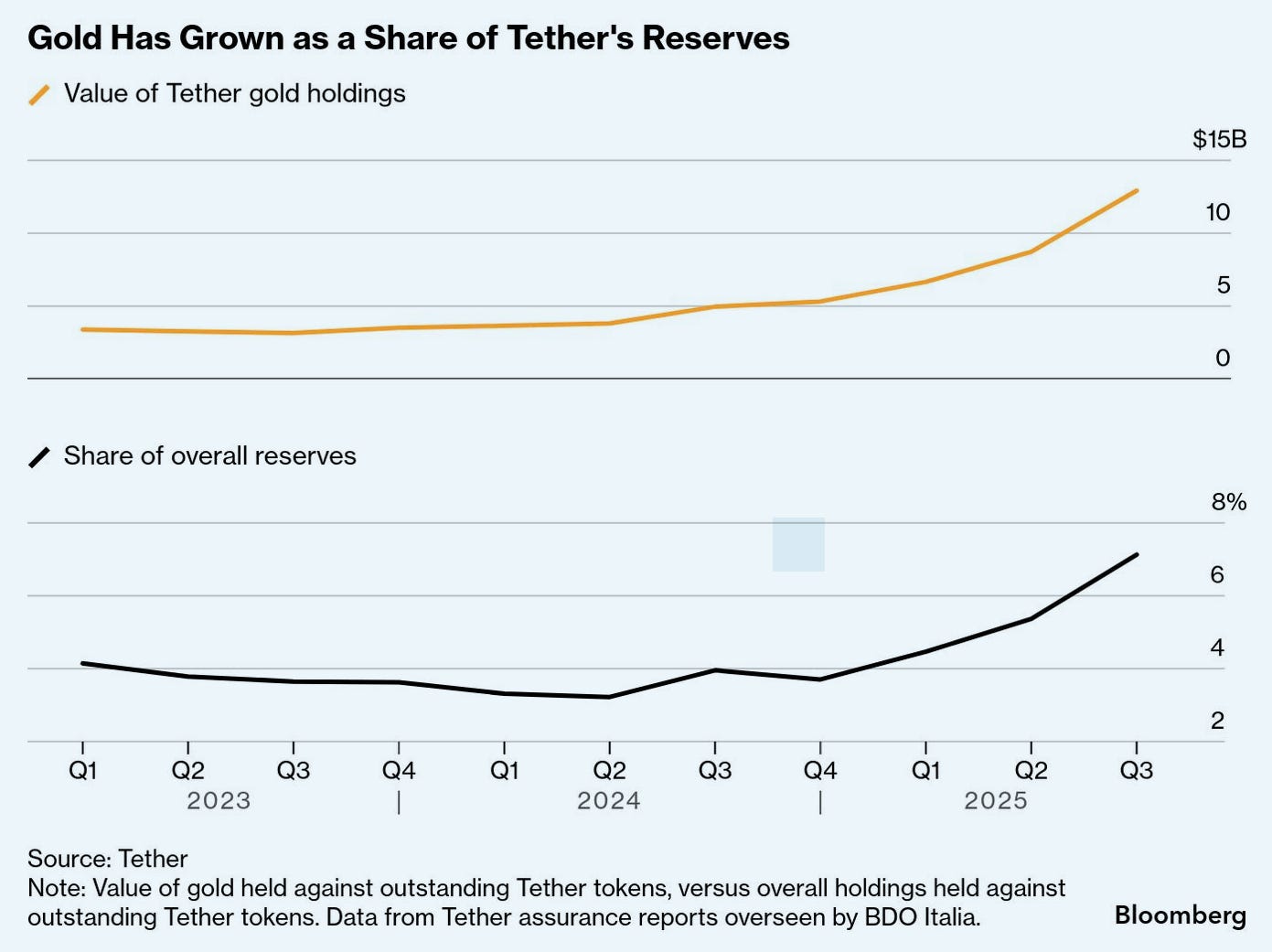
According to Bloomberg data sourced from Tether assurance reports overseen by BDO Italia, gold has become an increasingly prominent component of Tether’s reserves. The attached chart (below) shows the value of Tether’s gold holdings rising steadily from early 2023 through the third quarter of 2025, reaching close to $15 billion. Over the same period, gold’s share of Tether’s overall reserves has climbed from roughly 3% to nearly 7%.
This is not a marginal adjustment. In absolute terms, Tether reported buying more gold in 2024 than any central bank except Poland, a striking comparison for a private issuer of a dollar-pegged digital token. Central banks traditionally accumulate gold to hedge currency risk, preserve confidence, and ensure liquidity during systemic stress. Tether appears to be borrowing directly from this playbook.
Why a Stablecoin Issuer Wants Bullion?
Tether has long argued that its reserves are designed for resilience under stress scenarios. Gold fits neatly into that framework. Unlike longer-dated government bonds or riskier yield-generating instruments, gold can be rapidly liquidated in global markets, even during geopolitical or financial crises. It also carries no counterparty risk, a feature increasingly prized in a fragmented global financial system.
In effect, Tether is positioning gold as both a liquidity backstop and a signal of credibility. As scrutiny of stablecoins intensifies across jurisdictions, tangible assets stored in high-security jurisdictions such as Switzerland serve as a form of reputational insurance. The imagery matters: a Swiss bunker filled with bullion evokes permanence and discipline, qualities often questioned in the crypto sector.
World Gold Council data underscores this logic. Gold remains one of the most liquid assets globally, with daily trading volumes exceeding those of most sovereign bond markets, excluding U.S. Treasuries. This liquidity explains why central banks, particularly in emerging markets, have accelerated gold purchases since 2022.
Acting Like a Central Bank, Without Being One
Beyond passive accumulation, Tether is actively investing in gold mining ventures and has reportedly hired senior metals traders to operate in the bullion market. This is a notable escalation. Central banks typically avoid direct market trading, yet Tether is blending reserve management with profit-seeking behavior.
This hybrid approach blurs the line between financial infrastructure and speculative enterprise. While it may enhance returns during favorable market conditions, it also exposes the firm to commodity price volatility. Gold prices, though relatively stable compared to other commodities, can experience sharp drawdowns during periods of rising real interest rates or dollar strength.
The Credit Risk Warning
These risks are not theoretical. In 2024, S&P Global Ratings downgraded Tether’s USDT stablecoin to its lowest assessment tier, citing concerns over transparency, governance, and increasing exposure to what it termed high-risk assets, including gold. While gold is traditionally viewed as a safe haven, rating agencies evaluate risk differently.
Price volatility, custody complexity, and liquidation timing all factor into credit assessments. From a ratings perspective, a reserve portfolio heavily tilted toward bullion is less predictable than one dominated by short-term U.S. Treasury bills. This creates tension between market optics and institutional risk models.
A Signal of a Fragmenting Financial Order
Tether’s gold strategy reflects a broader trend: the decentralization of reserve management. As trust in fiat systems becomes more politicized and fragmented, private actors are adopting tools once reserved for states. Gold, with its millennia-long monetary history, is re-emerging as a neutral anchor in a polarized financial world. Whether this strategy ultimately strengthens Tether or amplifies its vulnerabilities remains unresolved.
What is clear is that the company is no longer merely shadowing traditional finance. It is selectively imitating it, vault by vault, bar by bar, deep inside a Swiss mountain. In doing so, Tether forces regulators, investors, and policymakers to confront an uncomfortable question: when private digital issuers start behaving like central banks, who is ultimately responsible for systemic trust?
Originally Published on Substack.






