
Investors are questioning the Fed's commitment to price stability as long-term bond yields climb to their highest level in nearly two decades.
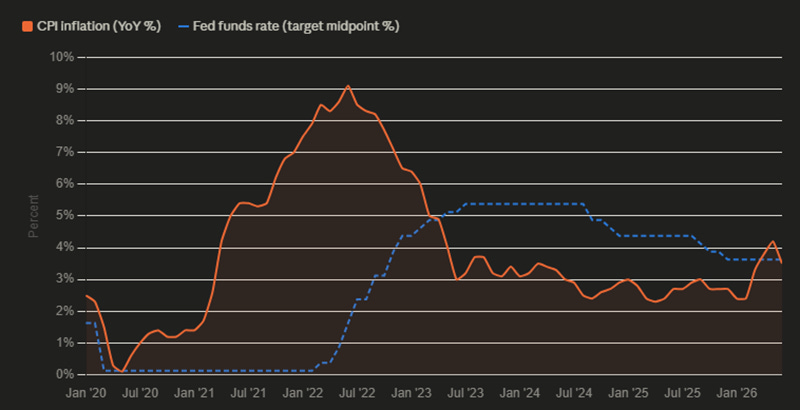
Financial markets can be remarkably patient, until they are not. This week, that patience appears to have run out. Federal Reserve Chair Kevin Warsh is facing intense criticism after the Federal Open Market Committee (FOMC) decided to leave its benchmark interest rate unchanged despite inflation continuing to run well above the Fed’s long-standing 2% target.
The decision immediately sparked a sharp reaction across financial markets, with investors questioning whether the central bank is moving aggressively enough to restore price stability. What followed was a bruising press conference. Reporters repeatedly returned to one central question: if inflation has remained elevated for years, why is the Federal Reserve choosing not to tighten monetary policy further?
The skepticism was not limited to journalists. Bond traders, economists, and institutional investors delivered an equally harsh verdict through market prices.
The Bond Market’s Message is Loud and Clear
The clearest signal came from the U.S. Treasury market. Following the Fed’s announcement, the yield on the 30-year Treasury climbed to approximately 5.23%, its highest level in nearly two decades. Long-term Treasury yields typically rise when investors demand greater compensation for inflation risk or lose confidence that policymakers will keep inflation under control.
This is more than a routine market fluctuation. Treasury securities serve as the foundation of the global financial system. Their yields influence everything from mortgage rates and corporate borrowing costs to infrastructure financing and consumer loans.
When long-term yields rise because investors are demanding a higher inflation premium, they are effectively expressing doubt in the central bank’s inflation-fighting credibility. That represents a dangerous development for any Federal Reserve chair.
Credibility is the Fed’s Most Valuable Asset
Modern central banking relies as much on expectations as it does on interest rates. If households and businesses believe inflation will eventually return to the Fed’s target, wage negotiations, pricing decisions, and long-term investment plans tend to remain stable.
However, when confidence begins to erode, inflation expectations can become self-reinforcing. Companies become more willing to raise prices, workers demand higher wages, and investors require higher returns to compensate for future purchasing power losses.
Ironically, Kevin Warsh has repeatedly emphasized his commitment to restoring price stability. Earlier this month, he stated that the Federal Reserve has “no tolerance” for persistently elevated inflation and reaffirmed the institution’s commitment to its 2% target. The challenge is that markets increasingly judge central bankers by actions rather than rhetoric.
A Divided Federal Reserve Adds More Uncertainty
Adding to investor concerns is the unusually visible disagreement within the Federal Reserve itself. Three voting members dissented from this week’s decision and favored an immediate rate increase, a rare occurrence that highlighted significant internal divisions over the appropriate policy response.
Although healthy debate is common within the FOMC, such public disagreement can create uncertainty about the Fed’s policy direction. Warsh defended the debate as a constructive “family fight,” arguing that open discussion ultimately produces better decisions.
Yet markets appeared unconvinced, focusing instead on the absence of clear forward guidance regarding future rate moves. Instead of reducing uncertainty, the press conference appeared to amplify it.
The Stock Market Sees September as a Turning Point
Interestingly, equity investors are sending a different message than bond investors. Rather than believing rates will remain unchanged, many market participants increasingly expect the Federal Reserve to raise interest rates at its September meeting.
This reflects a growing consensus that inflation pressures, particularly those stemming from higher energy prices and renewed geopolitical tensions in the Middle East, may ultimately leave policymakers with little alternative.
Market pricing following the July meeting shifted noticeably toward a higher probability of a September rate increase. In effect, investors are betting that economic reality may eventually force the Fed to adopt a more hawkish stance than it displayed this week.
Stagflation Risks Are Beginning to Reappear
Complicating matters further is a weakening economic backdrop. U.S. second-quarter GDP growth slowed to approximately 1.5%, suggesting that economic momentum is losing steam even as inflation remains stubbornly elevated. That combination immediately revives memories of one of the most challenging environments for any central bank: stagflation.
Stagflation combines sluggish economic growth, persistent inflation, and often weakening labor-market conditions. Traditional monetary policy becomes particularly difficult because raising rates can further slow economic activity, while cutting rates risks reigniting inflation.
Today’s environment is not yet comparable to the stagflation of the 1970s, but several ingredients are becoming increasingly familiar:
-
Slowing economic growth
-
Inflation remaining above target
-
Rising long-term borrowing costs
-
Elevated energy prices driven by geopolitical tensions
-
Increasing uncertainty across financial markets
For policymakers, this is among the most difficult macroeconomic scenarios to navigate.
The Real Test Lies Ahead
Kevin Warsh entered office promising to restore confidence in the Federal Reserve’s inflation-fighting credentials. Ironically, his first major policy decision has instead raised fresh questions about whether markets believe the institution remains fully committed to that mission. The surge in Treasury yields suggests investors are demanding greater compensation for inflation risk.
Stock markets appear to expect that rate hikes may simply have been postponed rather than avoided. Meanwhile, slowing economic growth limits the Fed’s flexibility just as geopolitical uncertainty threatens to push commodity prices even higher. Ultimately, credibility cannot be restored through speeches or press conferences alone.
Financial markets respond to consistent policy actions, not promises. The September FOMC meeting may therefore become one of the defining moments of Kevin Warsh’s tenure. Whether the Federal Reserve chooses to tighten policy or remain patient, investors will be watching for something arguably more important than the rate decision itself: a clear demonstration that the central bank remains firmly in control of inflation expectations.
For now, Wall Street’s verdict is unmistakable. The bond market is signaling that confidence has weakened, and rebuilding that credibility may prove far more difficult than maintaining it in the first place.
Originally Published on Substack.





