
AI stocks, falling dollar, fiscal stimulus, and deregulation hopes drive equity surge in historic six-month run and may also drive the next leg of the bull market.
At the midpoint of 2025, Wall Street is basking in fresh all-time highs, closing out a blistering six months that redefined investor expectations and shattered prior assumptions about recovery timelines. The benchmark index S&P 500 surged past the psychological 6,200 level, while the Nasdaq Composite ended June at record-setting highs—an outcome few could have predicted amid the economic anxieties that loomed just one quarter earlier.
What’s unfolding is more than just a bull market rebound; it’s a high-velocity shift in how markets interpret risk, policy, and momentum. The parallels with the COVID crash of 2020 and the inflation-induced dip of late 2023 are instructive, but this time, the recovery played out in weeks, not months. We are entering a new era of hyper-adaptive investing where sentiment can reverse on a dime, and Wall Street’s forward-looking lens is more powerful—and more politically attuned—than ever before.
From Tariff Turmoil to “Liberation Day” Euphoria
The pivotal moment came on what is now dubbed “Liberation Day”—the date President Trump unveiled sweeping tariff increases aimed at reshaping global trade. Initial market reaction was predictably grim. Fears of a return to 2018-style trade wars flared, and volatility spiked. But markets, always shrewder than they appear, began interpreting the tariffs not as rigid doctrine but as strategic leverage.
That hypothesis proved accurate. Within weeks, significant trade deals were signed with the United Kingdom and China. More are anticipated before a self-imposed July 9 deadline. The realization that tariffs were a bargaining chip—not an economic anchor—ignited a surge in investor confidence. The shock wore off, the VIX cooled, and equities began climbing in earnest.
Crucially, the tariff-induced inflation spike that many feared never materialized. Instead, supply chains adapted, consumer spending held steady, and input costs remained manageable, at least for now. With inflation trends stable, the Federal Reserve’s path toward rate cuts gained credibility, especially given speculation that President Trump may soon appoint a more dovish replacement for Fed Chair Jay Powell.
The “Big Beautiful Bill” and the Repricing of America
Fueling this optimism is the much-anticipated “Big Beautiful Bill”—a sweeping fiscal package set to infuse the U.S. economy with billions in stimulus. Corporate America stands to benefit handsomely from infrastructure subsidies, industrial policy support, and deregulation-friendly tax incentives. Consumers, too, are eyeing potential relief in the form of expanded tax deductions and family-focused credits.
This bill represents a return to supply-side stimulus, not unlike the Tax Cuts and Jobs Act of 2017. However, it comes paired with an updated lens: targeted at strategic sectors like AI, energy security, and manufacturing resilience. If passed, this legislation could spark the next great capital expenditure cycle across multiple industries.
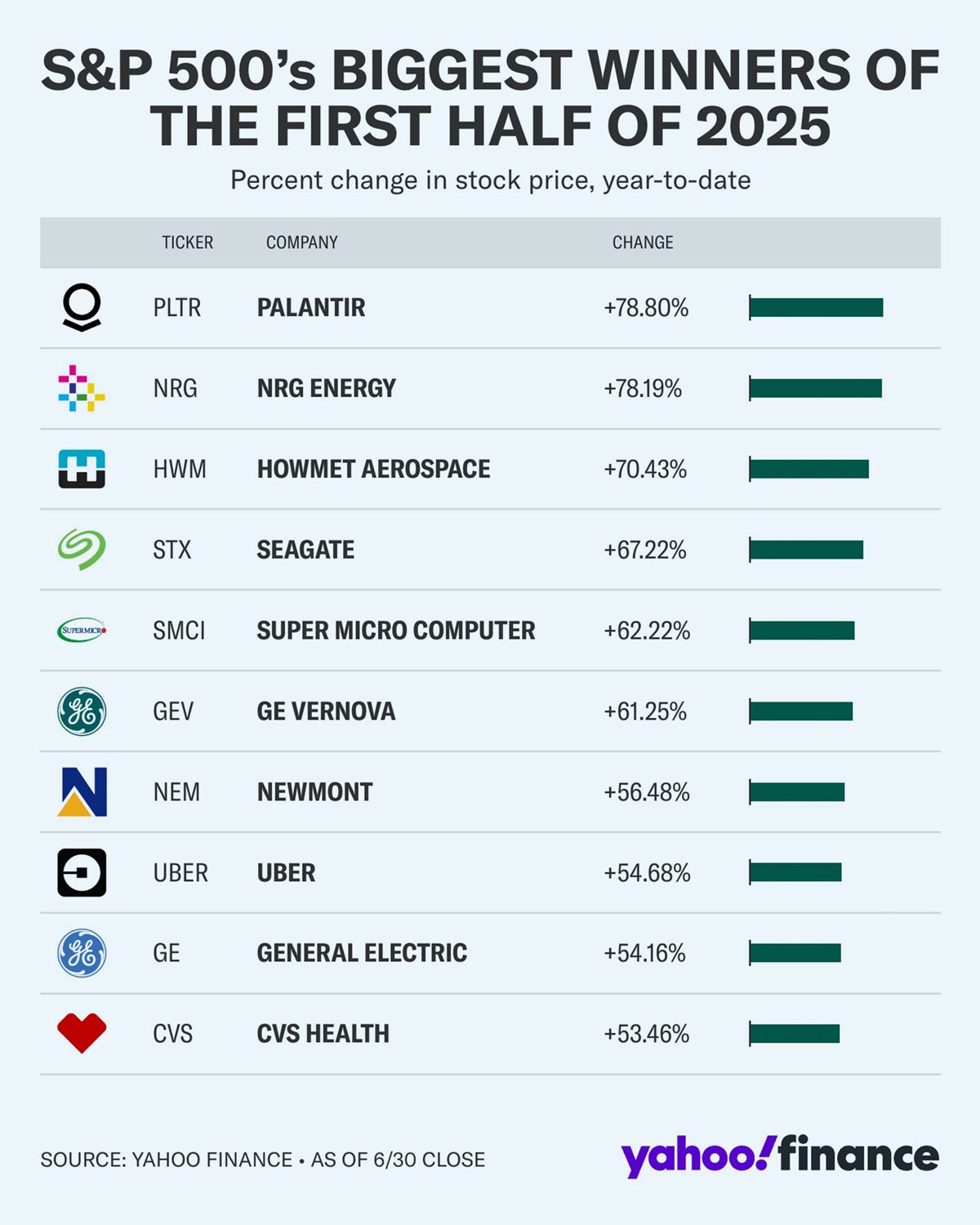
The S&P 500’s Biggest Winners: H1 2025
Nowhere is the bullish momentum clearer than in the year-to-date (YTD) stock performance data from the S&P 500. According to Yahoo Finance (as of June 30, 2025), the market’s biggest winners are highlighted below. Palantir’s near-80% rise signals the deepening relationship between AI and national security, particularly as geopolitical tensions flare globally.
NRG Energy’s surprising performance underscores the growing investor appetite for energy resilience and grid modernization, especially under a White House eager to repatriate strategic infrastructure. Meanwhile, Howmet Aerospace and Seagate reflect the ongoing capital flows into aerospace, industrial reshoring, and data infrastructure. Super Micro Computer’s rally solidifies AI hardware as a central pillar of tech investing, not a temporary theme.
The Macro Tailwinds: Currency, Cuts, and Crypto
As if fiscal and geopolitical catalysts weren’t enough, macroeconomic conditions are aligning in the market’s favor. The U.S. Dollar Index (DXY) has tumbled over the past quarter, making American exports more competitive and setting the stage for multinational earnings surprises this quarter. With revenue translation favoring U.S. firms, analysts expect tech giants to post outsized earnings beats, reigniting enthusiasm for the "Magnificent Seven" and beyond.
Then there’s the coming rate cut cycle—a narrative gaining steam as the Fed shifts from cautious to accommodative. Should President Trump install a more growth-focused Fed Chair, monetary conditions could loosen even further, supporting equity valuations and speculative assets alike. And in the realm of financial innovation, Circle (CRCL) has reignited the IPO market with a bang.
Its plans to obtain a national bank charter—thereby creating the first federally recognized digital currency bank—are groundbreaking. Meanwhile, Robinhood (HOOD) has soared to all-time highs on the back of tokenized securities offerings, including exposure to private companies like OpenAI and SpaceX. Its introduction of perpetual crypto futures and the return of staking is helping reengage sidelined retail investors.
Deregulation: The Coming Wave?
As tax and trade priorities are checked off the White House agenda, insiders suggest the latter half of 2025 will bring a renewed push for deregulation. Expect environmental rollbacks, streamlined business licensing, and revised labor rules—all of which could improve bottom lines for mid-cap and industrial firms, sectors that have yet to fully participate in the rally. Combined with the fiscal firehose, regulatory leniency could be the final ingredient that propels the market into a new supercycle.
Bubble or Breakthrough?
Still, with valuations stretched and political risks looming, skeptics warn of overheating. Are we entering a new age of structurally higher equity multiples driven by policy momentum and AI productivity gains? Or are we simply experiencing a fiscal sugar rush that will fade once the stimulus runs its course? That question will dominate boardrooms and trading desks alike in the second half of 2025.
A Market on Fast-Forward
The first half of 2025 wasn’t just a recovery—it was a reacceleration. Wall Street has never been more attuned to the nuances of trade diplomacy, monetary signaling, and digital disruption. What used to take a year now takes a quarter. Investors who blinked in April are now chasing in July. As Q2 earnings season approaches and July 9 trade milestones loom, one thing is clear: this market is being led not just by earnings and inflation data, but by the architecture of policy, geopolitics, and innovation.
Is this the dawn of a new bull era—or the final sprint before a reversion to the mean?
Let the second half begin.
Originally Published on Substack.





