
Exploring the explosive rise of USDT, USDC and the implications for the global financial system.
Stablecoins have become one of the most consequential innovations in digital finance, despite having a market capitalization that is only about 10 percent of Bitcoin’s. Their influence is expanding rapidly because they sit at the intersection of crypto markets and mainstream financial systems. Over the past two years, stablecoins have transitioned from a niche asset to a critical component of global digital transactions. Their ability to bridge traditional finance and blockchain-based ecosystems has driven a surge in adoption, cross-border flows, and regulatory attention.
As the International Monetary Fund (IMF) notes, their promise is substantial: stablecoins can make international payments faster, cheaper, and far more accessible for individuals and companies. Yet this potential comes with serious systemic risks, including currency substitution, capital flow volatility, and threats to financial integrity. Managing these dynamics will require coordinated domestic and international policy action.
Accelerating Growth and Global Adoption
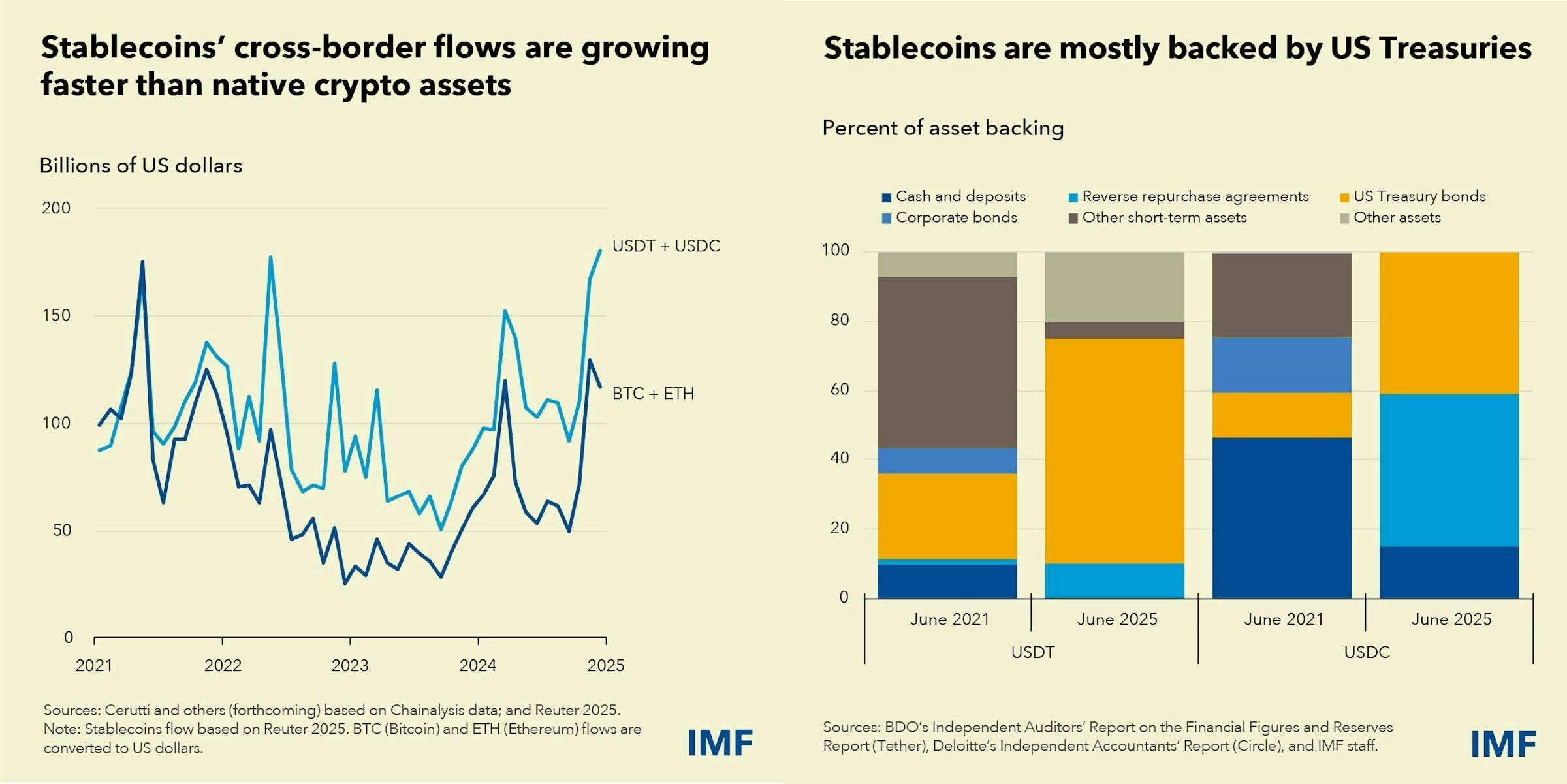
The scale of the stablecoin expansion is striking. The combined market capitalization of the two largest stablecoins has tripled since 2023, reaching roughly 260 billion dollars in 2025. Trading activity has grown even faster, with volume increasing 90% to reach an estimated 23 trillion dollars in 2024. Data from the IMF further illustrates this shift.
Cross-border flows of leading stablecoins such as USDT and USDC have outpaced those of native crypto assets like Bitcoin and Ethereum. Since 2021, stablecoin flows have repeatedly exceeded 100 billion dollars per month, with notable peaks surpassing 150 billion dollars. By contrast, Bitcoin and Ethereum flows have remained lower and more volatile, underscoring stablecoins’ growing role as a transactional medium rather than a speculative store of value.
Regionally, Asia now accounts for the largest share of stablecoin activity, surpassing North America. Yet, when measured relative to GDP, the highest usage comes from Africa, the Middle East, and Latin America—regions where access to traditional financial infrastructure is often limited. A substantial share of flow originates from North America and moves outward, reflecting both demand for dollar-denominated digital assets and the role of US-based issuers.
Reserve Structures: Increasing Dependence on US Treasuries
Much of the global significance of stablecoins stems from their asset backing. According to the IMF and independent audits (right chart below), stablecoins have steadily increased their holdings of US Treasury securities. In June 2021, reserves were diversified across cash, corporate debt, and short-term assets. By June 2025, US Treasury bonds represented the dominant share of backing for the largest stablecoins, particularly USDT and USDC.
This shift strengthens stablecoin credibility but also deepens the interconnection between crypto markets and traditional finance. In essence, stablecoin issuers have become major holders of US sovereign debt, adding a new, fast-moving participant to global capital markets. A sudden loss of confidence among users could force mass redemptions and trigger rapid liquidation of Treasury holdings, with spillover effects on funding markets.
Key Risks: Volatility, Runs, and Loss of Monetary Control
Despite their design, stablecoins are not inherently stable. Their value can diverge from their peg if the assets backing them fall in value or if users doubt an issuer’s ability to redeem tokens. This scenario risks triggering a run similar to those seen in money-market funds. Forced asset sales could spill into broader markets, especially given the concentration of Treasury holdings.
Another concern is currency substitution. In countries facing inflation or instability, households and firms may choose to transact in US-dollar-linked stablecoins instead of local currencies. Historically, physical cash and capital controls have limited dollarization, but stablecoins bypass many of these obstacles. A surge in digital dollar usage could undermine monetary sovereignty, macroeconomic management, and central banks’ ability to conduct policy.
Stablecoins also present financial integrity challenges. Their pseudonymity, low transaction costs, and ease of cross-border movement create opportunities for illicit finance, including money laundering and terrorist financing. Without robust safeguards, growing adoption can weaken domestic and global financial security.
Fragmentation and Interoperability Challenges
While stablecoins promise more efficient payments, the proliferation of independent networks poses a risk of fragmentation. Without interoperability, users may face siloed systems that cannot communicate across borders, chains, or jurisdictions. Regulatory inconsistencies further complicate cross-border use, raising operational and compliance burdens. These barriers could undermine the very efficiency gains that stablecoins aim to deliver.
The Policy Imperative: Building a Global Framework
Stablecoin regulation remains in its early stages, and countries have made uneven progress. The IMF and the Financial Stability Board have issued comprehensive recommendations intended to guide national authorities toward a coherent regulatory approach. These include:
-
Safeguards against currency substitution and erosion of monetary sovereignty
-
Robust capital flow management
-
Clear legal treatment of stablecoins and their issuers
-
Strengthened liquidity and reserve requirements
-
Implementation of financial-integrity standards
-
Greater international cooperation to ensure interoperability and consistent oversight
A globally coordinated regime would not only mitigate risks but also support innovation by setting clear rules for issuers, investors, and intermediaries.
Looking Ahead
Stablecoins sit at a pivotal juncture in the evolution of the international monetary system. Their rapid growth, deepening ties to sovereign debt markets, and expanding global user base signal both opportunity and vulnerability. If properly regulated, stablecoins could contribute to a more efficient, inclusive, and interconnected financial system.
If left unchecked, they risk undermining monetary stability, financial integrity, and global market resilience. The path forward requires deliberate, harmonized policymaking that balances innovation with security. Stablecoins are no longer a fringe experiment. They are shaping the future of money, and the decisions made today will determine whether they become a force for global good or a source of systemic disruption.
Originally published at https://khanfk.substack.com.





