
After decades of accelerating globalization, trade is shifting toward regional supply chains, friend-shoring, industrial policy and economic security.
For roughly four decades, globalization appeared to follow an almost unstoppable trajectory. From 1980 through the eve of the global financial crisis, falling trade barriers, containerization, cheaper communications and increasingly sophisticated supply chains encouraged companies to manufacture wherever production was most efficient.
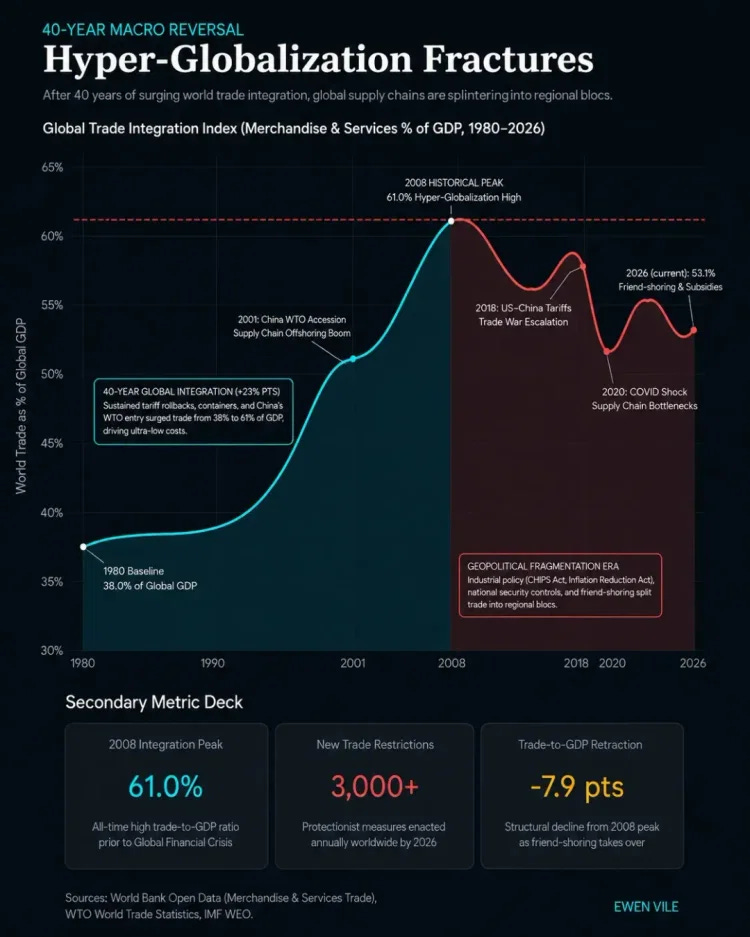
The result was extraordinary integration. The accompanying graphic shows world trade in goods and services rising from 38.0% of global GDP in 1980 to a historical peak of 61.0% in 2008, a gain of 23 percentage points. World Bank data put the 2008 figure at approximately 60.68%. But the era that rewarded maximum efficiency is increasingly giving way to one that prioritizes resilience, strategic autonomy and geopolitical security.
The Golden Age of Global Integration
The globalization model was built around a simple economic proposition: companies should produce wherever they could do so most efficiently, while consumers should benefit from the resulting lower prices. Container shipping dramatically reduced the cost and complexity of moving manufactured goods across oceans.
Trade liberalization lowered tariffs and other barriers. Advances in telecommunications and information technology allowed corporations to coordinate production across multiple continents. China’s accession to the World Trade Organization in December 2001 accelerated this transformation. China became the WTO’s 143rd member after years of negotiations and committed to significant market-opening and trade-liberalization measures.
The consequences were profound. A smartphone, automobile or piece of industrial machinery could contain components originating in numerous countries before final assembly somewhere else. Supply chains became longer, more specialized and increasingly global. The objective was not necessarily resilience. It was efficiency.
2008: The Turning Point
The global financial crisis of 2008 did not immediately destroy globalization, but it marked an important structural inflection point. The graphic identifies 2008 as the peak, when trade reached approximately 61% of global GDP. Thereafter, the ratio entered a different trajectory. Globalization did not disappear.
International trade continued to expand in absolute terms, and global supply chains remained deeply interconnected. But the extraordinary acceleration of trade relative to economic output that characterized the previous decades largely stopped. The distinction matters. The world did not suddenly become “deglobalized.” Rather, the process of hyper-globalization, trade growing dramatically faster than global economic output, lost momentum.
From Efficiency to Resilience
The next major shock came from the deterioration of U.S.-China economic relations. Beginning in 2018, the United States and China imposed successive rounds of tariffs, transforming trade policy from a largely economic question into an increasingly strategic one. Businesses began reassessing their dependence on individual countries and suppliers.
Then came COVID-19. The pandemic exposed vulnerabilities that had been largely invisible when supply chains were functioning normally. Factory shutdowns, semiconductor shortages, transportation bottlenecks and disruptions to medical supply chains demonstrated that a highly efficient supply chain could also be extremely fragile.
The lesson for governments and corporations was increasingly clear: the cheapest supplier is not necessarily the safest supplier. Russia’s invasion of Ukraine reinforced that lesson by demonstrating how geopolitical conflict could disrupt energy, commodities, logistics and critical inputs. The IMF has subsequently warned that geoeconomic fragmentation can affect trade, investment, technology diffusion and commodity markets simultaneously.
Friend-Shoring Replaces Globalization at Any Cost
This is where the concept of “friend-shoring” becomes important. Instead of asking, “Where can we manufacture this most cheaply?”, governments and companies are increasingly asking, “Where can we manufacture this reliably, securely and with acceptable geopolitical risk?”
The infographic (below) illustrates this transition: after the 2008 peak, trade fell during the pandemic shock and subsequently recovered partially, but the stated 2026 level of 53.1% remains 7.9 percentage points below the 2008 peak. That figure should be interpreted carefully. The chart also presents 53.1% as its 2026 current value; it is not a finalized World Bank historical observation for the full year.
Current WTO data instead show that global trade remains remarkably resilient. The WTO’s March 2026 forecast projects combined goods and services trade growth of 2.7% in 2026, even as merchandise trade growth slows to 1.9%. Nevertheless, the broader structural argument remains significant: trade can continue growing while becoming more regionalized, politically conditioned, and strategically managed.
Industrial Policy is Back
Governments are no longer leaving supply-chain decisions entirely to market forces. The U.S. semiconductor strategy is a prominent example. The CHIPS policy framework seeks to rebuild domestic semiconductor manufacturing and strengthen supply-chain resilience, with the U.S. government highlighting approximately $52 billion in semiconductor investments.
Europe is pursuing a similar strategy through its Green Deal Industrial Plan, the Net-Zero Industry Act and the Critical Raw Materials Act. The European Commission explicitly frames these initiatives around strengthening manufacturing capacity, resilience and secure supply chains. This represents a fundamental philosophical shift.
Industrial policy was once frequently criticized as inefficient interference in markets. Today, governments increasingly regard strategic manufacturing capacity as an economic-security asset. Semiconductors, batteries, critical minerals, pharmaceuticals, energy technology and artificial intelligence infrastructure are no longer viewed simply as commercial products. They are increasingly treated as strategic capabilities.
The Cost of a Fragmented World
There is a compelling argument for diversification. A supply chain dependent on a single country, shipping route or politically unstable region can create enormous risks. But resilience comes at a price. Duplicating factories, maintaining additional inventories and sourcing from higher-cost suppliers inevitably increases production costs.
Fragmentation can also reduce economies of scale and limit access to specialized expertise. The IMF has warned that deeper geoeconomic fragmentation could impose substantial output losses, with emerging and developing economies particularly vulnerable.
The danger is therefore not simply that globalization becomes smaller. It is that the world could end up with parallel economic ecosystems — one centered around particular geopolitical alliances and another around competing ones.
A New Era of “Selective Globalization”
The most likely future is not complete deglobalization. The WTO’s latest evidence actually points in the opposite direction: global trade remains substantial, and in 2025 world merchandise trade reached record levels in value terms. In 2026, AI-related demand for semiconductors, data-transmission equipment and other technology products is continuing to support international trade.
What is changing is the logic behind that trade.
The globalization of the 1980s and 1990s emphasized cost. The emerging model emphasizes cost plus resilience, security, political alignment and technological sovereignty. That is a profound change. The world economy is therefore not necessarily closing its doors. It is becoming more selective about whom it opens them to.
The Bigger Question
The decline from 61.0% peak to 53.1% illustrates something larger than a trade statistic. It captures a transformation in the assumptions underpinning the global economy. For decades, businesses optimized for efficiency because geopolitical stability was largely taken for granted. Today, geopolitical risk has become another variable in the cost equation.
The defining economic question of the next decade may therefore not be whether globalization survives. It almost certainly will. The more important question is what kind of globalization replaces it.
The answer increasingly appears to be a world of shorter supply chains, strategic stockpiles, industrial subsidies, regional trading blocs and trusted economic partners, a system that may be more resilient when crises strike, but potentially more expensive and less economically efficient when they do not.
Hyper-globalization may not have ended completely. But its central principle, that the world should relentlessly optimize for the lowest possible cost, is unmistakably being replaced by something more complicated: economic efficiency with a geopolitical risk premium.
Originally Published on Substack.






