
May 2025 marks a historic chapter in crypto history as stablecoins extend their dominance, Tether crosses $150B, and USD1 redefines political finance in the digital age.
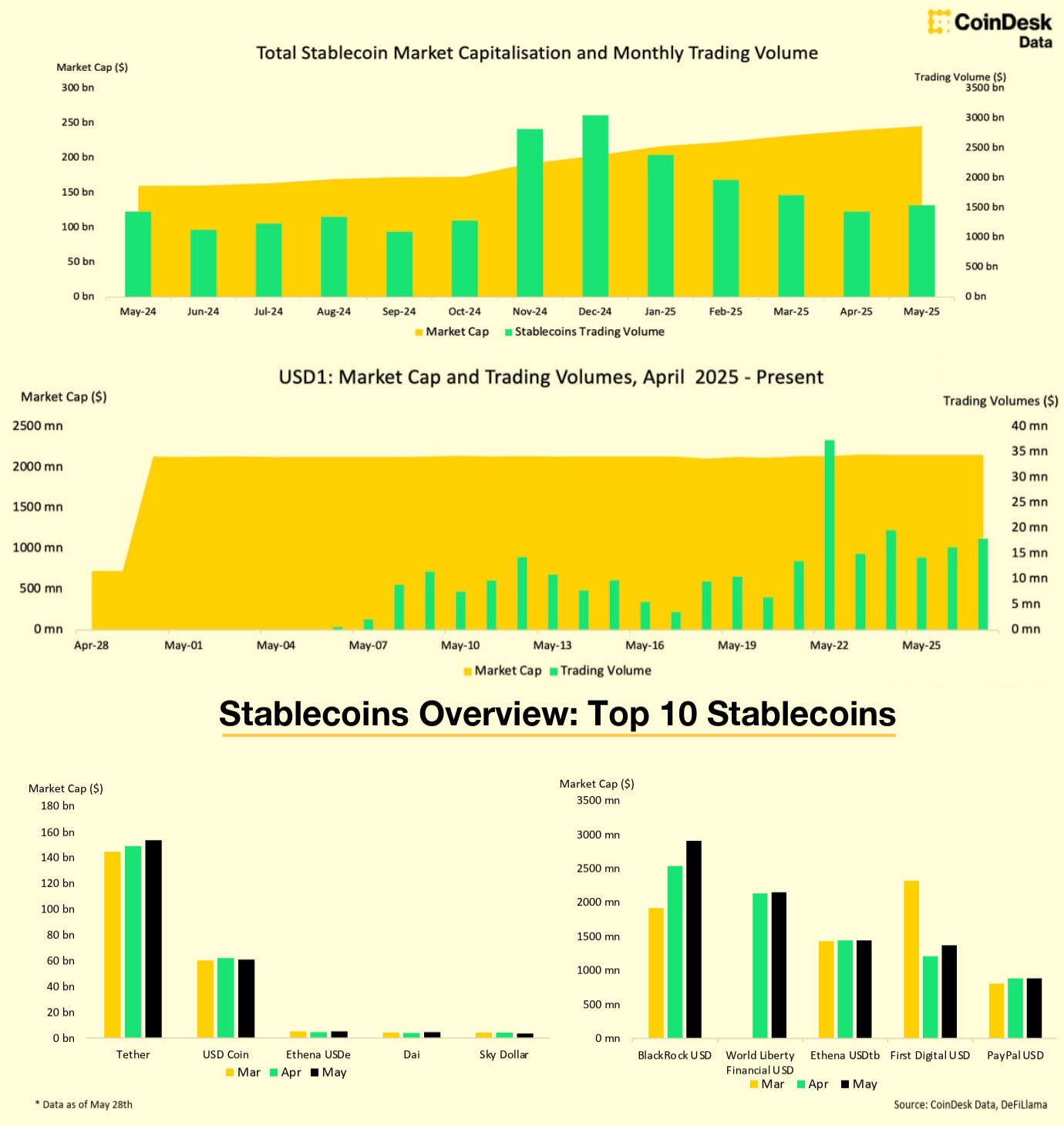
The stablecoin market's performance in May 2025 represents more than just numerical growth—it embodies the steady march toward mainstream financial integration. With total market capitalization rising 2.27% to reach $246 billion, the sector achieved its twentieth consecutive month of growth, a streak that speaks to the underlying demand for stable, blockchain-based digital assets that bridge traditional finance and the emerging digital economy.
This sustained growth pattern reveals a profound insight into the current state of digital asset adoption. While speculative cryptocurrencies often experience dramatic volatility cycles, stablecoins have maintained consistent upward momentum, suggesting that their utility extends far beyond trading pairs and into real-world financial applications. The consistency of this growth, spanning nearly two years without interruption, indicates that stablecoins have moved beyond experimental adoption into essential infrastructure for digital commerce.
Tether's Historic Milestone
Arguably the most significant event in the stablecoin world this May was Tether (USDT) becoming the first stablecoin to break the $150 billion market capitalization barrier. Climbing 3.12% over the month, Tether now stands at a record-breaking $153 billion. This growth represents its twenty-first consecutive monthly gain—a streak unmatched by any of its competitors.
Tether’s dominance also saw a subtle but meaningful shift: its share of the stablecoin market cap rose to 62.1%, the first such increase in six months. This reversal is significant. For the past half year, USDT has been losing market share as new entrants like USDC, Ethena USDe, and emerging geopolitical stablecoins gained ground. Tether's rebound highlights not just market confidence in its liquidity and reach, but perhaps a reinvigoration of trust amid ongoing regulatory clarity and technological innovation.
Political Capital Meets Digital Innovation
One of the most intriguing developments in May was the rapid ascent of USD1, a politically backed stablecoin issued by World Liberty Financial, reportedly tied to the Trump political apparatus. USD1 achieved a market capitalization of $2.15 billion by the end of May, positioning it as the seventh-largest stablecoin.
What is especially noteworthy is the pace of this growth. USD1 crossed the $1 billion threshold within just three days—making it the second-fastest stablecoin in history to reach this mark, surpassed only by the now-defunct Fei USD.
The implications of USD1's rise are manifold. Its success not only represents a broader trend of politically affiliated financial instruments entering the crypto space but also signals the beginning of a new era where digital currencies may become tools of geopolitical influence. Whether USD1’s momentum can be sustained in the long term will depend on regulatory acceptance, user trust, and global perceptions of U.S. political involvement in financial infrastructure.
Trading Volume Rebounds After Five-Month Decline
Beyond market capitalization, trading volumes also experienced a pivotal shift in May. After five consecutive months of decline, stablecoin trading volumes on centralized exchanges surged to $1.54 trillion. This rise reflects a renewed retail and institutional interest in the crypto sector amid bullish price action and possibly a more optimistic macroeconomic outlook.
USDT once again led this charge, accounting for a commanding 79% of the total trading volume among stablecoins. USDC and FDUSD followed, with 14.1% and 6.28% respectively. This reinforces Tether’s role not only as a store of stable value but also as the primary medium of exchange within the broader crypto trading ecosystem.
USD1: Short-Term Volatility and Long-Term Questions
The second chart (above) gives a granular look into USD1’s market dynamics. The data shows a sharp spike in market cap by May 1st, followed by sustained levels around $2.1 billion. Trading volume, however, has shown considerable volatility—suggesting a mix of speculation, adoption, and perhaps uncertainty among users.
Volume peaks around mid-May suggest heightened trading activity—likely due to speculative interest or integration into new platforms. As USD1 settles into the ecosystem, these fluctuations may smoothen. But they also raise questions: Will USD1 prove to be a long-term asset, or is it merely capitalizing on current political and economic narratives?
Regulatory Winds Are Shifting
May witnessed critical developments across several jurisdictions. The European Union finalized provisions under MiCA for stablecoin issuance, while the United States made progress on bipartisan proposals for digital asset regulation. Hong Kong, Singapore, and the UAE also signaled openness to regulating stablecoins more clearly—especially those backed by traditional financial institutions.
The political affiliation of USD1 may bring about new debates over monetary policy, sovereignty, and the role of private (and now political) entities in issuing de facto currencies. Regulators worldwide will likely be watching USD1’s rise with keen interest.
Looking Forward: Infrastructure for the Digital Economy
As we move forward, the lessons from May's landmark achievements suggest that the stablecoin market will continue to evolve, driven by technological innovation, regulatory developments, and the growing recognition that digital assets represent the future of financial infrastructure. The question is no longer whether stablecoins will achieve mainstream adoption, but rather how quickly they will reshape the fundamental architecture of global finance.
The confluence of Bitcoin's new all-time high and stablecoins' sustained growth creates a compelling narrative about the digital asset ecosystem's maturation. While speculative assets capture headlines with dramatic price movements, stablecoins provide the stable foundation upon which this new financial system is being built, one milestone at a time.
Originally Published on Substack.





