
Data-driven insight into the U.S. stock market’s dramatic recovery, market cap trends, sector leadership, and what to expect going forward.
The American stock market has staged one of the most dramatic recoveries in recent memory, rising from the ashes of the Liberation Day tariff-induced selloff to reach unprecedented heights. As of June 26, 2025, the benchmark index S&P 500 has not only recovered from its April lows but has soared to a record market capitalization of $54.6 trillion, marking a stunning vindication of investor resilience, helped along by a confluence of macroeconomic and geopolitical factors.
The Fall and Rise of the S&P 500
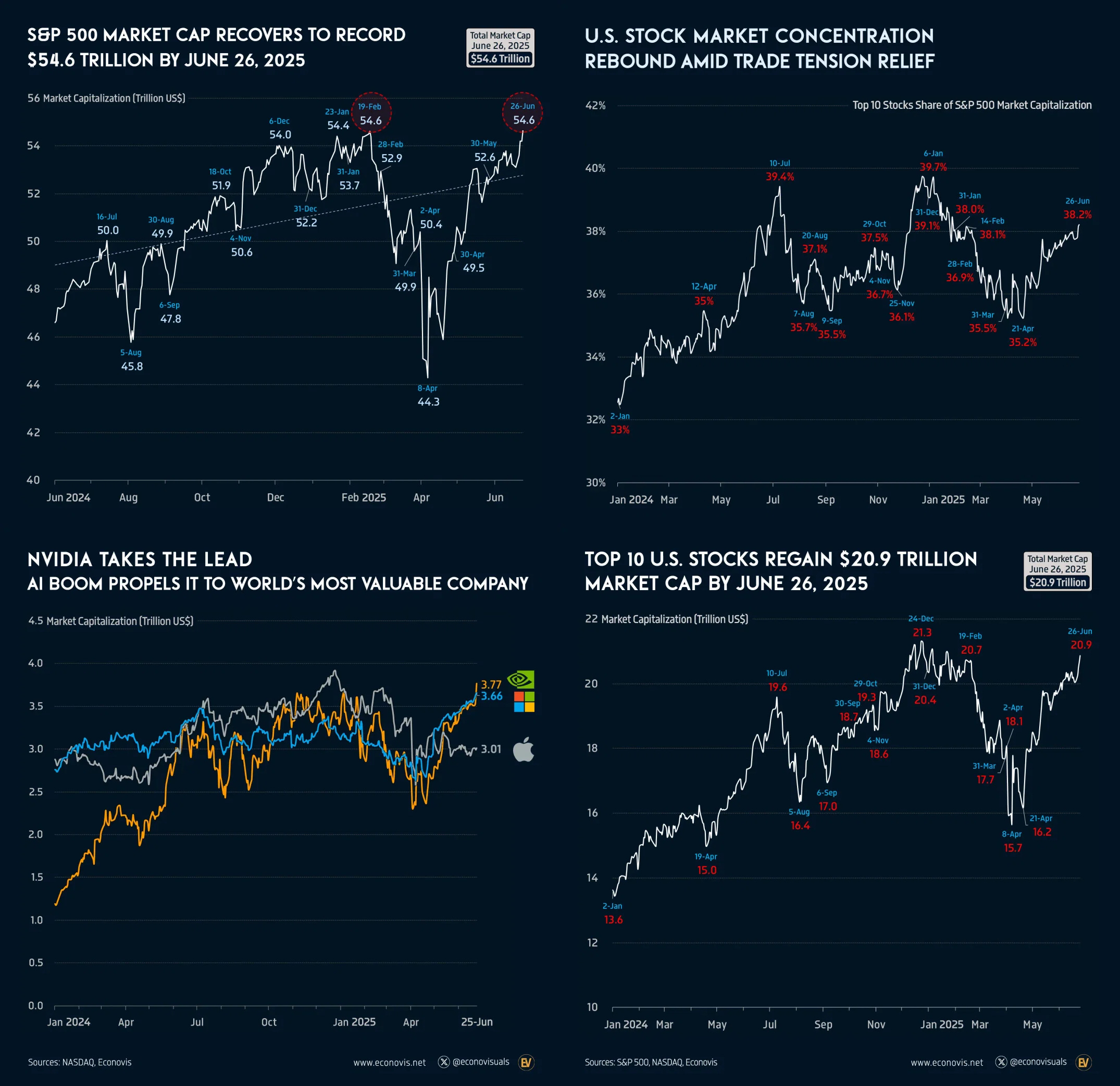
At the height of market fear following the imposition of the Liberation Day tariffs—a protectionist trade maneuver aimed at recalibrating U.S. industrial sovereignty—the S&P 500 saw its total market capitalization plummet to $44.3 trillion on April 8, 2025. This marked a sharp decline from its pre-tariff peak of $54.0 trillion in February, signaling a loss of over $9.7 trillion in just two months.
However, in the weeks that followed, a series of trade renegotiations and tariff rollbacks between the U.S. and its major partners, most notably the EU and Japan, helped stem the outflows. By June 26, 2025, the index had not only recouped its losses but posted a new high of $54.6 trillion—an all-time record (top-left chart below).
This recovery represents a 23% gain from the April low, underscoring the effectiveness of coordinated policy backpedaling and central bank reassurances in stabilizing market sentiment.
Market Concentration: The Rise of the Few, Once Again
One of the most telling indicators of this turnaround lies in the renewed market concentration within the S&P 500. The top 10 stocks now account for nearly 38.2% of the index’s total market capitalization, a notable increase from the 33% seen in early 2024 (top-right chart below).
This resurgence in concentration, previously viewed as a systemic risk, is being reframed by many analysts as a validation of structural transformations in the U.S. tech and innovation economy. Notably, the artificial intelligence sector continues to drive exponential valuations for a select group of companies.
By peaking near 39.7% on January 6, 2025, the top 10 stocks’ dominance was interrupted briefly during the tariff turmoil, dropping to 35.2% on April 8. Yet, as trade tensions eased and AI optimism returned, this figure rebounded to 38.2% by late June.
NVIDIA’s Historic Surge
At the center of this market concentration is NVIDIA, whose meteoric rise has reshaped the corporate landscape. As of June 25, 2025, NVIDIA's market cap reached $3.77 trillion, surpassing both Microsoft ($3.66 trillion) and Apple ($3.01 trillion) to become the most valuable publicly traded company in the world (bottom-left chart).
This dominance is directly attributed to the AI boom, with NVIDIA's high-performance computing hardware becoming the backbone for everything from large language models to national defense systems. The company's valuation nearly doubled from its 2024 levels, showcasing its strategic importance in a geopolitically fragmented, tech-driven global order.
Importantly, the data also reflect that Microsoft and Apple have retained strong market caps, suggesting the AI wave is lifting multiple boats, but NVIDIA has clearly taken the lead.
Top 10 U.S. Stocks Reclaim $20.9 Trillion in Value
The recovery narrative is further reinforced by the performance of the top 10 U.S. stocks, whose combined market capitalization rose to $20.9 trillion by June 26, 2025 (bottom-right chart above). This too is a full recovery from the post-tariff decline to $14.2 trillion on April 8, illustrating a swift and focused investor rotation back into blue-chip growth and AI-fueled equities.
The historical chart shows sharp inflection points: the group had peaked at $21.0 trillion in February 2025, collapsed nearly 32% by April, and then steadily regained ground, with May and June seeing persistent weekly gains. What’s noteworthy here is not just the total recovery, but the narrow breadth of that rally. Investors are increasingly concentrating capital into a smaller cohort of companies perceived as long-term strategic winners—those with robust balance sheets, monopolistic advantages, and AI integrations.
Policy & Sentiment: A Coordinated Reversal
The sharp recovery in U.S. markets hasn’t occurred in a vacuum and was driven by a powerful trio of factors: the easing of trade tensions, geopolitical de-escalation, and a dovish shift by the Federal Reserve. Following the disruption caused by the Liberation Day tariffs, quiet diplomatic efforts led to a partial rollback of levies on critical tech goods, restoring investor confidence and boosting capital flows into mega-cap stocks.
More recently, a U.S.-mediated ceasefire in the Middle East helped stabilize energy markets. Reinforcing these gains, the Federal Reserve signaled a pivot toward monetary policy easing as early as July 2025, citing cooling inflation and subdued economic growth. This combination of improving global conditions and supportive policy created a fertile environment for risk assets, leading to a surge in equity valuations and renewed concentration in top-performing firms.
Implications Going Forward: A Market of Extremes?
While the headlines celebrate the record highs, the underlying data prompts important questions. Is this rally sustainable? Are we entering a new regime of winner-take-all dynamics, where a handful of tech firms monopolize returns? The S&P 500's broad recovery masks a polarization in performance, with small-cap and cyclical stocks still lagging behind.
Additionally, the top-heavy structure increases vulnerability—any negative earnings surprises or regulatory shifts targeting AI leaders could have outsized effects. Moreover, trade tensions—though temporarily relieved—remain structurally embedded in global geopolitics. Markets could again be tested by unforeseen policy changes, geopolitical tensions, or new tariffs.
Final Thoughts
The data speaks volumes: from the depths of a confidence crisis post-tariff turmoil to record-breaking valuations in just over two months, the U.S. markets have staged one of the most dramatic turnarounds in modern financial history.
Yet, the nature of this recovery—powered by AI, dominated by a few, and fueled by swift policy action—presents a market narrative that is as fragile as it is formidable. For investors, analysts, and policymakers alike, the months ahead will demand vigilance, adaptability, and a deeper understanding of the technological and geopolitical levers that now dictate market direction.
Originally Published on Substack.






