
If the idea of cryptos is too outlandish for you, wait till you hear about the meme cryptocurrency which has achieved a cult status
Not that cryptocurrencies are usually in the spotlight, this week was especially an interesting one for digital assets. They formed a part of the debate in the U.S Senate on the infrastructure bill. This followed SEC Commissioner Gary Gensler's comments that he is neutral about the tech, but not about investor protection. While this received harsh criticism from crypto enthusiasts, clearer regulations might actually be good news for the space as it may attract more money and help in building bigger, mainstream companies.
Faith in stable coins, the backbone of fiat to crypto transactions, also took a hit when Coinbase Global Inc. dropped a promise that its USD Coin was fully backed by cash. And on top of this, the Cryptoverse was hit with possibly the biggest DeFi hack ever — although it is now being reported that the white hat hackers are returning all the money to the Poly Network. None of this bad news, however, seemed to have dampened the investor appetite for Bitcoin and the associated cryptos. At the time of writing, BTC was trading around $47.7k & ETH trading at a whisker away from $3,300.
But today, we are not going to be talking about Bitcoin or Ethereum. Today’s piece focuses on crypto that has achieved somewhat of cult status with the new age investors. I am talking about Dogecoin — created as a joke to poke fun at Bitcoin, it has exploded in popularity in 2021 (gaining over 5000%). Created back in late 2013 by developers Billy Marcus and Jackson Palmer, the crypto’s logo was branded using a meme popular at the time that featured the deliberately misspelled word “doge” to describe a Shiba Inu dog.
Early in 2021, an army of amateur traders on Reddit’s WallStreetBets message board propelled Dogecoin to astronomical highs. As if this was not enough, inventor & crypto proponent Elon Musk called DOGE his favorite currency — labeling it the people’s crypto. The momentum was unstoppable. Although Dogecoin has dropped more than 50% from its earlier peak in May, the long-term picture highlights the journey of meme cryptocurrency rising from the ashes to become the 7th largest crypto by market cap, currently. The adoption has been on such a scale that one of the biggest & most well-reported crypto exchanges, Coinbase, listed it on its platform in June.
Although most of the cryptocurrencies are speculative & volatile in nature, DOGE dwarfs most of them with the price movements and investments we have seen — not only in 2021 but over a span of over 7 years, since its inception. Data for today’s article was gathered from Chainalysis Market Intel to take a broad overview of the price action & investment in Dogecoin. Currently, DOGE is trading around $0.28 with a total market cap of over $35.9 billion.
Rise from the Ashes
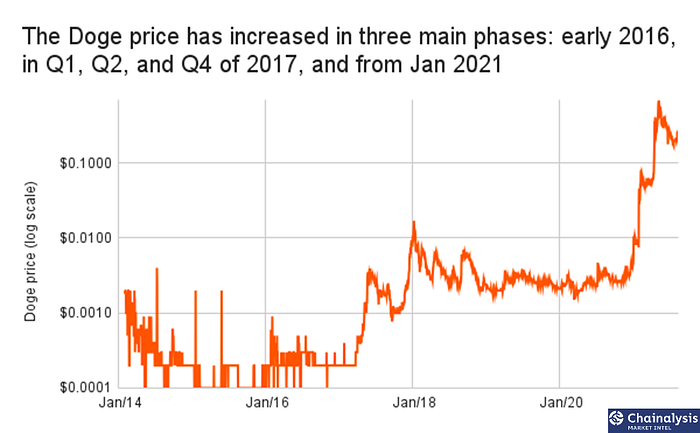
Figure 1
As per the chart above (Figure 1), Dogecoin has seen three main phases of price increase, going back all the way to 2014 — early 2016, three quarters of 2017, and Jan. 2021 onwards. DOGE’s price started low, at tenths of a cent, and declined through 2014 and largely plateaued in 2015 to hundredths of a cent. Price increased in early 2016, then largely plateaued until it started rising again in Q1 and Q2 of 2017. It fell back in Q3 but then climbed to 1 cent in early January 2018 as the late-2017 bull market peaked. And most recently, Reddit & Musk took the meme crypto to the moon — to as high as $0.76.
New Investors Influx
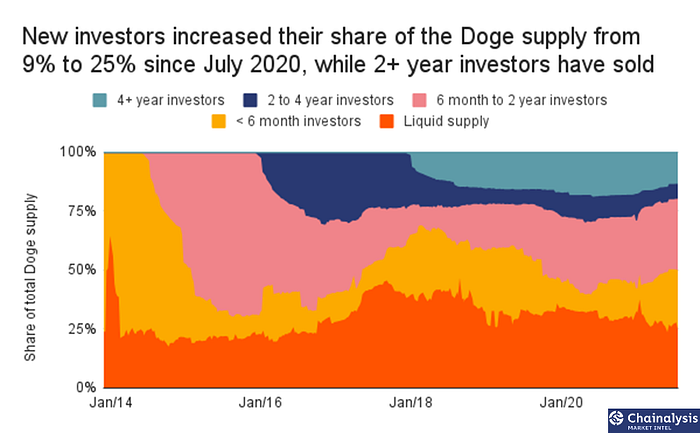
Figure 2
The second chart (Figure 2) in the report shows the share of the total DOGE supply held by different types of holders. Much of DOGE was liquid in its first year, as 74% of the current supply was mined in 2014. Once the initial distribution settled, the liquid supply and new investors, those holding for less than 6 months, held 30% of supply in 2015. Price increases were usually accompanied by an influx of new investors. This was seen in early 2016 when new investors acquired 13% of the supply.
Then as the price surged in 2017, new investors accounted for 70% of supply. Investors again started to come back to DOGE in July 2020 and by the year-end, new investors had increased their supply from 9% to 17%. Since the beginning of this year, new investors have further increased this share — now holding 25% of the supply, while longer-term investors (holding DOGE for 2+ years) decreased their share of supply from 30% in July 2020 to 20% today — most probably booking profits on their investment.
Who’s Holding & How much?
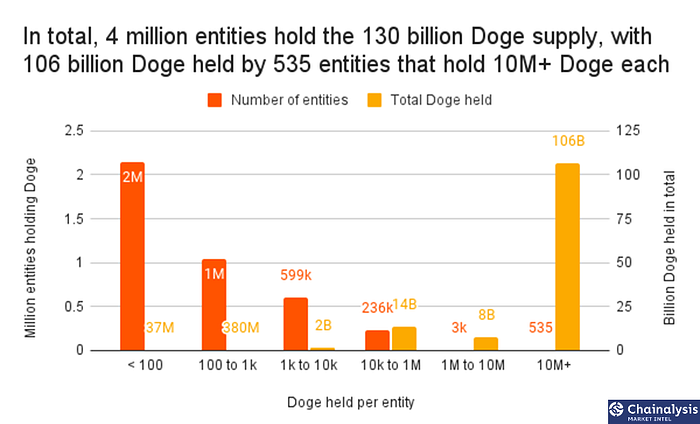
Figure 3
According to the analysis, Investors send less than 25% of the DOGE they receive (in 2021 on average they have sent 9% but previously just 4%) — that means most of the investors in the crypto are looking at it as holding it for longer time frames. So who are the investors in Dogecoin? As the chart above suggests (Figure 3), currently there are 4 million on-chain holders of Doge.
But most of the supply is held by a small number of wealthy entities. The most startling statistic is that 106 billion Doge or 82% of supply, is held by only 535 entities (0.01% of total), that hold more than 10 million+ DOGE each. At the same time, more than half of the entities (2 million) hold less than 100 DOGE each.
Breakup Of Investors
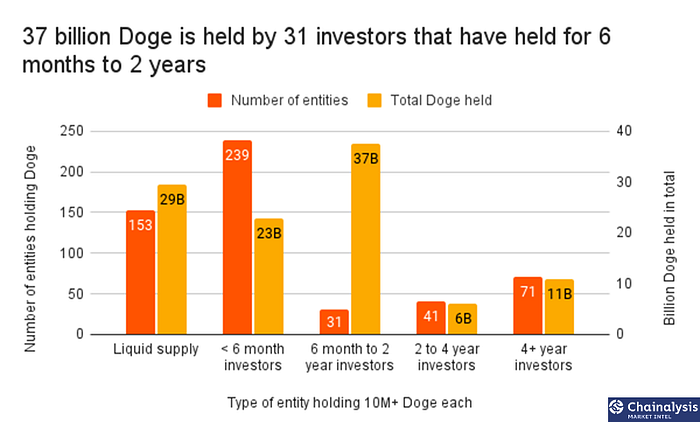
Figure 4
Looking deeper into the 535 entities mentioned above further, they probably consist of businesses like crypto exchanges holding DOGE for millions of users, accompanied by possibly a few, now-wealthy, early investors. The chart above (Figure 4) provides more details on these 535 entities — holding more than 10M+ each. The most interesting statistic on this chart highlights that 37 billion of the 106 billion Doge is held by just 31 investors, that have held their DOGE for between 6 months and 2 years — that is over 1 billion Doge each on average.
Daily Active Users
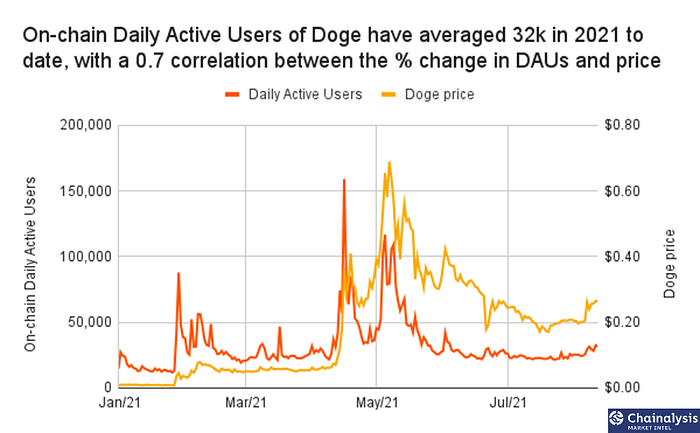
Figure 5
And the final chart (Figure 5) shows the strong relationship between the daily active users (DUAs) and the price movement in the coin. DOGE has had an average of 32k on-chain Daily Active Users (DAUs) in 2021, but this has moved with the price. The correlation between the two parameters in the chart is evident from the R-value of 0.7 in 2021 so far. Spikes in DAUs and price also coincide with DOGE-related social media posts, from Reddit activity to Elon Musk tweets. DAUs are usually synonymous with short-term investors who are actively trading on-chain.
This is typical of other cryptocurrencies, where a much smaller minority actively trades while a vast majority holds on to digital assets for a much longer time frame. Summarizing the complete findings, DOGE has likely accumulated new 1 to 2 million on-chain investors — at the same time DOGE ownership is highly concentrated in a very small number of entities like crypto exchanges or long-term investors.
Originally Published on Medium
Email 📭| Twitter 📜 | LinkedIn 📑| StockTwits 📉 | Telegram 🔗 | Facebook 📘






