
As global demand for the U.S. dollar shrinks, stablecoins pegged to the Greenback may offer Washington a powerful new tool for financial dominance.
The U.S. dollar (USD), long heralded as the world’s preeminent reserve currency, has seen its global dominance gradually erode over the past two decades. However, while some analysts warn of its waning influence amid growing multipolar financial dynamics, a digital transformation may offer the greenback a renewed lease on life.
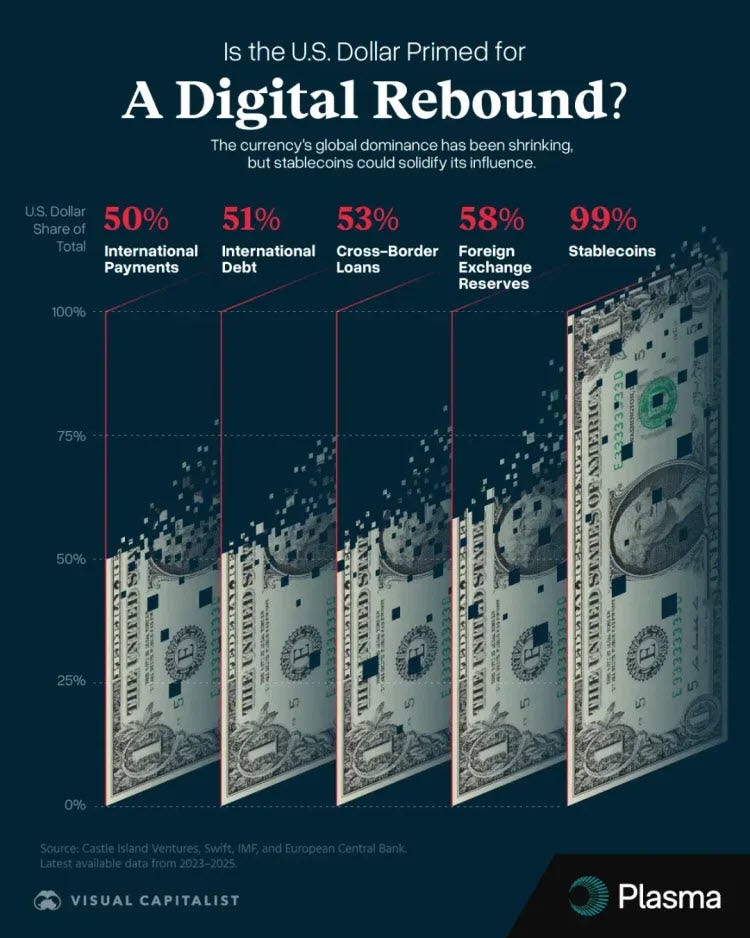
At the heart of this transformation lies the rise of stablecoins—crypto-assets pegged to fiat currencies, and more often than not, to the U.S. dollar itself. A staggering 99% of all stablecoins are currently pegged to the USD, signaling an evolving financial ecosystem where digital finance may serve as the lifeline of American monetary supremacy.
The Evolution of the Dollar: From Bretton Woods to Blockchain
To understand the current state of the dollar and its prospects for resurgence, it’s essential to appreciate its historical ascent. The USD's dominance took root in the aftermath of World War II through the Bretton Woods Agreement of 1944, which pegged global currencies to the dollar, itself backed by gold. This established the USD as the cornerstone of global finance.
When the gold standard was abandoned in 1971 under U.S President Nixon, the dollar transitioned into a fiat currency—but its role in international finance only strengthened, especially through petrodollar arrangements and the expanding reach of U.S. capital markets.
By the early 2000s, the dollar accounted for over 70% of foreign exchange reserves globally. It was the default choice for international trade settlements, sovereign debt issuance, and cross-border investments. However, in recent years, cracks in this financial hegemony have begun to surface.
A Gradual Decline
According to data visualized by Visual Capitalist below (sourced from Castle Island Ventures, Swift, IMF, and the European Central Bank), the dollar’s share in key global financial metrics, while still substantial, has been shrinking:
-
International Payments: USD accounts for 50%
-
International Debt: 51%
-
Cross-Border Loans: 53%
-
Foreign Exchange Reserves: 58%
The data paints a picture of a currency still very much in command, but facing steady attrition. Geopolitical shifts, such as China’s growing economic clout, increased Eurozone integration, and BRICS nations exploring alternative payment systems, have all contributed to a slow erosion of the USD’s supremacy. As central banks diversify their reserves and more countries push for de-dollarization, concerns have mounted in Washington and on Wall Street alike.
Stablecoins: The Digital Anchors of the Dollar
Amid these uncertainties, however, stablecoins represent a powerful countertrend. The fact that 99% of all stablecoins are pegged to the U.S. dollar reveals a profound irony: while the physical and fiat manifestations of the USD are experiencing gradual decline, its digital representation is flourishing.
Stablecoins such as USDT (Tether), USDC (Circle), and newer entrants like PayPal’s PYUSD are increasingly used for everything from crypto trading to remittances, decentralized finance (DeFi), and emerging market transactions. Their popularity stems from the ability to maintain the USD’s price stability while operating within borderless, decentralized, and fast-settling systems.
More critically, stablecoins are often backed by U.S. Treasury bonds or other liquid dollar-based assets. This creates a reinforcing demand loop—to issue more coins, issuers must purchase more Treasuries, thereby boosting the demand and utility of the U.S. dollar in financial markets. It's no surprise, then, that the current U.S. administration views digital dollars and stablecoins not as threats but as instruments to reassert American financial power in the 21st century.
The U.S. Government’s Digital Pivot
The Trump administration has adopted a proactive and strategic approach to digital finance, recognizing the growing importance of cryptocurrencies and blockchain-based assets. One of the main initiatives has been the passage of the GENIUS Act, a comprehensive legislative framework that regulates stablecoins. The act sets strict standards for reserve backing, auditing, and issuer accountability, requiring systemically important stablecoins to be collateralized by U.S. Treasuries or equivalent liquid assets.
This not only ensures consumer and financial system protections but also deepens the link between digital dollar-based assets and U.S. monetary instruments, positioning stablecoins as tools to reinforce and potentially expand the global dominance of the U.S. dollar in the digital era.
Challenges Ahead: Regulatory, Geopolitical & Technological
The path toward a digital rebound is not without obstacles. Regulatory fragmentation in the U.S., skepticism from lawmakers wary of overreach, and the risk of private sector mismanagement (as seen in Tether’s opacity scandals) all present valid concerns. Furthermore, international competitors like China’s digital yuan, launched through the People’s Bank of China, pose direct challenges to the idea of dollar-centric digital finance.
However, the U.S. benefits from several enduring advantages: a global trust in its legal and financial systems, deep and liquid capital markets, and the network effect of existing dollar-based trade and finance relationships. Stablecoins extend this advantage into new realms, particularly in developing nations where traditional banking is weak but mobile internet penetration is strong.
A Digital Dollar Renaissance?
If the 20th century was defined by oil and physical trade, the 21st century would be defined by data and digital transactions. In this environment, currency power will increasingly be tied not just to sovereign decisions but to programmable finance, smart contracts, and global digital platforms.
Stablecoins allow the USD to remain embedded in decentralized systems. From Web3 to cross-border fintech, from tokenized Treasuries to on-chain settlements, the dollar continues to reinvent itself—not through brute geopolitical force, but through strategic integration into the rails of the future digital economy.
The Dollar’s Next Chapter
Though the narrative of the dollar’s decline is not unfounded, it is perhaps incomplete. The USD is not merely a legacy artifact of Bretton Woods—it is also a remarkably adaptive currency that has weathered inflation shocks, geopolitical upheavals, and technological revolutions.
With stablecoins serving as a digital bridge, the greenback is not just surviving but expanding into previously unreachable corners of the global economy. Far from signaling its demise, the rise of stablecoins may actually herald a new era of dollar primacy—one where the most influential currency in the world lives not just in vaults and banks, but on the blockchain.
Originally Published on Substack.





