
Google's breakthrough AI video tool exposes the vulnerability of knowledge workers across industries.
At the start of 2025, one of the boldest predictions reverberating across the tech landscape was that artificial intelligence would soon be capable of producing Hollywood-level video content—at least in visual fidelity—by year’s end. We didn’t have to wait that long. Google's new Veo 3 model has arrived, and it is not just meeting expectations; it is shattering them.
Unveiled with much fanfare and already integrated into Gemini and the newly announced Flow, a cinematic AI co-director tool, Veo is generating footage that looks indistinguishable from the work of seasoned human filmmakers. These aren’t grainy, uncanny clips cobbled together in a research lab. These are emotionally evocative, visually stunning sequences—often photorealistic—that are making audiences question whether a human was ever behind the camera.
This sudden leap in creative automation offers vindication for the thousands of screenwriters and actors who staged strikes throughout 2023, partially in protest against the use of AI in Hollywood. Their fear was not unfounded. Today, the existential concern isn’t just theoretical. It’s encoded in algorithms, embedded in production workflows, and increasingly, it’s generating content that might have once employed hundreds of creatives.
But the story doesn't end at the studio gates.
Across the broader economy, particularly in white-collar sectors, a quiet but seismic shift is underway. The most visible indicators are the headline-making layoffs: Microsoft trimming its engineering teams, Duolingo replacing human translators with generative models 3, and Walmart shedding technology staff. These are only the tip of a much larger iceberg.
Many terminations don’t show up in press releases or trending hashtags. They occur in the silence of frozen hiring pipelines. In meetings that never get scheduled. In Slack channels that go inactive. Roles vanish not with a bang but with a passive-aggressive calendar deletion. The jobs lost are not just in customer support or content moderation—they include copywriters, UX designers, communications specialists, software developers, and even middle managers.
Even CEOs are beginning to question their own irreplaceability. Venture capitalists have started discussing whether founding teams can remain leaner by relying on AI co-founders rather than human ones 5.
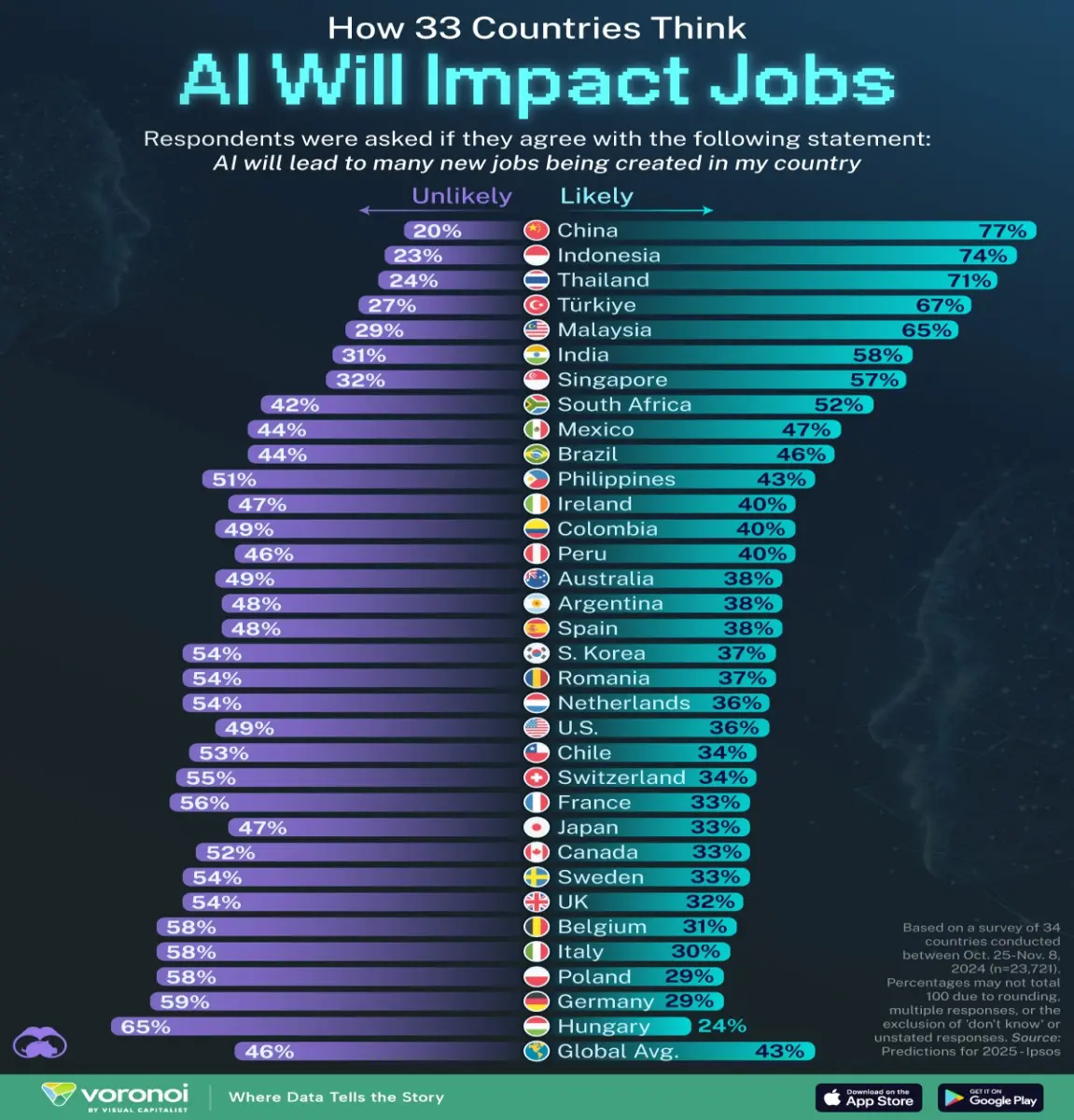

We are now facing an economic riddle of the highest order: If intelligence is no longer scarce—if cognition itself has been commoditized—what happens to the very idea of a “knowledge economy”? For decades, white-collar professionals believed their jobs were future-proof, protected by creativity, judgment, and complexity. But AI is coming for those, too.
This isn’t just technological disruption. It’s a cultural reckoning.
Just as the Industrial Revolution displaced manual labor and reshaped society, this wave of AI is threatening the cognitive class—the once-insulated tier of knowledge workers that defined the modern professional era. And while innovation marches on, society must decide how to reckon with the pace and distribution of its benefits—and its burdens.
So where do we go from here?
Do we demand policy interventions—a universal basic income, large-scale retraining programs, or regulatory boundaries on AI deployment? Or do we double down on productivity, hoping that the displacement will eventually be offset by new, unforeseen opportunities?
Either way, one thing is now undeniable: the illusion that AI would remain a mere “tool” is over. The director’s chair is no longer exclusively human.
Originally Published on LinkedIn.






