
Comparing enterprise or permission blockchains & how they are being used by top companies to improve business functions
Like it or not blockchain technology has revolutionized the way top companies are conducting business these days. The novel tech has shown great potential in solving real-world problems. It’s the same tech that forms the basis of some of the most popular decentralized platforms like Bitcoin & Ethereum. Many people equate cryptocurrencies with blockchain which is obviously not the case — the latter just provides that platform on which cryptos like Bitcoin are built.
While novices may struggle to differentiate between the two, big companies have been quick to adopt blockchain tech. Some of the biggest public companies in the world have started using enterprise blockchains, which are permissioned in nature. Unlike public blockchains like Bitcoin, they are private in nature. So why are they using a private iteration of this tech, when decentralization is such a desired feature by everyday users?
The permissioned use of this tech basically enables these companies to improve their business processes significantly — like improving transparency, and reducing costs. According to a report published by International Data Corporation (IDC), it is expected that investments in enterprise blockchain are expected to reach $16 billion by 2023, at a 5-year compound annual growth rate (CAGR) of 60.2% between 2018–2023.
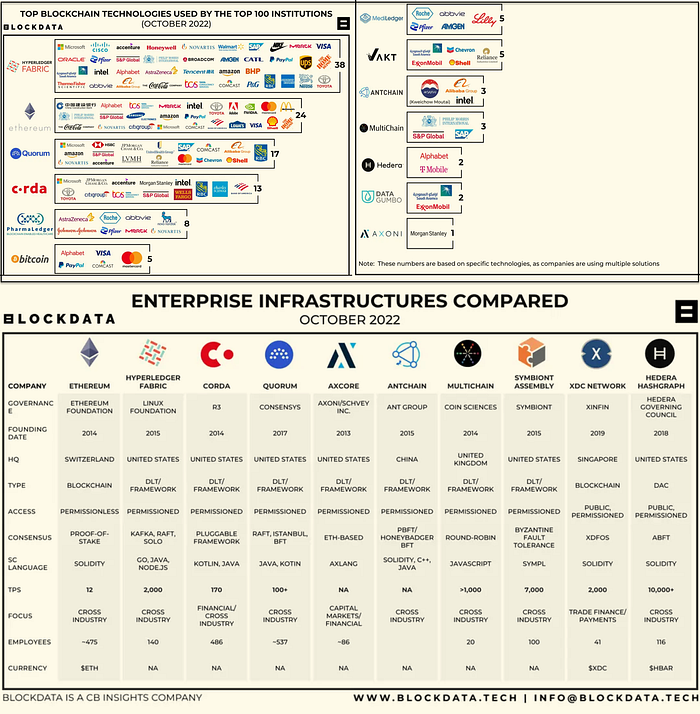
As you can see in the infographic above by Blockdata, permissioned blockchains like Hyperledger Fabric, ConsenSys’s Quorum, and R3’s Corda are increasingly being adopted by corporations. Having said that, the decentralized smart contract pioneer platform Ethereum is the second most popular choice among them. Not a surprise, since many of these companies are using more than one platform for different business functions. Some of the other notable names used by companies include AntChain, Hadera HashGraph & MultiChain.
Research conducted by Blockdata found that distributed ledger technologies (DLTs) show impressive growth across industries, companies, and use cases — like improved security, efficiency, and cost-effectiveness. According to their research, Of the top 100 public companies, 77 are using blockchain technology. The breakdown is as follows: Hyperledger at 38%, Ethereum at 24%, Quorum at 17%, and R3’s Corda at 13%.
Of course, the big blockchain names are not the only ones being used by these top companies. Industry-specific blockchain projects have also made a mark. For example, PharmaLedger is used in the pharmaceutical industry (Pfizer, AstraZeneca, AbbVie, Novartis, Merck, GlaxoSmithKline, Janssen by Johnson & Johnson, Novo Nordisk, Bayer & Roche), VAKT is used in oil and gas industry (ExxonMobil, Aramco, BP, Shell, Chevron, Reliance & Total) & MediLedger is used in the life sciences and healthcare industry (Genentech, Pfizer, Eli Lily, Amgen, Bayer, and Gilead Sciences).
The second part of the infographic draws out a detailed comparison between all the iterations of blockchain tech being used by these top companies. Data includes when the specific project was launched, the governance model, country of origin, consensus protocol and industry focus, etc.
Blockchain space is constantly evolving — new players are popping as the existing ones flourish too. In 2021, more than 800 companies were building their blockchain networks on the 12 DLT platforms that Blockdata analyzed. Having said that the growth potential remains immense as the technology matures and the trust grows among the market participants.
Originally Published on Medium
Email | Twitter | LinkedIn | StockTwits | Telegram | Newsletter






