
Spot gold surges as central banks diversify, the Fed tilts toward easing, and geopolitical turmoil reshapes the global financial order.
In a world where fiat currencies are backed by promises and algorithms trade billions in microseconds, gold has reclaimed the narrative of permanence. This week, the precious metal surged beyond $4,000 per troy ounce for the first time in history — a threshold once viewed as distant speculation, now a flashing headline on trading terminals from New York to Shanghai.
Far from being a relic of the past, gold’s record-breaking ascent underscores a profound truth about the present: confidence in the global financial order is eroding.
The New Reality: Gold as a Measure of Fear and Faith
Gold’s journey from under $2,000 just two years ago to this new peak tells a story of monetary fatigue and geopolitical unease. The surge, a doubling in less than 24 months, marks the strongest annual advance since 1979 - a year seared into memory for its runaway inflation and crisis of confidence in central banks.
Today’s forces are strikingly similar. Markets are pricing further easing of the Federal Reserve’s monetary policy, betting on rate cuts amid slowing growth. Meanwhile, conflicts in Ukraine and the Middle East, tariff risks, and surging sovereign debt have reignited the age-old instinct to seek safety in tangible assets.
As spot gold rose over 1% overnight and December futures crossed $4,000, the symbolism outweighed the statistics. Gold is no longer just a commodity; it has become a referendum on trust itself — in governments, in currencies, and in the global system that binds them.
A Quarter-Century Chart of Crises and Convulsions
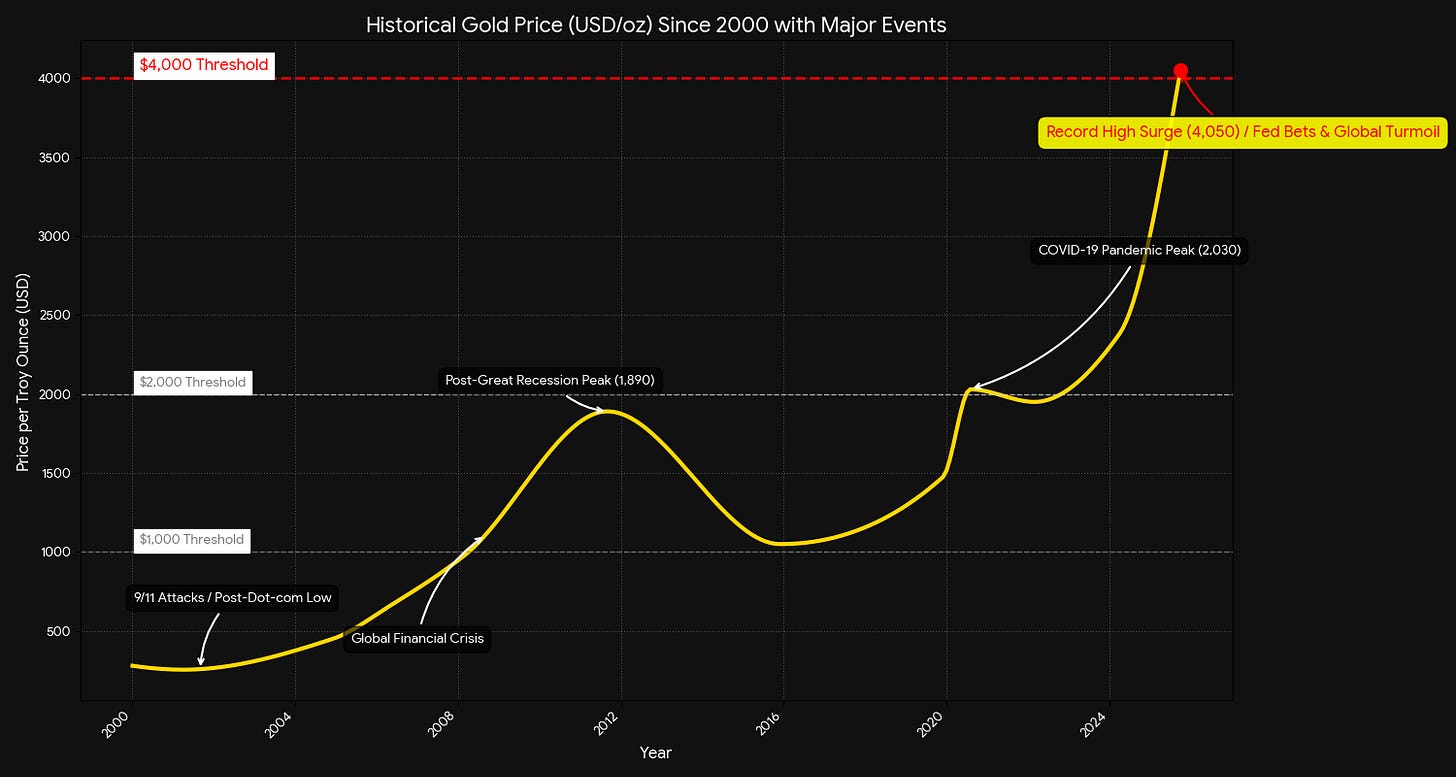
The historical price chart from 2000 to 2025 (below) reads like a timeline of global anxiety — a mirror reflecting every tremor in the modern economic order.
-
2001 — 9/11 and the Post-Dot-Com Era:
From the ashes of the dot-com bubble and the shock of the September 11 attacks, gold began its quiet ascent from near $280. As the Federal Reserve slashed rates to rescue markets, investors rediscovered the comfort of real assets. -
2008–2011 — The Great Recession Peak:
The Global Financial Crisis was gold’s coming of age. As trust in banks and fiat currencies evaporated, the metal climbed relentlessly, reaching $1,890 per ounce by 2011 — a reflection of both panic and policy distortion. -
2013–2018 — The Pause of Complacency:
As equities roared back and monetary easing turned into normalization, gold drifted into the background, stabilizing around $1,200. Yet, below the surface, central banks quietly accumulated reserves, signaling what was to come. -
2020–2021 — The Pandemic Shock:
COVID-19 shattered the illusion of predictability. With economies frozen and trillions in fiscal stimulus unleashed, gold spiked to $2,030, a record that stood as a monument to monetary excess. -
2022–2025 — The Era of De-Dollarization:
The latest surge, catapulting gold to $4,050, reflects a structural shift. The drivers are unmistakable: central banks diversifying away from the U.S. dollar, markets bracing for renewed Fed easing, and nations hedging against a fractured geopolitical order.
The chart’s golden curve mirrors two decades of human behavior under duress — every peak a crisis, every correction a sigh of relief.
The Structural Forces Behind the Rally
1. Central Banks and the De-Dollarization Drive: The World Gold Council reports record central bank purchases since 2022. The motive is strategic, not speculative. From Beijing to Ankara, monetary authorities are exchanging dollars for gold to reduce vulnerability to U.S. sanctions and increase reserve independence. The trend represents a tectonic shift in global finance, a quiet vote against dollar hegemony.
2. The Federal Reserve and the Liquidity Inflection: Markets are sensing a turning point. After the most aggressive tightening cycle in decades, the Fed has started easing. Historically, lower real interest rates are gold’s oxygen. As yields decline, the opportunity cost of holding non-yielding assets evaporates, drawing capital back to bullion.
3. Fiscal Erosion and Inflation Persistence: The post-pandemic era has normalized chronic deficits and elevated inflation. With global debt exceeding $338 trillion at the end of Q2 2025, the value of paper promises weakens. Gold, immune to dilution, thrives precisely when confidence in monetary discipline wanes.
4. Geopolitical Volatility as a Catalyst: From trade fragmentation to regional conflicts, the world is now operating under multipolar tension. Investors interpret this not merely as risk, but as an existential test of financial architecture. Each crisis, whether in energy, technology, or defense, fuels the demand for what cannot default.
A Century-Long Outperformer
While equities and cryptocurrencies often dominate headlines, few assets have matched gold’s long-term record. Since 2000, gold has outperformed the S&P 500 on a cumulative basis, rising more than 1,300% compared to roughly 400% for the index (excluding dividends).
Even during periods of relative calm, gold has delivered real returns that hedge against monetary policy errors and systemic crises, the very traits that define its timeless allure. The recent surge further underscores gold’s psychological role in markets. When investors lose faith in growth, governments, or the stability of money itself, they don’t turn to algorithms; they turn to atoms.
Is $4,000 the Ceiling or Just the Beginning?
With gold now comfortably above the once-unthinkable $4,000 mark, analysts are divided on what comes next. Some foresee consolidation as speculative flows cool. Others argue that this is merely the midpoint of a structural bull market, fueled by declining real yields, fiscal deficits, and central banks’ continued diversification.
Strategists at UBS and Goldman Sachs have recently raised their 12-month gold targets to between $4,200 and $4,500, citing global “liquidity inflection points.” Meanwhile, some macro analysts warn of a “monetary reset decade,” where gold, rather than digital assets or fiat currencies, could anchor a new hybrid financial system.
The Eternal Allure
Gold’s record run is not about nostalgia. It is a reflection of human nature, the desire for something that endures when everything else is uncertain. When currencies weaken, policy falters, when algorithms fail to explain emotion, gold remains the constant. It is not a rebellion against progress, but a recognition that true value must be grounded in permanence.
As 2025 draws to a close, the glint of gold above $4,000 per ounce is not merely a data point in the markets; it is the pulse of a global system in quiet recalibration. Gold is not just shining again. It is reminding the world why it never truly stopped.
Originally Published on Substack.





