
China’s role in the global economy is changing. After decades of export-led growth, the world’s second-largest economy is being powered more by its consumers than its cargo ships.
For decades, China held the moniker of the “Factory of the World”—a title earned through its staggering dominance in manufacturing and exports. It built the world’s goods, shipped them globally, and fueled its rapid economic ascent with double-digit GDP growth. But over the past 15 years, the landscape has been shifting. The country is undergoing a quiet but significant transformation: from an export-led growth model to a more consumption- and innovation-driven economy.
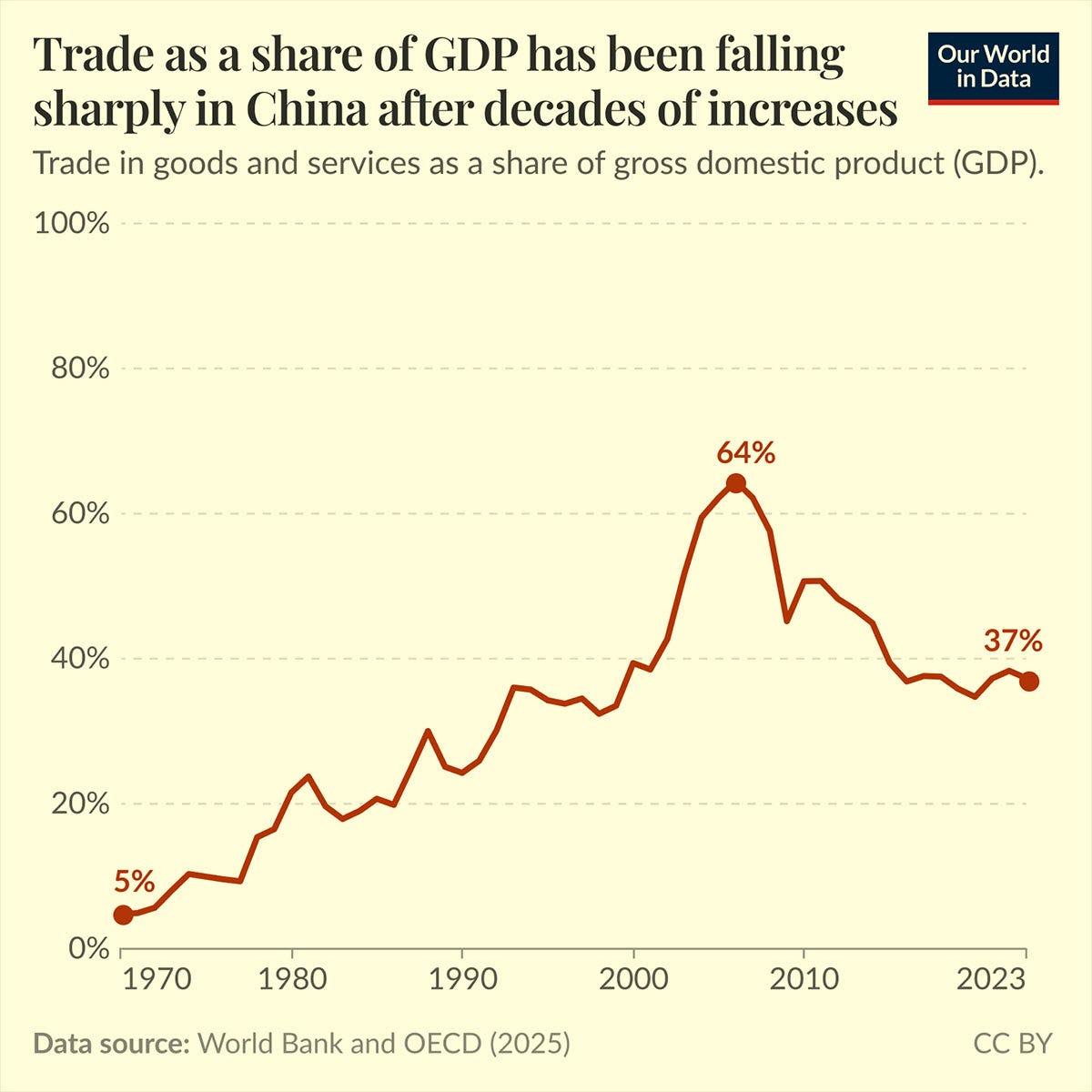
One of the most revealing indicators of this structural transition is China’s trade-to-GDP ratio—the share of the economy composed of imports and exports of goods and services. According to data from the World Bank and OECD (chart below), China’s trade-to-GDP ratio peaked at 64% in 2006.
Fast forward to 2023, and it has declined to 37%, with an average of around 33% between 2016 and 2024. While still substantial, the trend marks a dramatic decoupling of trade from China’s GDP growth engine. What does this decline mean, and what does it reveal about China’s economic evolution?
The Era of Export-Led Growth
In the late 20th century, China’s economic miracle was engineered on the back of exports. Following Deng Xiaoping’s economic reforms in the late 1970s, the country embraced globalization, opened up Special Economic Zones, and leaned into its comparative advantage—abundant, low-cost labor. By the 1990s and early 2000s, China had become a manufacturing juggernaut, producing everything from textiles and toys to electronics and steel.
The trade-to-GDP ratio rose in lockstep, reaching its zenith in 2006 at 64%. China’s accession to the World Trade Organization (WTO) in 2001 further catalyzed this surge, integrating it deeper into global supply chains. Exports became the backbone of growth. Coastal megacities like Shenzhen and Shanghai flourished, foreign direct investment poured in, and hundreds of millions were lifted out of poverty.
Why the Shift?
The decline in the trade-to-GDP ratio doesn’t suggest a simple drop in exports. In fact, China remains the world’s largest exporter. Rather, it reflects a rebalancing of the economy and a relative rise in other components of GDP, particularly domestic consumption and services. Several factors have driven this evolution:
1. Policy-Driven Rebalancing
Recognizing the vulnerabilities of overreliance on exports, especially in the wake of the 2008 Global Financial Crisis, Beijing initiated a strategic pivot. The government’s “dual circulation” strategy, introduced in recent years, explicitly promotes domestic consumption (internal circulation) while maintaining external trade (external circulation). Massive infrastructure investment, urbanization, and the expansion of the middle class have helped drive internal demand. Domestic consumption now contributes more than half of China’s GDP growth.
2. Rising Wages and Changing Demographics
Labor costs in China have been steadily rising. The once ample supply of cheap rural labor has diminished due to urban migration, aging demographics, and the declining birth rate. This erodes China's edge in low-cost manufacturing and pushes production to lower-cost countries like India, Vietnam, Bangladesh, or Mexico. Rather than compete on cost, China is upgrading the value chain—investing in robotics, automation, and high-tech industries.
3. Global Trade Tensions and Supply Chain Realignment
The U.S.-China trade war, coupled with increasing geopolitical fragmentation, has accelerated the move away from export dependency. Tariffs, export controls, and “de-risking” narratives among Western economies have prompted China to reduce its exposure to external shocks. While exports remain vital, they no longer carry the disproportionate weight they once did.
4. Rise of the Chinese Consumer
China's burgeoning middle class—estimated at over 500 million people—has transformed domestic consumption into a robust economic pillar. Household spending on services, leisure, healthcare, and digital goods is on the rise. Tech giants like Alibaba, Tencent, and Meituan cater to a digital-savvy population that is reshaping consumption patterns. Retail sales in China exceeded $6 trillion in 2023, rivaling the United States, and e-commerce penetration is among the highest globally.
How China Compares Globally?
At 37%, China’s trade-to-GDP ratio remains well above the United States (~30%) but significantly below export-driven economies like Germany (~80%) or smaller trade-centric nations such as Singapore or the Netherlands, which often exceed 100%. This positioning underscores China's hybrid economic character. While it is moving toward internal consumption, it remains deeply embedded in global trade, just not as dominantly as before.
Challenges and Implications
The shift from an export-led to a consumption-driven model is not without challenges:
-
Income inequality and underconsumption: Despite headline figures, consumption still lags as a percentage of GDP compared to developed economies. Wealth concentration and a weak social safety net hinder broader consumer spending.
-
Debt and real estate woes: The recent dramatic decline of the property sector—once a key driver of investment and household wealth—could dampen consumer confidence.
-
Geopolitical headwinds: China's relations with the West continue to influence its trade and tech sectors, especially in semiconductors and critical supply chains.
However, China’s deepening domestic market, technological ambitions (e.g., EVs, AI, green energy), and regional integration through initiatives like the Belt and Road and RCEP (Regional Comprehensive Economic Partnership) provide it with multiple levers for growth.
From Made in China to Designed for China
The transformation of China’s economy reflects a broader strategic shift. It is no longer content to be the world's factory. Increasingly, it seeks to become a hub of innovation, consumer demand, and regional influence. Multinational corporations are adapting accordingly.
Companies like Apple, Tesla, and Nike now design products with the Chinese consumer in mind, recognizing that success in the 21st century hinges not just on selling from China but to China. This transition is not linear nor guaranteed, but it is undeniably profound.
Consumer Giant?
The decline of China’s trade-to-GDP ratio from a peak of 64% in 2006 to around 37% today marks more than a statistical shift—it reflects a deeper economic transformation. From the sweatshops of Guangdong to the tech parks of Hangzhou, China’s journey from an export-driven powerhouse to a consumption-oriented superpower is reshaping global commerce, geopolitics, and the very architecture of globalization.
Trade remains vital, but the future of China's growth story increasingly lies within: in the wallets, aspirations, and innovations of its 1.4 billion people.
Originally Published on Substack.






