
Crypto markets hit a four-month trading low of $7.2 trillion last month as economic uncertainty and exchange hacks shook investor confidence.
As we approach mid-March, the cryptocurrency market continues to navigate choppy waters. The imposition of U.S. tariffs on China, Mexico and Canada that went into effect earlier this month has prolonged the macroeconomic uncertainty that began affecting markets in February. Traders and investors remain cautious, with trading activity showing little signs of recovery from February's lows. With more reciprocal tariffs on the docket, riskier bets like cryptos are off the table for investors.
Institutional players appear to be taking a wait-and-see approach as global trade tensions create ripple effects across financial markets. With Bitcoin recently testing support levels and altcoins bleeding even more, market participants are closely monitoring economic indicators and geopolitical developments for signs of stability. Any bounce in price is proving to be short-lived. Let’s analyze how February trading data is showing a glimpse of things shaping up.
Trading Volumes Hit 4-Month Low
February marked a significant cooling in cryptocurrency trading activity, according to CoinDesk Data's latest Exchange Review. The total trading volume across centralized exchanges plummeted by 20.6% to $7.20 trillion, reaching its lowest level since October 2024. This decline occurred as digital asset prices hit new yearly lows amid growing economic uncertainty, particularly related to U.S tariffs on various countries.
Spot Market Decline
Spot trading volumes took a substantial hit, decreasing by 19.9% to $2.31 trillion. This marked the second consecutive month of decline in spot activity, indicating a broader market slowdown. Top-tier spot exchanges were not immune to the downturn, with volumes falling 22.1% to $1.53 trillion. Lower-tier spot exchanges saw a comparatively smaller decline of 15.1% to $773 billion. The data suggests that even highly ranked exchanges struggled to maintain liquidity amid challenging market conditions.
Among the leading spot trading platforms, Binance continued to dominate, accounting for 26.9% of the total market share. However, its trading volume fell 17.6% to $621 billion. Bybit and Coinbase also saw notable declines, with their spot trading volumes dropping 23.0% and 21.2%, respectively. Other major exchanges, such as OKX and Bitget, faced similar setbacks, with OKX seeing an 18.7% decline in trading volume and Bitget experiencing an 11.0% drop.
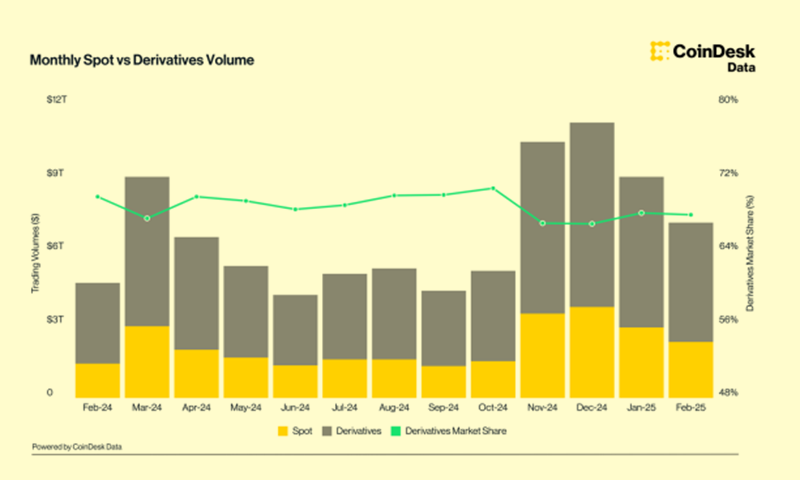 Figure 1
Derivatives Market: Further Contraction
Derivatives trading, which has historically made up a substantial portion of the crypto market, was also significantly impacted in February (Figure 1). Total derivatives volume decreased by 20.9% to $4.90 trillion, marking another consecutive month of decline. The market share of derivatives trading fell slightly from 68.2% in January to 68.0% in February, signaling that the spot market led the downturn in overall trading activity.
Binance retained its position as the largest derivatives exchange, but its trading volume declined by 22.3% to $1.91 trillion. OKX and Bybit followed, with derivatives volumes of $790 billion (-22.5%) and $746 billion (-24.4%), respectively. Despite the overall downturn, some platforms managed to gain market share. Coinbase International and Bullish saw increases of 27.4% and 17.2%, respectively, in derivatives trading volume, suggesting that traders may be shifting strategies toward institutional-grade platforms in response to market uncertainty.
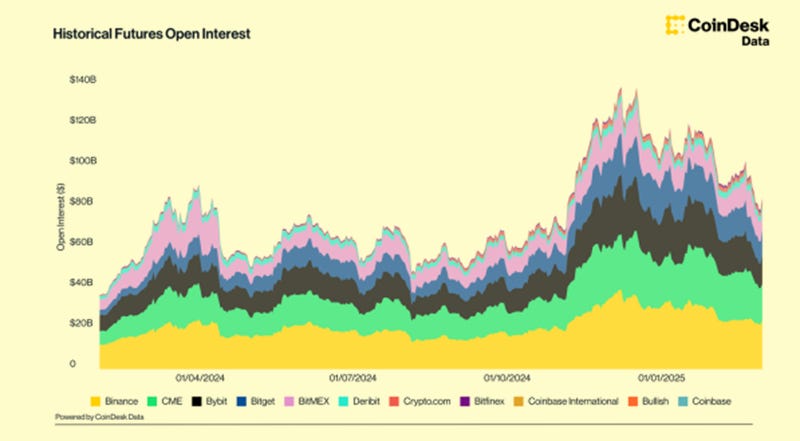 Figure 2
Institutional Activity at CME
The Chicago Mercantile Exchange (CME), widely regarded as the primary venue for institutional crypto trading, registered its first monthly decline in trading volume in five months. February's total CME derivatives trading volume fell by 19.9% to $229 billion. Bitcoin futures on CME decreased by 20.3% to $175 billion, while Ethereum futures declined by 13.1% to $35.9 billion.
Options trading on the exchange saw an even more dramatic contraction, falling 39.3% to $3.74 billion (Figure 2). Despite these declines, CME's market share among derivatives exchanges reached an all-time high of 4.67%, suggesting that retail-focused platforms experienced even more severe volume reductions.
Open Interest Falls to Pre-Election Levels
Total open interest across all trading pairs on centralized exchanges decreased substantially in February, falling 29.8% to $78.8 billion—the lowest level since November 5, 2024, before the U.S. presidential election. This significant reduction in open positions reflects a more risk-averse sentiment in the market, following multiple high liquidation events that accompanied February's price declines. Binance, CME, and Bybit were the top three exchanges by open interest, accounting for 28.0%, 22.7%, and 15.5% of all open positions, respectively.
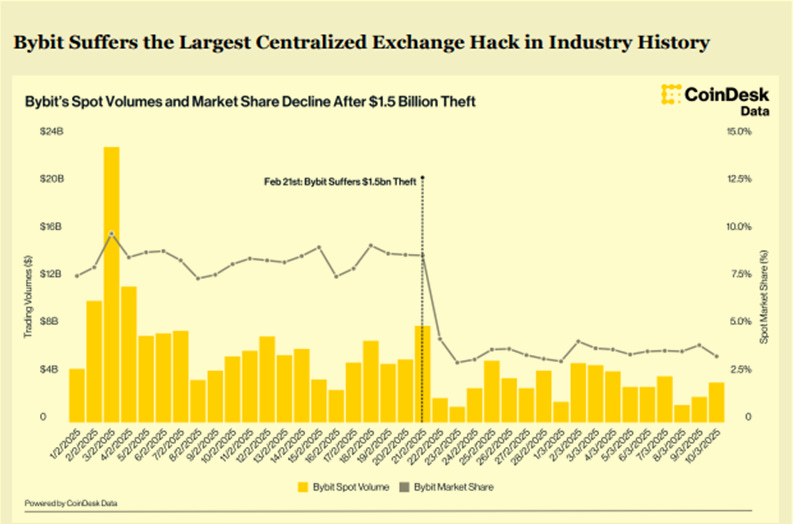 Figure 3
Bybit Hack Impact
A notable event in February was the Bybit hack on February 21st, which resulted in the loss of 401,346.7 ETH (valued at $1.4 billion), marking the largest centralized exchange hack in industry history. While the exchange's infrastructure remained uncompromised, malicious code within Gnosis Safe Wallet's AWS infrastructure led to the breach.
Two weeks following the incident, Bybit experienced a significant decline in trading activity (Figure 3), with its daily spot market share dropping from 8.68% to 3.74%—levels not seen since August 2023.
Looking Ahead
February 2025 was a month of significant declines in both spot and derivatives trading volumes, reflecting the broader market's cautious sentiment amid macroeconomic uncertainties. As we move further into March, the market remains volatile, with traders closely monitoring developments and bracing for potential turbulence.
As market participants await further economic developments, all eyes will be on whether March can reverse the trend of declining volumes or if the cautious sentiment will continue to define trading activity in the short term.
Originally published on Substack.






