
The crypto bear market is no longer just visible on price charts. It is now showing up in project announcements, shutdown notices, migration deadlines and quiet farewell messages from teams that once promised to build the next generation of Web3.
Over the past few months, the number of crypto projects closing their doors has continued to rise. According to recent data highlighted by Cryptoast, 15 additional projects have stopped operating since April 2026, wiping out the equivalent of roughly $145 million in previously raised funding.
That number tells a bigger story than a simple list of failed startups.
It shows how unforgiving the current market has become. When liquidity disappears, users become harder to retain, venture capital becomes more selective, and token incentives stop working, only the strongest projects can survive.
The rest are forced to face a brutal question: is there still enough demand to justify continuing?
A Market That No Longer Rewards Every Narrative
Crypto has always moved in waves.
During bull markets, capital spreads everywhere. Investors fund new chains, new DeFi protocols, new wallets, new infrastructure layers and experimental applications that may not have immediate product-market fit. Optimism is cheap, and narratives often matter more than revenue.
Bear markets reverse that logic.
Suddenly, users become selective. Venture capital slows down. Token prices fall. Treasury reserves shrink. Communities become quieter. Projects that once looked exciting start to look expensive to maintain.
That is what appears to be happening now.
The latest wave of shutdowns includes projects from decentralized finance, infrastructure, Layer 2 networks, developer tools and wallets. Among the names reported are Balancer Labs, Seamless Protocol, Carrot, Ranger Finance, Radiant Capital, Everclear, ZERO Network, Botanix, Hyli, Syndicate Labs, Lattice, Tally, Code4rena, 0xPPL and Leap Wallet.
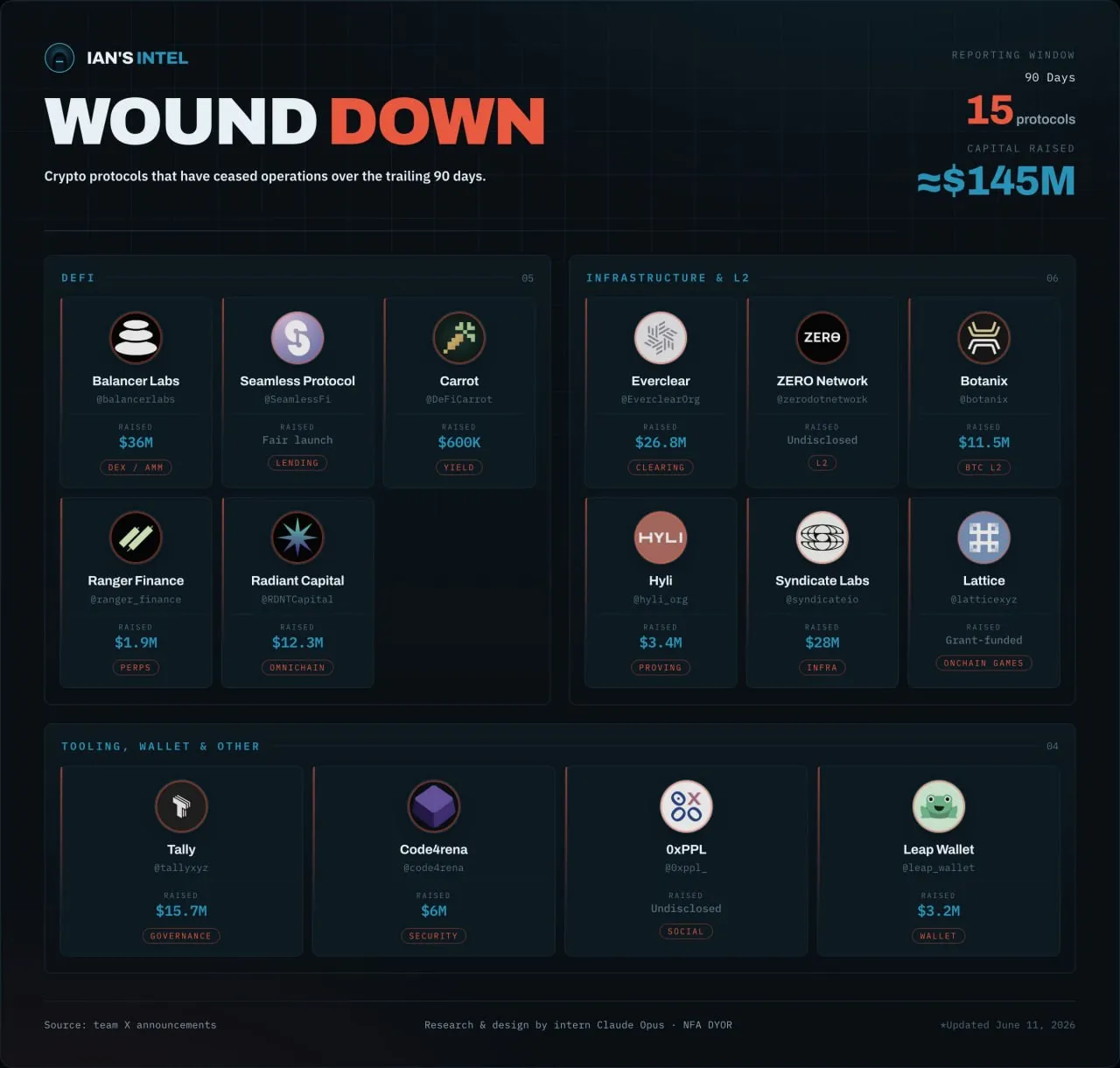
This diversity is important. It means the pressure is not limited to one weak niche. The market downturn is cutting across the whole ecosystem.
DeFi projects are struggling with lower activity and thinner liquidity. Infrastructure projects are fighting for developers and integrations. Layer 2 and appchain teams are discovering that launching a network is easier than attracting lasting usage. Wallets and tooling companies are dealing with the same problem many crypto startups face: users may like the product, but not enough to make the business sustainable.
The market is no longer asking, “Is this idea interesting?”
It is asking, “Can this survive without artificial incentives?”
That is a much harder test.
Technical Progress Is Not Enough Anymore
One of the most painful lessons of this bear market is that good engineering does not always create a viable project.
Hyli is a good example. The project had spent around two years working on zero-knowledge technology, aiming to push blockchain scalability beyond current limits. It built serious technical components, including a full node client and consensus-related infrastructure. But the team ultimately concluded that technical achievement alone was not enough.
That statement captures one of the central problems of this cycle.
Crypto has no shortage of brilliant technical teams. It has advanced cryptography, complex infrastructure, new virtual machines, modular architectures, account abstraction, interoperability layers and zero-knowledge systems. But many of these innovations are still searching for mass adoption.
A project can be technically impressive and still fail commercially.
This is especially true in sectors like ZK, modular infrastructure and app-specific chains. The technology may be promising, but the market does not always move fast enough to support every team building in the space. If user adoption is slow, fundraising becomes difficult and revenue remains unclear, even strong engineering may not save the project.
The same tension appears in the closure of Botanix, a Bitcoin Layer 2 project that had spent four years trying to build a network with genuine product-market fit rather than relying on artificial incentives. The idea was ambitious: extend Bitcoin’s capabilities without falling into the trap of fake usage and unsustainable rewards.
But ambition is not the same as traction.
Botanix has begun winding down its network, and users have been told to withdraw their funds before July 9. RARI Chain, linked to the NFT platform Rarible, has also started a decommissioning process, with users asked to move assets back to Ethereum before June 14.
These deadlines are not just administrative details. They are reminders that users must pay attention when networks close. Assets sitting on abandoned chains, discontinued bridges or unsupported wallets can become difficult — or impossible — to recover later.
In crypto, project shutdowns are not always clean. Users need to act before the lights go out.
The Great Liquidity Filter
The most important force behind these closures is liquidity.
When markets are strong, liquidity hides weaknesses. Projects can raise money. Tokens can support treasury values. Incentive campaigns can attract users. Investors are willing to fund long-term visions. Even weak business models can survive for a while.
When markets turn bearish, liquidity becomes a filter.
Projects with real demand, strong treasuries and disciplined spending can continue. Projects dependent on hype, token rewards or constant fundraising begin to struggle. The difference between “promising” and “sustainable” becomes painfully clear.
This is why the contrast with Morpho is so striking. While 15 projects shut down and roughly $145 million in previous funding effectively disappears, Morpho managed to raise $175 million in the middle of the same bear market.
That does not mean the market is closed to everyone. It means capital is concentrating.
Investors are still willing to write large checks, but only for projects they believe have exceptional positioning, strong usage, serious backers or a clear role in the future of on-chain finance. Morpho, as a major on-chain lending protocol, fits that category for many institutional investors.
The rest of the market does not receive the same treatment.
This is a major difference from earlier cycles. In previous hype phases, capital often flowed broadly across the ecosystem. In 2026, the bar is much higher. Venture funds may still have money, but they are not distributing it evenly. They are choosing winners more aggressively.
For smaller projects, that creates a difficult environment. Without strong revenue or fresh funding, they must cut costs, reduce scope, merge, pivot or shut down.
The bear market is not killing every crypto project.
It is deciding which ones still deserve oxygen.
Why Shutdowns Can Be Healthy, Even When They Hurt
Project closures are painful. Teams lose years of work. Investors lose money. Users lose products they may have relied on. Communities disappear. In some cases, assets must be migrated quickly to avoid being stranded.
But shutdowns are also part of how markets mature.
Crypto has spent years rewarding expansion. Every problem produced a new chain, a new protocol, a new DAO, a new token or a new layer. That explosion of experimentation created innovation, but it also created fragmentation. Too many projects chased the same users, the same liquidity and the same developers.
Bear markets force consolidation.
Weak projects exit. Stronger projects absorb attention. Developers move to ecosystems with better funding or stronger adoption. Users become more cautious. Investors ask harder questions. The industry becomes less forgiving, but also less wasteful.
This process is not unique to crypto. Every emerging technology sector goes through cycles of overfunding, hype, collapse and consolidation. The difference is that crypto moves faster, and because tokens trade publicly, the pain is visible in real time.
A failed startup in traditional tech may disappear quietly. A failed crypto project often leaves behind a token chart, a Discord server, stranded liquidity and users asking what happened.
That visibility makes the downturn feel harsher.
But it also makes the lessons clearer.
The next generation of crypto projects will need more than a roadmap and a narrative. They will need real users, realistic tokenomics, transparent treasury management, careful spending and a reason to exist beyond speculation.
What Users Should Do When Projects Start Closing
For users, the wave of shutdowns should be treated as a practical warning.
When a project announces it is winding down, the first priority is to check whether any funds, NFTs, liquidity positions or staked assets are still connected to that ecosystem. Users should verify official announcements through trusted channels and act before withdrawal deadlines.
This is especially important for Layer 2 networks, bridges, wallets and DeFi protocols. If infrastructure is discontinued, support may not last forever. Bridges may close. Frontends may disappear. Validators may stop operating. Liquidity may dry up.
The second priority is to avoid panic-based mistakes.
Scammers often exploit shutdown announcements. They create fake migration links, fake support accounts and fake recovery forms. Users should never enter seed phrases, approve suspicious contracts or follow links from random social media replies.
The third priority is to reassess risk.
A project closing does not always mean fraud. Sometimes it simply means the business no longer works. But repeated shutdowns across the industry are a sign that market conditions are weak. That should affect how users think about smaller tokens, experimental chains and protocols with limited liquidity.
In a bull market, risk often feels invisible.
In a bear market, risk becomes operational.
The Bear Market Is Separating Survivors From Experiments
The latest wave of crypto closures is not just bad news. It is a sign that the industry is being forced to become more serious.
Projects that rely only on hype are struggling. Teams without sustainable funding are disappearing. Networks without users are shutting down. Tools without strong demand are being abandoned.
At the same time, capital is still flowing into selected winners. Morpho’s massive funding round proves that investors have not left crypto completely. They are simply becoming far more selective.
That is the real story of this bear market.
Crypto is not dead. But the easy-money phase is over.
The next cycle will likely be shaped by fewer projects, stronger teams, clearer business models and more demanding users. That may feel painful today, especially for those affected by closures. But in the long run, a market that stops rewarding everything equally may become healthier.
The bear market is doing what bear markets always do.
It is removing the projects that cannot survive without favorable conditions.
And in crypto, survival is often the first real proof of value.






