
A deep dive into market fears, rising prices, and the erosion of trust in U.S. economic reporting.
In a $2 trillion corner of the U.S. financial markets—namely, inflation-linked Treasury securities—a sudden tremor has exposed the fragility that can emerge when politics collides with statistics. The recent firing of U.S Bureau of Labor Statistics (BLS) chief Erika McEntarfer by President Donald Trump, following a disappointing jobs report, has sent a wave of unease across bond markets.
Investors are grappling not just with the implications of weakened institutional independence, but also with economic data that is troubling even when taken at face value. At the heart of this concern is trust—trust in the integrity of government-reported figures that undergird everything from monetary policy to market pricing.
When that trust is undermined, the ripple effects are swift and unforgiving. The U.S. inflation-linked securities market, often considered a safe harbor for investors hedging against rising prices, could be the first to fracture if market participants begin to question the credibility of inflation data issued by the BLS.
The Fragile Bedrock of Data Integrity
Inflation-linked Treasuries, or TIPS (Treasury Inflation-Protected Securities), are explicitly tied to the Consumer Price Index (CPI), a core measure published by the BLS. If the integrity of this data is cast into doubt—whether through political interference, leadership purges, or manipulated methodologies—the entire pricing mechanism of TIPS becomes unstable. What happens to a market that can no longer trust its benchmark?
According to market strategists and bond investors interviewed by Bloomberg, the fear is not just hypothetical. It’s real and immediate. “This isn’t just about one job report,” said one portfolio manager. “It’s about whether we can trust any report at all.” In a high-stakes environment where trillions of dollars are priced off government statistics, any hint of politicization reverberates far beyond Washington.
A Chilling Coincidence: Weak Services Data Adds to the Malaise
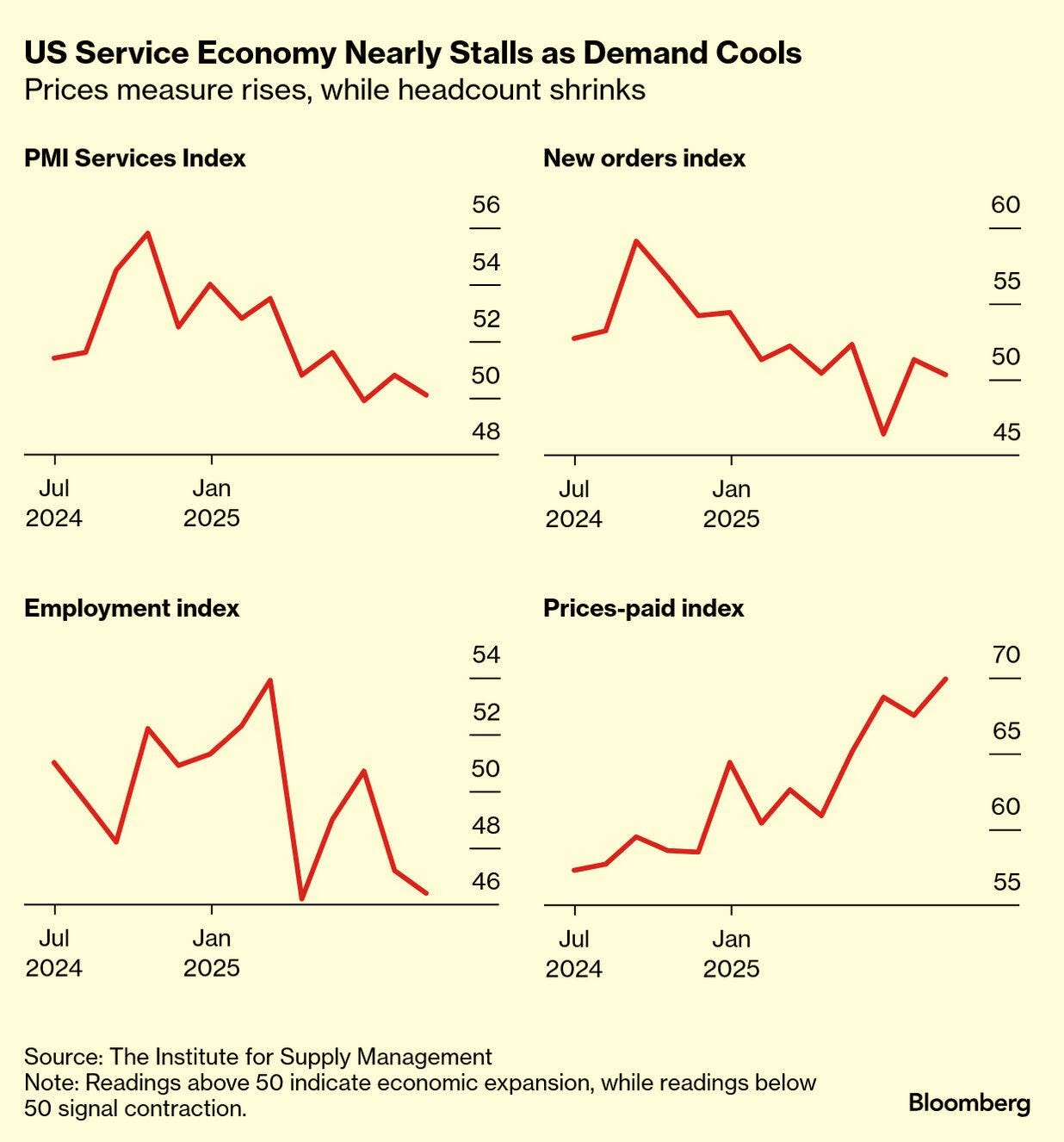
Coinciding with these concerns is a string of dismal data from outside the federal government—data that only reinforces the impression of a faltering economy. The Institute for Supply Management (ISM), a private-sector group, released its July 2025 report on the U.S. services sector (chart below). The findings were sobering:
-
The PMI Services Index declined to 50.1, just a hair’s breadth above contraction territory. This was below all economists’ estimates surveyed by Bloomberg.
-
The New Orders Index, a forward-looking indicator of demand, hovered just below 50, reflecting a loss of momentum in consumer and corporate spending.
-
The Employment Index plunged to 46.4, signaling job contraction for the fourth time in five months, one of the lowest readings since the pandemic era.
-
Meanwhile, the Prices-Paid Index surged to nearly 70, a worrisome sign of persistent input cost pressures even as demand wanes.
These trends point to an uncomfortable reality: the U.S. service economy, which represents over 70% of GDP, is barely treading water. Businesses are scaling back hiring in response to tepid demand and elevated input costs. Inflation may be cooling on paper, but firms are still feeling the squeeze.
The Tariff Overhang
Compounding these headwinds is the broader policy environment, most notably, the revival of Trump-era tariffs. While originally billed as a strategy to protect American industry and punish unfair trade practices, the net effect has been higher input prices and retaliatory moves from trading partners.
Services firms, often assumed to be immune to trade wars, are now grappling with higher equipment and supply costs that feed directly into operations. Whether it’s restaurants paying more for imported kitchen equipment or IT firms facing higher costs on outsourced services, the pain is real and growing.
These cost pressures feed directly into the Prices-Paid Index—a key metric that jumped notably in July. The surge suggests that inflation may be stickier than anticipated, which could trap the Federal Reserve in a policy bind: slow growth with persistent cost inflation, otherwise known as stagflation-lite.
A Slippery Slope Toward Institutional Distrust
President Trump’s dismissal of Erika McEntarfer comes against a backdrop of rising authoritarian flirtations globally, where economic data is often manipulated to suit political narratives. Until recently, the United States was considered immune to such tendencies. But recent events are forcing a reassessment.
What happens when the market begins to second-guess the authenticity of CPI, jobs numbers, or GDP growth? In such a scenario, even credible third-party data like ISM’s reports could be insufficient to stem the tide of distrust. For inflation-linked securities, which rely on monthly CPI prints to adjust their value, the consequences could be severe:
-
If investors perceive data manipulation, they may demand higher real yields to compensate for uncertainty.
-
This, in turn, would raise borrowing costs for the U.S. government at a time when the fiscal deficit is already ballooning.
-
It could also undermine the Federal Reserve’s credibility, forcing policymakers to rely more on private data sets, further complicating the policy response.
The Larger Picture: Trust as a Public Asset
More than any single policy or personality, economic stability rests on the predictability and integrity of public institutions. Once trust is broken, it is hard to rebuild. For financial markets that rely on the sanctity of data, even a hint of interference can cause enduring harm. The TIPS market may be the first to react, but it won’t be the last. Corporate credit, municipal bonds, and mortgage-backed securities all depend on stable inflation expectations and credible macroeconomic data.
A Warning Shot
The service sector’s stagnation and the recent data volatility are not just symptoms of an economic slowdown—they are warning shots. They underscore how deeply economic sentiment is tied to the perception of fairness and objectivity in statistical reporting.
President Trump’s dismissal of the BLS chief—whether intended as a political signal or not—could come at a steep price. If trust erodes, so too will the very foundations of market stability. As we navigate an increasingly complex and politicized economic landscape, one thing becomes clear: facts must remain sacred, especially when trillions of dollars are at stake.
Originally Published on Substack.





