
From tariffs to tech bans, the U.S.–China rivalry is shaking risk markets again, and Bitcoin isn’t immune. The parallels with early-year drawdowns are too strong to ignore.
When geopolitics turns turbulent, Bitcoin often ends up caught in the crossfire. The cryptocurrency that was once hailed as a hedge against global uncertainty has, in recent years, shown a pattern of reacting sharply to macroeconomic stress, particularly those tied to trade disruptions and liquidity pressures.
Now, as the U.S.–China trade tensions reignite, Bitcoin finds itself retracing a familiar path. The market has shed roughly 15% from its recent high, mirroring the start of a similar correction earlier this year that took nearly three months to find its footing. The parallels between these two drawdowns are striking — both were sparked by the same macro shock and both reveal how liquidity stress can ripple from global trade policy into digital assets.
The Pattern Returns: From Trade Turbulence to Crypto Drawdown
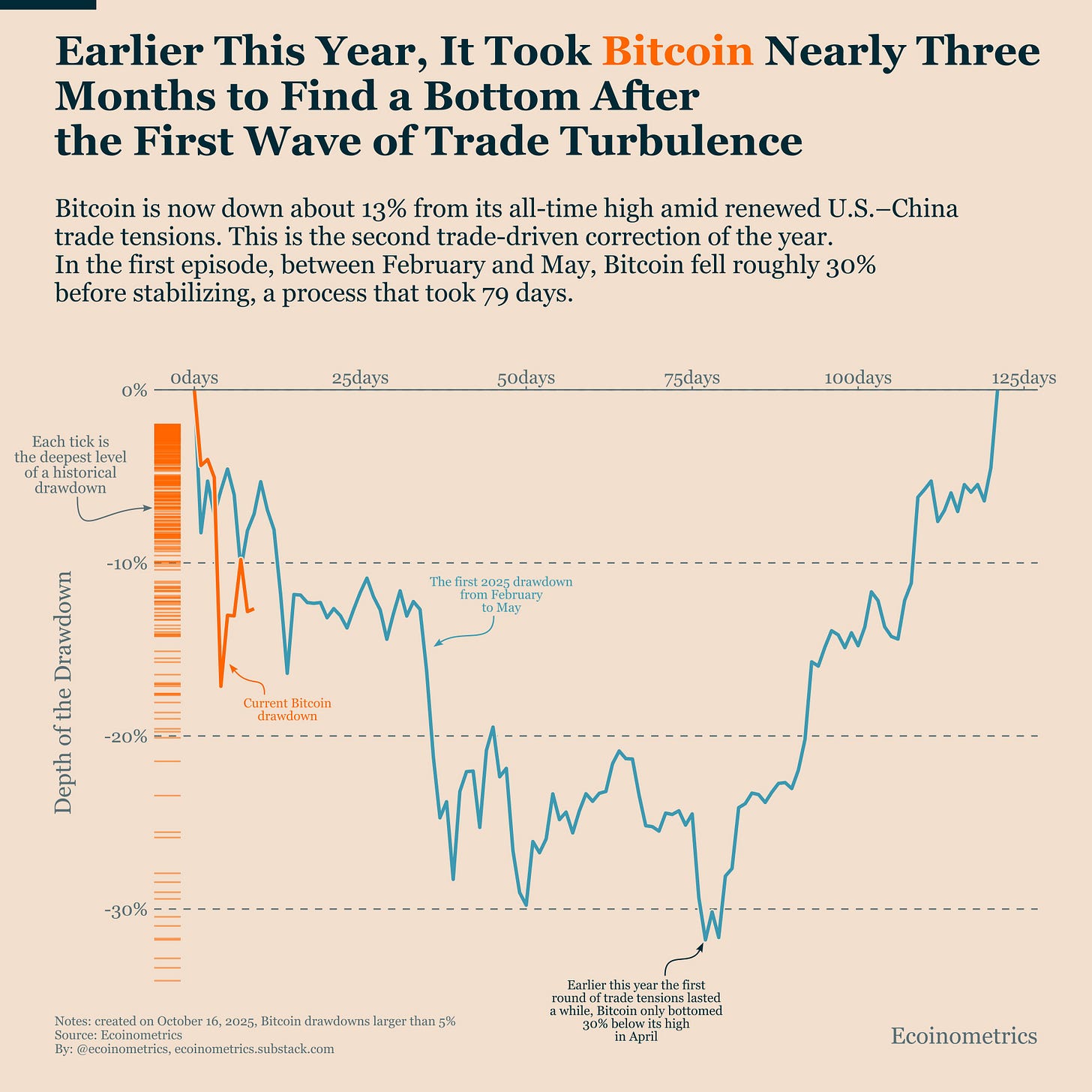
According to data visualized by Ecoinometrics (chart below), the current Bitcoin drawdown bears a close resemblance to the first correction of 2025, a steep, three-month descent that unfolded between February and May. During that episode, Bitcoin tumbled roughly 30% from its peak, hitting bottom only after 79 days of persistent declines.
The chart shows a clear “U-shaped” recovery: the price first capitulated as trade rhetoric intensified, then slowly stabilized as risk appetite returned to equity and commodity markets. Fast-forward to October, and we see a familiar setup. Renewed trade friction between the U.S. and China has once again triggered a wave of risk aversion. Bitcoin, which had been trading near record highs, is now down about 15% from its peak.
If the current trajectory mirrors the earlier correction, the market could remain under pressure until late November before finding a stable floor. In both instances, the story begins the same way — with a tightening of global liquidity. As investors reposition portfolios in anticipation of trade disruptions, capital tends to flow out of high-risk assets, including cryptocurrencies.
Despite its decentralized nature, Bitcoin has become increasingly correlated with traditional risk indicators, particularly the Nasdaq-100 and emerging market currencies. When macro stress builds, crypto often behaves less like “digital gold” and more like a high-beta tech stock.
Liquidity Stress: The Hidden Catalyst
To understand why trade tensions hit Bitcoin so hard, it helps to unpack the mechanics of global liquidity. Trade wars, by design, create uncertainty around supply chains, currency stability, and export demand. In response, institutional investors tend to de-risk portfolios, pulling funds out of volatile or speculative assets.
This process drains liquidity, not just from equities and commodities, but from crypto markets as well. Historically, Bitcoin thrives on abundant liquidity. Low interest rates, strong capital flows, and robust investor sentiment have been the key ingredients behind every major bull cycle. Conversely, when liquidity tightens, whether through monetary policy or macro shocks, Bitcoin’s volatility amplifies.
The February–May 2025 drawdown, as noted by Ecoinometrics, offers a case in point. At the height of that selloff, risk metrics across the global financial system spiked: credit spreads widened, the U.S. dollar strengthened, and emerging markets experienced sharp outflows. In such an environment, even well-capitalized crypto investors sought safety, leading to cascading liquidations and forced selling on leverage-heavy exchanges.
The “Risk-Off” Reflex
Bitcoin’s behavior during trade shocks reveals an uncomfortable truth: macroeconomic risk has become its dominant driver. While early narratives framed Bitcoin as an uncorrelated asset — immune to the whims of global finance — the data now suggest otherwise. Ecoinometrics’ chart clearly illustrates this behavioral shift.
Each tick on the vertical axis represents the deepest level of a historical drawdown, showing how closely Bitcoin’s major selloffs have clustered around global stress events — from the 2020 pandemic shock to the 2022 Fed tightening cycle, and now, the renewed U.S.–China trade standoff. What makes the current episode particularly interesting is the timing.
After months of optimism surrounding institutional adoption, spot ETFs, and corporate treasury exposure, Bitcoin’s latest correction serves as a reminder that macro still rules the narrative. As the U.S. and China trade jabs over semiconductor access, rare earth exports, and AI dominance, investors are recalibrating expectations for growth, inflation, and risk premiums. These shifts directly affect Bitcoin’s liquidity profile — influencing both speculative demand and structural inflows from institutions.
A Possible Timeline: November as the Inflection Point
If history is any guide, Bitcoin’s current drawdown could follow a similar duration to the earlier one. The February–May correction took roughly 79 days to reach bottom. Assuming a comparable trajectory, this correction could persist into late November before stabilizing.
This timeline aligns with broader macro developments. The ongoing tariff negotiations and monetary policy uncertainty create a backdrop where risk appetite may remain subdued for weeks. Investors will likely wait for clarity on trade policy and signs of stabilization in global equities before re-engaging with high-volatility assets.
The good news is that previous trade-driven drawdowns have ultimately been followed by robust recoveries. Once risk appetite normalized in mid-2025, Bitcoin staged a sharp rebound, reclaiming much of its lost ground within two months. If the same pattern repeats, the current weakness could set the stage for a strong year-end rally, provided global liquidity conditions improve.
Structural vs. Cyclical Trends
It’s important to distinguish between structural adoption trends and cyclical macro corrections. Structurally, Bitcoin remains in an upward trajectory, fueled by institutional integration, technological upgrades like the Lightning Network and L2 scaling, and broader acceptance as a digital store of value.
Cyclically, however, Bitcoin remains vulnerable to shocks that disrupt liquidity and sentiment. The current trade-driven pullback, while uncomfortable, does not fundamentally alter the asset’s long-term trajectory. Instead, it underscores the growing interplay between macro policy and crypto performance — a dynamic that will likely define the next phase of market maturity.
The Bigger Picture: Decoupling Still a Mirage
The recurring pattern between the two 2025 drawdowns suggests that Bitcoin’s much-anticipated “decoupling” from traditional markets remains elusive. As long as institutional investors dominate trading volumes and global liquidity dictates risk flows, Bitcoin will continue to reflect the rhythm of the macro economy. That doesn’t diminish its significance — it simply reframes the narrative.
Bitcoin is no longer just a speculative digital asset or a hedge against inflation. It’s now a global liquidity barometer, responding instantly to shifts in trade policy, monetary stance, and cross-border capital movement. Perhaps the real question now is not whether Bitcoin will recover, but how many times it will need to prove its resilience before the market finally believes in its long-term inevitability.
Originally Published on Substack.






