
Public companies are proving to be consistent buyers, providing stability even when funds and retail investors step back.
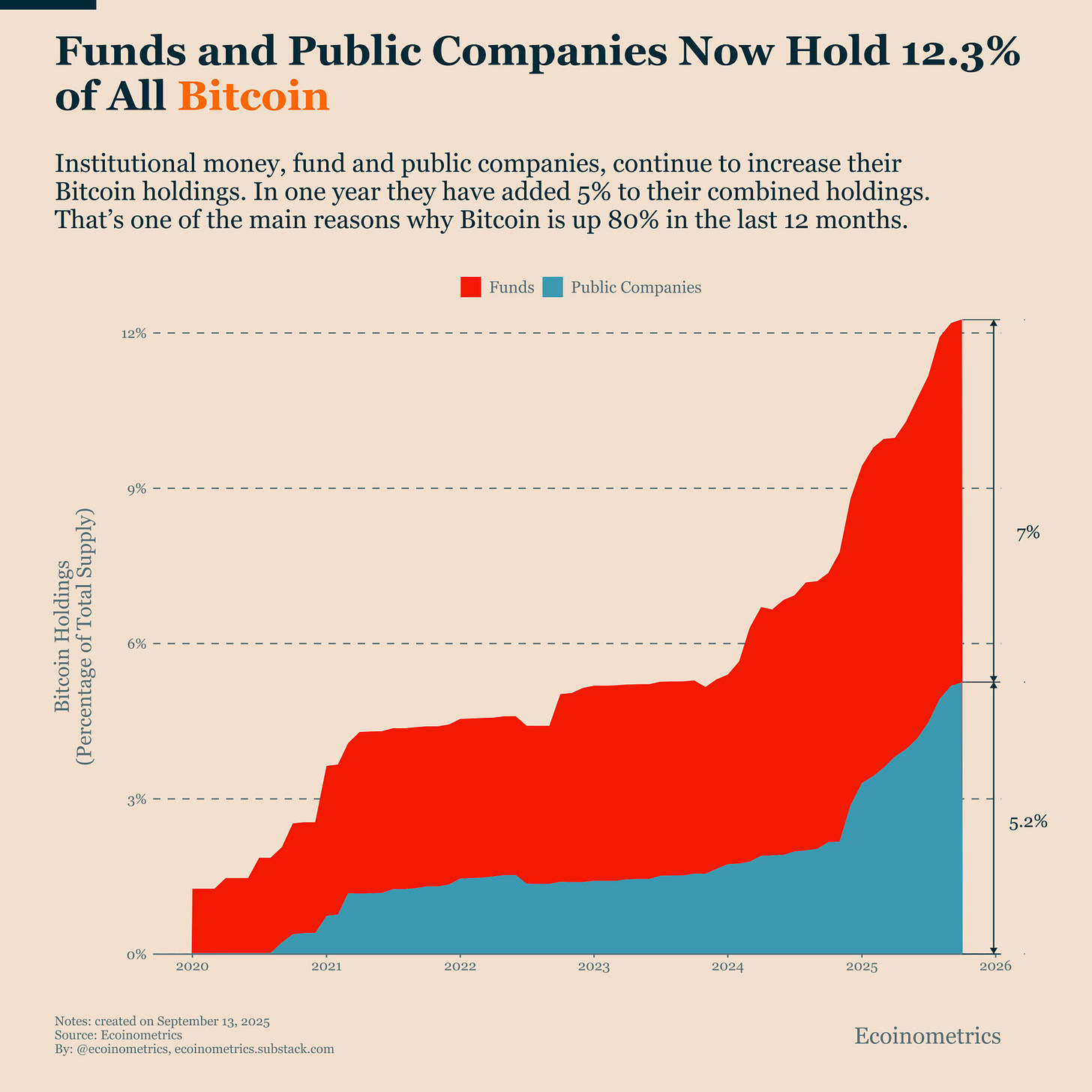
In the evolving narrative of Bitcoin’s adoption, institutional money continues to play an increasingly decisive role. According to recent data from Ecoinometrics, funds and public companies now collectively hold 12.3% of the total Bitcoin supply. This represents a sharp increase over the past year, with institutional holdings rising by 5 percentage points, coinciding with Bitcoin’s 80% surge in price during the same period.
This suggests that Bitcoin is no longer the exclusive domain of retail investors and crypto-native players. Institutional actors like hedge funds, asset managers, and publicly traded corporations are accumulating significant slices of the digital currency pie. Their involvement is reshaping market dynamics, adding legitimacy, and, perhaps most importantly, providing stability to an asset long associated with volatility.
Institutional Appetite: The Numbers Behind the Growth
The chart compiled by Ecoinometrics (below) reveals a powerful story. Funds (in red) and public companies (in blue) have steadily grown their share of Bitcoin since 2020. While the pandemic-era bull run initially sparked institutional curiosity, what is notable today is the persistence of their accumulation strategy, even through market cycles.
-
Funds now account for around 7% of Bitcoin’s total supply.
-
Public companies hold approximately 5.2%.
-
Together, these groups own 12.3% of all Bitcoin in existence, up significantly from single-digit levels just a few years ago.
What stands out in the data is the consistency of public companies as buyers. While funds have shown a more opportunistic accumulation pattern, slowing during downturns and accelerating during rallies, public companies have maintained a steady pace of acquisition regardless of market sentiment. That steady bid has been one of the quiet but critical pillars supporting Bitcoin’s resilience.
Public Companies: A Steady Hand in Volatile Times
The role of public companies is especially worth highlighting. From Tesla’s high-profile $1.5 billion Bitcoin purchase in early 2021 to MicroStrategy’s relentless accumulation under Michael Saylor’s leadership, corporate treasuries have become unlikely yet pivotal actors in the Bitcoin market.
Unlike hedge funds, which are often driven by short-term performance metrics and investor redemptions, public companies tend to operate with longer horizons and strategic motives. For some, Bitcoin represents a hedge against fiat currency debasement. For others, it is a way to align their brand with technological innovation and attract forward-looking investors.
The consistency of corporate buying provides an important backstop. Even during crypto winters, when retail enthusiasm fades and funds reduce exposure, public companies have quietly maintained their allocations. This steady demand has acted as a stabilizer, cushioning Bitcoin from deeper drawdowns and reinforcing its long-term scarcity narrative.
Why Institutional Flows Matter for Bitcoin’s Price?
Bitcoin’s 80% rally over the past 12 months cannot be attributed solely to macroeconomic conditions or retail speculation. The deepening involvement of institutions has been a critical factor. Institutional accumulation not only removes supply from the market but also signals confidence to other investors.
The effects are twofold:
-
Liquidity Constraints – As more Bitcoin is held in long-term institutional vaults, the circulating supply available on exchanges diminishes. This supply squeeze exerts upward price pressure, particularly during periods of heightened demand.
-
Legitimacy Effect – When well-capitalized, regulated entities hold Bitcoin, it helps erode lingering skepticism. Pension funds, family offices, and conservative allocators are more likely to follow once respected institutions set a precedent.
In essence, institutional money amplifies both the demand and credibility sides of the equation, magnifying Bitcoin’s price response to broader market conditions.
A Structural Shift in Bitcoin’s Market Profile
What we are witnessing is not a passing trend but a structural transformation in Bitcoin’s investor base. A few years ago, the narrative centered largely on retail speculation and the whims of short-term traders. Today, with more than one in every ten Bitcoins held by funds and public companies, the center of gravity is shifting.
This has several implications:
-
Reduced Volatility Over Time – While Bitcoin remains volatile, the presence of long-term institutional holders can dampen the extremes of boom-and-bust cycles.
-
Increased Correlation with Traditional Assets – As funds integrate Bitcoin into diversified portfolios, correlations with equities and other risk assets may rise.
-
Greater Regulatory Scrutiny – With institutional adoption comes regulatory oversight. Governments and regulators are less likely to ignore an asset class that forms part of corporate balance sheets and pension fund portfolios.
Looking Ahead
The trajectory suggests that institutional accumulation is far from over. With the approval of Bitcoin ETFs in multiple jurisdictions, new capital inflows are poised to accelerate. If public companies continue their steady acquisition strategies and funds ramp up buying during bullish phases, we may soon see institutions controlling 15% or more of the Bitcoin supply.
That raises important questions:
-
At what point does institutional ownership change the character of Bitcoin from a grassroots monetary experiment into a mainstream financial asset?
-
And what might this mean for the ethos of decentralization that originally animated its creation?
Bitcoin’s Future
The fact that funds and public companies now hold 12.3% of all Bitcoin is more than a statistic; it is a signal of Bitcoin’s maturing role in global finance. Over the past year alone, their growing share of supply has been a key factor driving Bitcoin’s 80% price increase. But perhaps the most striking insight lies in the behavior of public companies, whose unwavering commitment has quietly underpinned Bitcoin’s resilience through market turbulence.
As we look forward, institutional adoption will likely remain the dominant driver of Bitcoin’s trajectory. The big question for investors, policymakers, and the Bitcoin community alike is whether this growing concentration of ownership will strengthen Bitcoin’s case as a global asset or dilute its founding principles of decentralization and independence.
Originally Published on Substack.






