
Overbought signals and record ETF flows suggest a short-term cool-off, but the long-term outlook is brighter than ever.
Over the past year, the world's most popular cryptocurrency, Bitcoin (BTC-USD), has more than doubled in value, recently crossing the $120,000 threshold—a feat that seemed far off just 12 months ago. The price surge, which marks one of the strongest rallies in the asset’s history, comes on the back of several converging catalysts that are transforming Bitcoin from a speculative bet into a strategic allocation for investors and institutions alike.
However, as with any rally that moves too far, too fast, caution is warranted. Data from Ecoinometrics shows that flows into Bitcoin ETFs and price momentum are now entering historically overheated territory. This doesn't spell doom—it’s not 2022 again—but it does suggest that the next phase may require a breather before the next leg up.
A Year of Explosive Growth
In July 2024, Bitcoin was hovering around the $60,000 mark, consolidating after the approval of several spot Bitcoin ETFs earlier in the year. That development opened the floodgates for institutional capital to pour into crypto through regulated, familiar vehicles. Fast forward to July 2025, and Bitcoin has broken above $120,000, with renewed momentum fueled by both technical and fundamental factors.
While the overnight dip on July 14th, likely triggered by short-term profit-taking, caused some to wonder if the rally had peaked, sentiment remains overwhelmingly bullish. Volatility remains part of the game—but increasingly, the game itself is changing.
ETFs Are On Fire
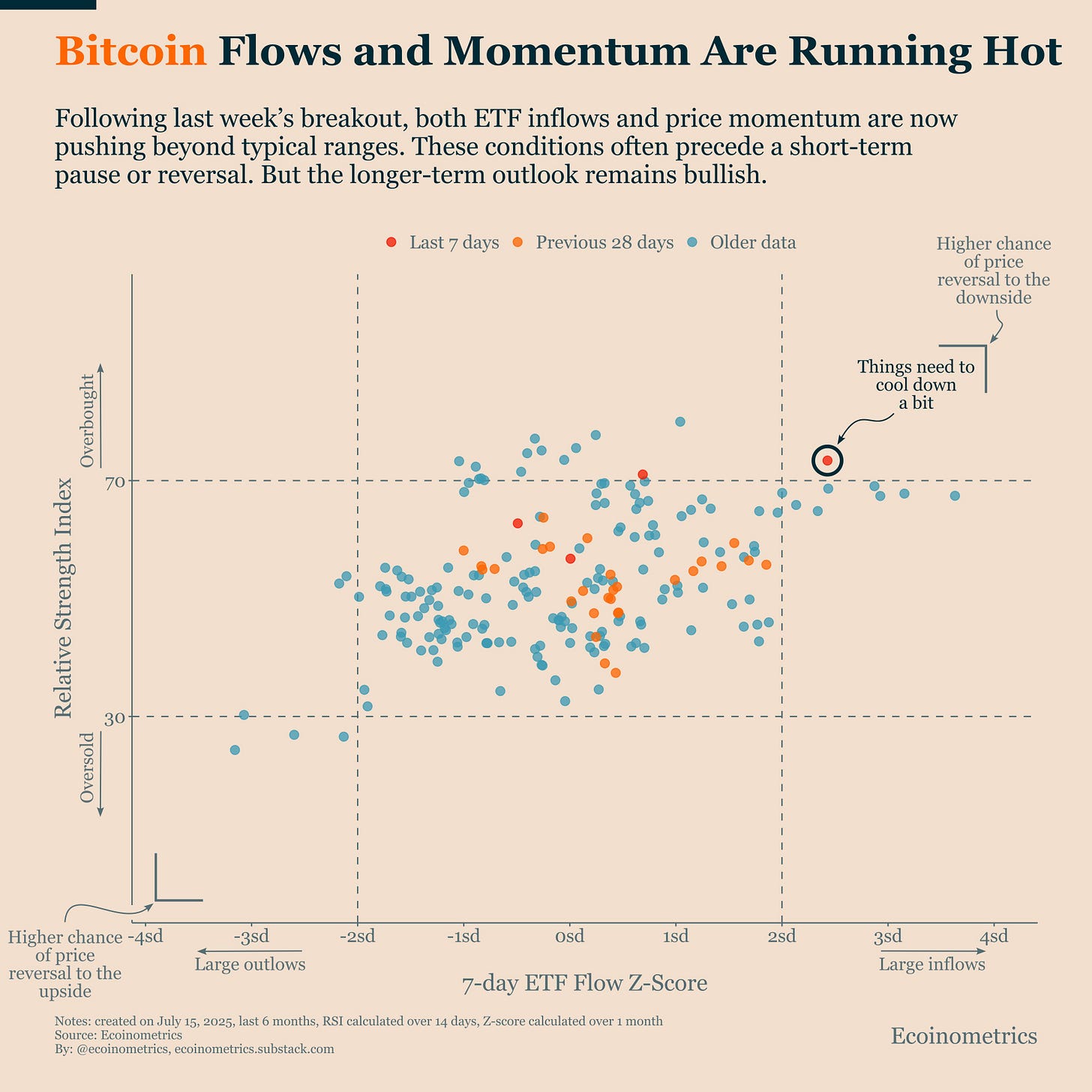
According to the latest data from Ecoinometrics, the 7-day ETF Flow Z-Score—a measure of how unusual the current flow activity is relative to the recent norm—is flashing red-hot. Inflows are more than three standard deviations above the mean, signaling a massive appetite for exposure to Bitcoin via ETFs.
The accompanying chart visually depicts the current environment:
-
The Relative Strength Index (RSI), a popular technical indicator that measures price momentum, is above 70, commonly considered "overbought" territory.
-
Simultaneously, the ETF Flow Z-Score has crossed into the +3 standard deviation zone.
-
This specific confluence—strong momentum and strong inflows—has historically preceded short-term cooling periods or mild corrections.
The chart humorously annotates the current point with: "Things need to cool down a bit." That’s not a prediction of doom, but a nudge to temper expectations in the immediate term.
Why the Surge?
Three primary forces are driving Bitcoin’s record-breaking run:
1. Corporate Treasury Adoption
Major U.S. and international companies are increasingly allocating portions of their treasury holdings to Bitcoin. With inflation still hovering above central bank targets and interest rate expectations in flux, firms are seeking inflation-resistant stores of value. Following MicroStrategy’s playbook, a new wave of corporations—ranging from fintech to energy firms—have disclosed BTC holdings in recent SEC filings. This shift is transforming Bitcoin into a legitimate treasury asset.
2. ETF Mania and Retail Participation
Bitcoin ETFs are not just an institutional story. Retail investors have embraced these products too, especially within retirement accounts, thanks to their regulatory clarity, ease of access, and tax advantages. Record-breaking inflows across multiple funds are pushing the BTC price upward while tightening supply.
Notably, BlackRock’s IBTC and Fidelity’s FBTC have each amassed billions in assets under management, with no signs of slowing. The chart data from Ecoinometrics highlights just how out-of-range these inflows have become, compared to historical norms.
3. Regulatory Breakthrough in Washington
Perhaps the most significant catalyst of all is legislative. For years, crypto has been in a regulatory gray zone in the U.S. However, that’s changing. Lawmakers are now closer than ever to passing long-awaited legislation that would clearly define how digital assets are classified, taxed, and regulated.
The proposed bills, which enjoy bipartisan support, would clarify the roles of the SEC and CFTC, establish consumer protections, and open the doors for broader financial institution participation. With regulation finally catching up to innovation, confidence in the space has soared.
Short-Term Risk, Long-Term Promise
The data from Ecoinometrics is clear: we are in overbought territory. The combination of extremely high ETF inflows and strong momentum (as shown in the top-right quadrant of the scatter plot) has historically preceded cooling periods.
These are not crashes, but natural pauses in the market that allow for consolidation and healthier future growth. As the chart notes, this is a zone where a “higher chance of price reversal to the downside” exists. It’s not a certainty, but a statistical tendency worth noting.
For long-term investors, however, the broader picture remains bullish:
-
Supply is tightening as long-term holders accumulate.
-
Demand is diversifying beyond crypto natives to include institutions, corporates, and sovereign wealth funds.
-
Policy clarity is emerging, reducing one of the biggest sources of uncertainty.
Even if Bitcoin retraces to $100,000 or below in the short term, such a move would likely be viewed as a buying opportunity rather than a structural breakdown.
A New Era for Bitcoin?
Bitcoin’s journey has always been volatile, controversial, and disruptive. But what’s unfolding in mid-2025 is different from previous cycles. This isn’t just about speculation. It’s about integration—Bitcoin becoming part of the financial fabric. With ETFs scaling, corporates adopting, and regulators finally stepping in with clarity rather than ambiguity, the asset class is moving from the fringe to the mainstream. The narrative is no longer "Will Bitcoin survive?" It’s now "How big will its role become in the global financial system?"
A New Chapter in Digital Asset Evolution
The record-breaking rally of Bitcoin to $123,000 reflects more than just speculative fever. It’s a manifestation of growing legitimacy, structural demand, and the maturation of crypto infrastructure. Yes, the technical indicators suggest a short-term pause is due. But the longer-term trend is one of increasing adoption and institutionalization. Whether you are a believer, a skeptic, or somewhere in between, one thing is clear: Bitcoin is no longer the outsider. It’s knocking on the doors of traditional finance—and increasingly, those doors are opening.
Originally Published on Substack.






