
Visual data reveals the cycles of hype, collapse, and recovery that have shaped Bitcoin’s market leadership over the past decade.
In the ever-evolving world of cryptocurrencies, Bitcoin dominance has long been one of the most closely watched indicators of market health, sentiment, and investor confidence. Bitcoin dominance refers to Bitcoin’s share of the total cryptocurrency market capitalization. At its core, it is a measure of how much influence the world’s first cryptocurrency continues to wield in a sector that now boasts thousands of digital assets.
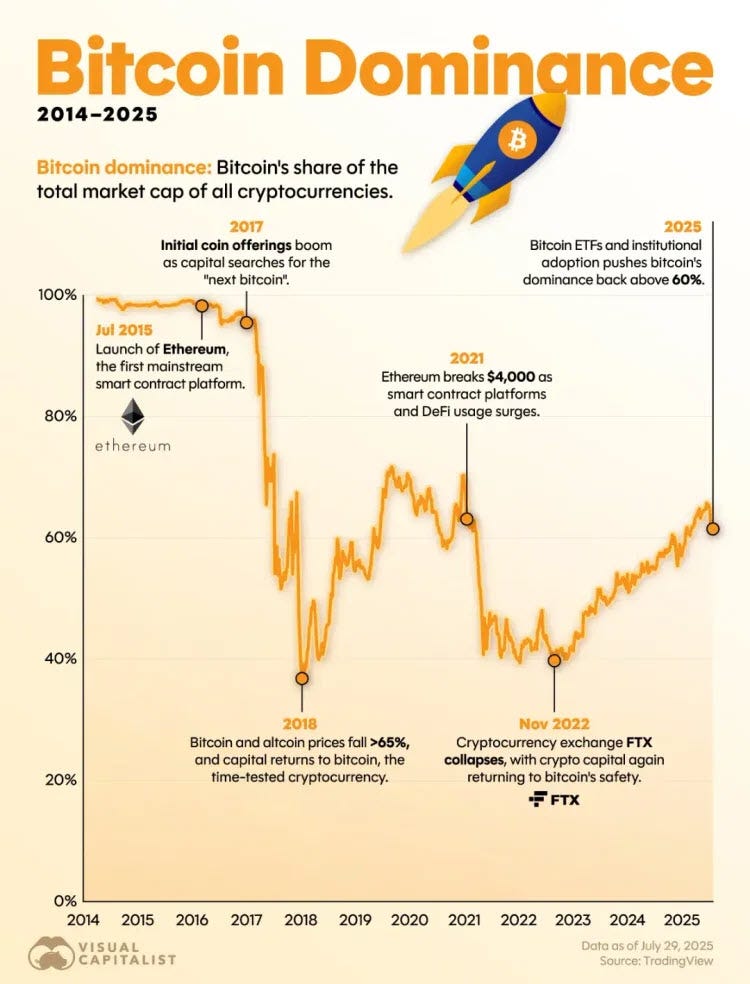
A recently updated chart from Visual Capitalist (below), based on TradingView data as of July 29, 2025, offers a striking illustration of how Bitcoin’s dominance has shifted over the last decade. From near-total control of the market in 2014 to periods where its share dipped below 40%, Bitcoin has faced challenges from Ethereum, DeFi, altcoins, and the collapse of major exchanges.
Yet today, as Bitcoin ETFs gain traction and institutional adoption accelerates, its dominance is once again climbing above 60%. This journey not only reflects Bitcoin’s resilience but also reveals much about the cycles of hype, innovation, and crises that have shaped the broader cryptocurrency ecosystem.
The Early Era: Bitcoin as the Undisputed King (2014–2015)
In 2014, Bitcoin effectively defined the cryptocurrency market. With no true rivals, its dominance hovered close to 100%, serving as the primary entry point for anyone interested in digital assets. This period coincided with early mainstream awareness, alongside skepticism following incidents like the collapse of Mt. Gox in 2014.
The first significant challenge to Bitcoin’s dominance emerged in July 2015, with the launch of Ethereum, the first widely adopted smart contract platform. Unlike Bitcoin, which functioned primarily as a peer-to-peer digital currency, Ethereum enabled developers to build decentralized applications (dApps). This innovation laid the foundation for an explosion of new tokens, projects, and use cases, ultimately beginning the erosion of Bitcoin’s overwhelming market control.
The ICO Boom and the Search for “The Next Bitcoin” (2017)
By 2017, the cryptocurrency market witnessed an unprecedented boom in initial coin offerings (ICOs). Startups across the globe launched tokens promising to revolutionize industries from finance to healthcare. Capital poured into these projects, and investors speculated aggressively on which coin might dethrone Bitcoin. During this period, Bitcoin’s dominance plummeted as low as 38%, its lowest point at the time.
Ethereum gained significant traction as the go-to platform for ICO launches, cementing its position as Bitcoin’s primary competitor. While Bitcoin remained the largest cryptocurrency by market capitalization, it no longer stood alone at the center of the crypto universe. This era epitomized both the promise and perils of crypto innovation: enormous gains for early adopters but also rampant scams, failed projects, and regulatory scrutiny that would follow.
The Crypto Winter and Return to Safety (2018)
The euphoria of 2017 was short-lived. In 2018, the cryptocurrency market crashed, with Bitcoin and altcoin prices falling by more than 65%. As speculative projects collapsed and investors reassessed risk, capital flowed back into Bitcoin—the “time-tested” cryptocurrency.
Bitcoin dominance surged again, reaffirming the perception of Bitcoin as the sector’s digital gold: volatile but safer than newer, unproven tokens. This pattern of capital retreating to Bitcoin in times of uncertainty would repeat in future crises, strengthening its role as the anchor of the cryptocurrency market.
Ethereum’s Rise and the DeFi Surge (2020–2021)
The launch of decentralized finance (DeFi) platforms, largely built on Ethereum, sparked another transformative period in crypto markets. By 2021, Ethereum broke above $4,000, driven by surging demand for smart contract applications in lending, borrowing, and decentralized exchanges.
Once again, Bitcoin’s dominance fell as investors explored new use cases beyond store-of-value narratives. The rise of non-fungible tokens (NFTs), also primarily hosted on Ethereum, added further fuel to this diversification. The crypto ecosystem was expanding into a multi-chain, multi-purpose arena, and Bitcoin’s market share reflected that reality.
Crisis and Collapse: The FTX Shock (2022)
November 2022 marked another watershed moment: the spectacular collapse of FTX, one of the largest cryptocurrency exchanges. The implosion, triggered by revelations of mismanagement and alleged fraud, sent shockwaves across the industry. Billions of dollars in customer funds evaporated, and regulatory scrutiny intensified globally.
Amid the chaos, investors once again sought refuge in Bitcoin. Its dominance spiked as confidence in centralized exchanges and riskier tokens deteriorated. While many projects vanished in the aftermath, Bitcoin endured, bolstering its reputation as the most resilient asset in crypto.
Institutional Era: Bitcoin ETFs and Renewed Dominance (2023–2025)
Fast forward to today: in 2025, Bitcoin’s dominance has climbed back above 60%, driven by two key forces—institutional adoption and the rise of Bitcoin ETFs. The approval and widespread uptake of Bitcoin exchange-traded funds have given mainstream investors a regulated, accessible avenue to gain exposure to Bitcoin. This has fundamentally shifted the balance of power in crypto markets.
Institutional players, once wary of the sector, now treat Bitcoin as a legitimate portfolio allocation—sometimes likened to a digital hedge against inflation or “digital gold 2.0”. In parallel, stricter regulations have curtailed speculative altcoin projects, tilting capital flows back toward Bitcoin. The narrative of safety, liquidity, and institutional backing has reestablished Bitcoin as the dominant force in crypto markets.
What Bitcoin Dominance Tells Us About the Future?
The story of Bitcoin dominance is not just about market share—it’s a reflection of trust, utility, and cycles of innovation. Several lessons emerge from the past decade:
-
Bitcoin as a Safe Haven
Repeatedly, in times of crisis (2018, 2022), capital has retreated into Bitcoin. Its robust network, limited supply, and brand recognition reinforce its role as the safest bet in an otherwise volatile sector. -
Innovation Challenges Bitcoin’s Dominance
Ethereum, DeFi, and NFTs have shown that technological breakthroughs can erode Bitcoin’s market share. However, no rival has yet matched Bitcoin’s combination of decentralization, security, and global recognition. -
Institutions Change the Game
The rise of ETFs and regulatory clarity has anchored Bitcoin’s role in global finance. Unlike the speculative retail-driven surges of 2017, today’s growth is increasingly institutional. -
Cyclicality Remains a Constant
Bitcoin dominance will likely continue to ebb and flow with cycles of speculation, innovation, and crisis. Investors must recognize that dominance is not static—it mirrors the evolving priorities of the market.
A Decade of Resilience
From near-total dominance in 2014 to the depths of the ICO era, and now a resurgence to around 60% in 2025, Bitcoin’s journey illustrates the dynamic interplay between innovation and stability in cryptocurrency markets. While challengers like Ethereum have introduced powerful innovations, Bitcoin’s enduring dominance underscores its foundational role.
Looking ahead, the key question is whether Bitcoin can maintain its position as crypto’s anchor while the broader ecosystem matures. Will emerging technologies—layer-2 scaling solutions, CBDCs, or AI-driven finance—further fragment market share, or will institutional adoption cement Bitcoin’s supremacy? Either way, the narrative of Bitcoin dominance will remain central to understanding the future of digital assets.
Originally Published on Substack.






