

This is an excerpt from the Flarnchain Newsletter.
Sign up here to receive Flarnchain in your inbox each and every week.
Validators and Delegators
What is the Delegated Proof of Stake (DPoS) protocol? Well, it's a blockchain consensus mechanism that differs substantially from the way Bitcoin works. Bitcoin operates under a Proof of Work (PoW) protocol. Proof of work requires people to solve arbitrarily complex computer problems to be given the opportunity to validate new blocks on the Bitcoin blockchain. This is effectively what is known as "Bitcoin mining".
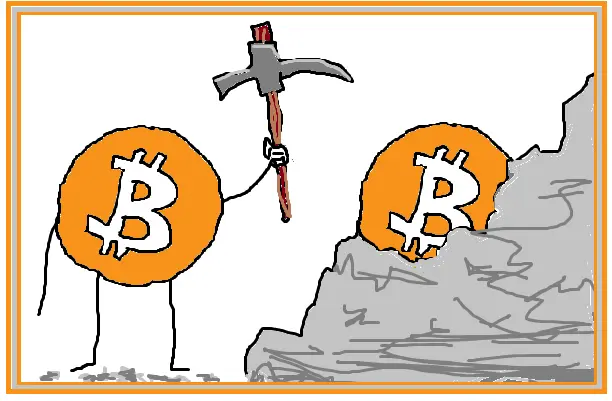
Hey! Look: a Bitcoin mining a Bitcoin. This is similar to the movie Predestination (2014).
[Bitcoin stuff: Basically, in order to mine Bitcoin, you need to use lots of electricity (energy) to run as many computers as you can to be the first person every 10 minutes to solve a very complex cryptographic puzzle. Because Bitcoin is worth a lot of real world money, there are a lot of resources being thrown at this, which causes the difficulty of the cryptographic puzzle to increase, which requires more computers, requiring more energy, ultimately resulting in a feedback loop causing the energy costs associated with Bitcoin mining to skyrocket.]
Proof of Work protocols are not the only type of protocol. Proof of Work was merely the first, and Bitcoin was the first crypto-currency to use it successfully. In fact, there are many other types of protocols.
Delegated Proof of Stake Protocol (DPoS)
I'm not going to go on and on explaining how Delegated Proof of Stake Protocols work, because frankly, I barely understand the basics. What I am going to do is try to briefly explain two key entities that are integral to the functioning of a DPoS protocol. DELEGATORS and VALIDATORS.

These little blue squares represent individuals, or entities that own tokens in a delegated proof of stake blockchain. The one with the crown is a Validator. [Trivia Time: Can you guess what the other ones are supposed to represent?]
In simple terms, Delegated Proof of Stake works like this: The blockchain needs individuals to use their computers to validate new blocks on the blockchain. Validating means to legitimize, or to check the validity of new blocks that are added to the blockchain.
People will not do this activity for free, because it takes effort and time to set-up and maintain this type of process, so the proof of stake protocol is set up in such a way that you can receive payment, by the protocol itself, for validating each new block. People who validate new blocks are called validators. Validating new blocks is essentially equivalent to mining in Proof of Work protocols like Bitcoin.
Now, not all owners of the crypto-currency will want to set up their computer to be able to validate blocks. They may still be interested in assisting with the validation of blocks, with no additional effort, so they too can receive some of the block reward. These individuals can stake their tokens to a specific validator. This gives the validator more powah.
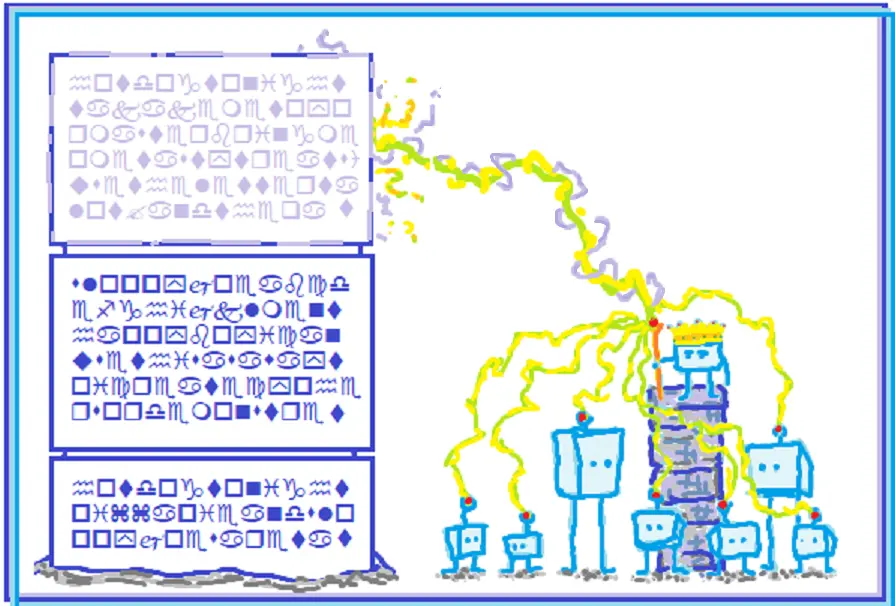
On the left is a generic Delegated Proof of Stake blockchain, with 3 blocks. The top block has not yet been added to the blockchain, because it hasn't yet been validated. The symbols inside each block represent transactions on the blockchain. I used the "wingdings" font here. Again, all of the blue cubes are entities that hold tokens of the crypto-currency being run on a Proof of Stake blockchain. The ones with no arms are delegators, delegating their power. The little guy on the pillar with a crown and a staff is the validator. It's sort of like a representative democracy, where we elect representatives (we give them some of our power) to go do our bidding (validate new blocks on the blockchain).
By staking their tokens, these people delegate their tokens to the validator of their choice. This is where the term Delegator comes from. It's sort of like representative Democracy.
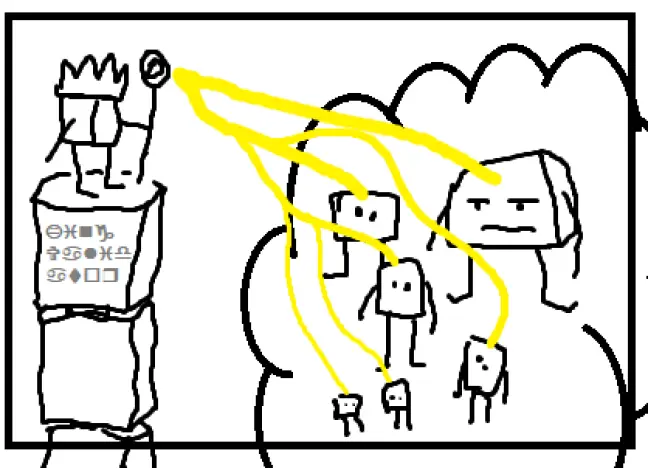
This rough sketch is not a good representation of Delegated Proof of Stake. In this situation, it appears that the validator is taking power from the delegators. In fact, it works the other way around. The delegators give power to the validator, by staking their own tokens, freely and willingly.
Staking is a very difficult concept to explain, and I basically needed to explain staking before I explain delegating. So I think I'm pretty much at the end of the line here. Refer to the drawing below for more details:
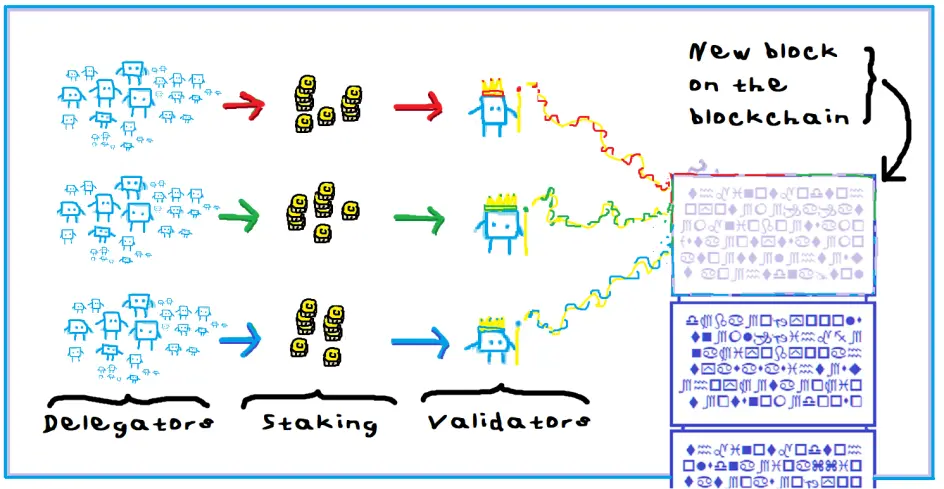
Delegators stake their tokens to their preferred validator. This gives the validator more powah to validate new blocks on the blockchain. Delegators can technically stake to multiple validators, but this drawing was already getting pretty complex.
Alright, hopefully all of that made sense to you. I will definitely try this topic again in a few weeks.
Please make sure to comment on any errors I made in this post. I am still learning, also, please take that into consideration when reading any of my posts. I could have explained things totally wrong.
My goal is to contribute to mass adoption of Web3 / blockchain technology, thus I'm trying to explain things the way I understand them, as an insight into the evolution of thought throughout my crypto journey.
Thanks for reading.
- Flarn






