
According to a Chainalysis report, 2019 was the year with the most Ponzi schemes in the history of cryptocurrencies. These schemes took billions of dollars in cash from investors.
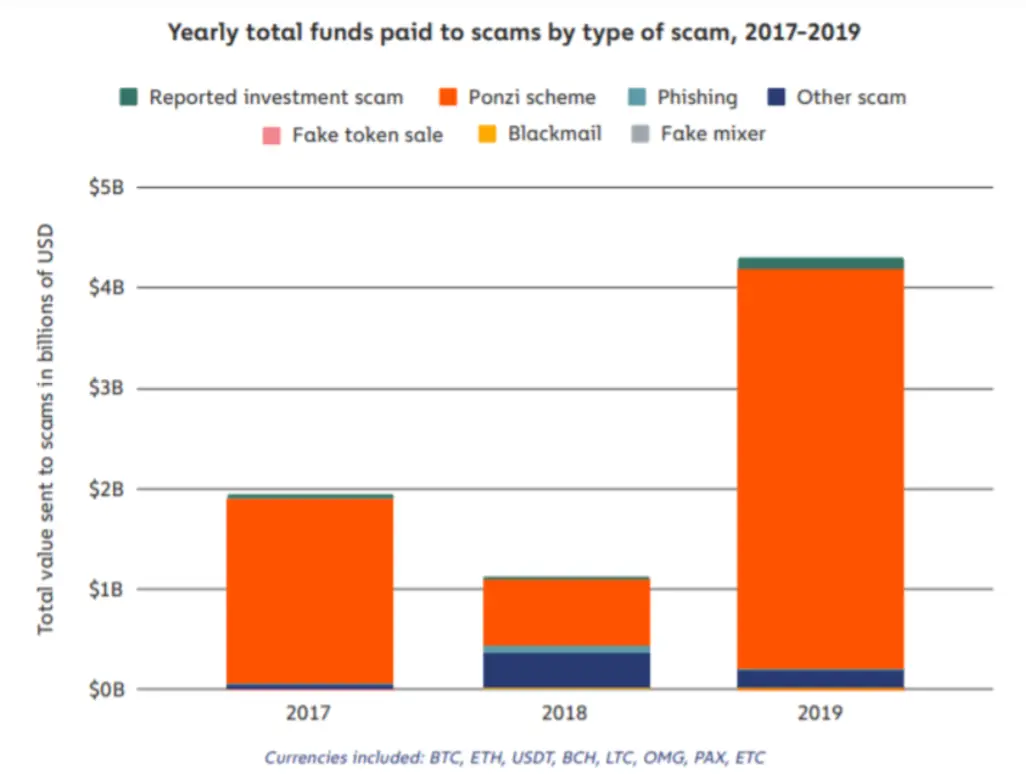
According to the report, about $ 4.3 billion was lost to the hands of cryptocurrency scammers. Besides, this is more than three times the value when compared to the previous year, which was about US $ 1.7 billion.
What is a Ponzi scheme?
Generally, a Ponzi scheme (or a pyramid scheme) is a form of investment - but in reality, a financial fraud - that attracts unsuspecting investors, promising them a massive ROI in the shortest possible time.
The general concept of a Ponzi scheme is to generate investment interests for early investors as new investors join the system. What this means is that Ponzi schemes are driven by the constant flow of new investors into the system, collecting larger payments from them to pay the first investors. The scheme then collapses when no new investors come in or when all investors decide to withdraw money at once.
Let's consider some common features of a Ponzi scheme: there is no real product; promises of a guaranteed high return on investment with little or no risk; excessively consistent returns on investments; organizers are generally unregulated and unlicensed; difficulty receiving payments; as with many other types of fraud, Ponzi scheme organizers often take advantage of the latest technology or product to attract potential investors to join the group.
The decentralized and semi-anonymous nature of the cryptocurrency makes it an attractive portal for scammers to distribute massive profits from innocent investors. However, the idea behind crypto decentralization makes it possible to view all transactions made on the public ledger.
How does a Ponzi scheme work in the crypto industry?
Ponzi schemes in cryptocurrencies follow a pattern similar to traditional Ponzi schemes. It basically works by appealing to people's desire to make a quick profit, promising them a high return on their investments. Usually, the first group of investors is paid, which invariably entices others to join the gold rush.
Some Ponzi cryptocurrency scams use sophisticated and complex processes, going so far as to develop their own exchanges to achieve their goal. Other Ponzi scams use automated software to interact with people. A typical case is the iCenter Bitcoin and Litecoin investment saga. ICenter used a pyramid-style reference system to keep the system running. The company operated through a group chat from Telegram and a bot to deceive investors with false percentages of investment growth.
The company promised a return profit of 1.2% per day for 99 or 120 days of maturity - the period in which you are eligible to charge your principal amount and the profit that comes with it. Investors were also encouraged to share their referral codes with others to earn more from their referrals.
Out of sheer excitement, most investors would post videos on social media to invite more people to participate. This model ensures that a flow of people moves continuously to the system to keep it active.
Some Ponzi schemes lead people to lose money, even without meaning to. Recently, three transactions on the Ethereum network were sent at huge rates, one of which was 10,668 ETH for a transaction of 0.55 ETH. It turned out that a little-known South Korean cryptocurrency P2P exchange, Good Cycle, which appears to be a Ponzi project, has been hacked. The security holes were quite obvious:
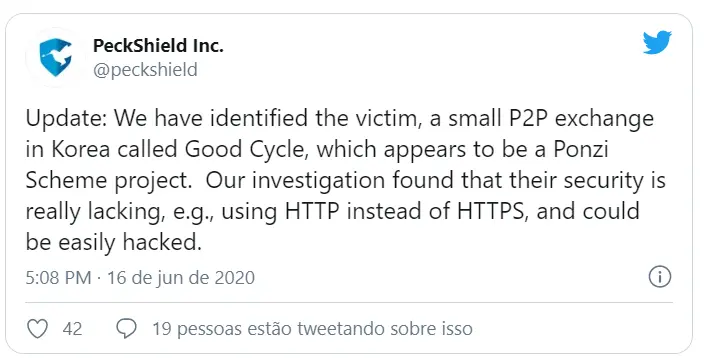
However, it is still unclear who broke into the exchange and was behind the potential blackmail.
The biggest crypto schemes Ponzi - in numbers
According to data from Chainalysis, of the vast majority of cryptocurrency scams, Ponzi schemes were responsible for 92% of the total fraudulent money.
In the chart below, Chainalysis has combined all cryptocurrency-related scams in one place. As you can see, the year 2019 reached the largest number of Ponzi cryptocurrency scams, drawing huge money from millions of innocent investors.
In addition, Chainalysis investigated that more than 2.4 million individual transfers were made in just six different Ponzi schemes in 2019. In addition, on average, about $ 1,676 in crypto were transferred.
Some of the largest Ponzi crypto schemes in the world
As the adoption of the cryptocurrency continues, Ponzi scheme organizers have wasted no time exploring people's ignorance and their quest for financial fortune. Let's take a look at some of the biggest names in Ponzi cryptocurrency schemes.
BitConnect
BitConnect was one of the first Ponzi cryptocurrency schemes that skillfully attracted countless investors to its trap. Like many other scams, BitConnect looked promising at an early stage. The company started in 2016 with an Initial Coin Offering (ICO) for the public. It has consistently become the best performing cryptocurrency at CoinMarketCap, with over 2.5 billion market capitalization.
All of these achievements seemed to keep investors at ease, although critics and experts, such as Ethereum co-founder Vitalik Buterin and Litecoin founder Charlie Lee, were not fooled by BitConnect's dubious business model.
But, like all other Ponzi schemes, BitConnect ended its lending and foreign exchange services two years later, raising a whopping $ 2.5 to $ 3.5 billion in cash from investors.
OneCoin
Onecoin has also embraced one of the biggest cryptocurrency scams of the century with its imaginary blockchain and cryptocurrency technology. The scam organizers claimed that OneCoin works like any other cryptocurrency, where the coins are extracted and can be used for global payments. They even compared themselves to Bitcoin and then started distributing currencies to investors. It turned out that it was all a trick.
After the collapse, OneCoin's Ponzi scheme raised a whopping $ 4 billion from people around the world.
PlusToken
PlusToken was a company based in China that presented itself as one of the best cryptocurrency portfolios. Through elaborate and sophisticated marketing strategies, the organizers managed to attract more than 3 million investors, mainly from China, Japan, Korea, Canada and Germany.
The company promised to reward people with high returns if they invest in the ‘Plus’ token - the crypto associated with the wallet. Investors could buy Plus tokens using assets like BTC or Ethereum. PlusToken claimed that profits would be generated by "foreign exchange earnings, mining revenue and benchmark benefits".
According to Chainalysis, PlusToken deceived its investors by about $ 2 billion in crypto.
MMM BSC
Another major Ponzi scheme is gaining momentum now - in mid-June 2020, MMM BSC's transactions significantly overload the Ethereum network, consuming at least 8.7% of all gas. This raised gas prices above 20 Gwei - above 3 Gwei in January. According to reports, over 55% of all PAX stablecoin transactions are linked to MMM today. Here is the list of the main gas spenders on the Ethereum network. As you can see, MMM is among the Top 4 with $ 780,000 in total value:

The MMM BSC website promises 30% of monthly income in a “non-high-risk investment project”. “It is a community where ordinary people help one another selflessly. It is a global mutual aid fund ”. We believe that it is only a matter of time when this “aid fund” will be exposed and forced to collapse. And how much money people will lose from this ‘selfless help’ is still a big question.
Continuity of work
As you may have noticed, the largest Ponzi schemes in the history of cryptocurrencies followed a similar pattern. Scammers usually attract investors through aggressive promotion on social media and elsewhere, while promising an outrageous amount of investment returns.
As a result, more scams are likely to continue to evolve as new technologies and sophisticated software are developed. However, cryptocurrency companies and blockchain analytics companies continue to work together to crack down on scammers and make it a safe industry.






