
In the study of the origins of money and the financial system, it is common to come across the term SOUND MONEY that has its origins in Ancient Rome, where small silver coins were used in everyday life.
The concept of Sound Money means money that sounds like real, strong and stable. The sounding coin maintains its value over time and has intrinsic value, backed by something tangible.
Human experiences accumulated over thousands of years have led to the conclusion that coins of another and silver are the example of Sound Money. These precious metals became traded goods throughout history due to their portability, divisibility, scarcity and their physical properties that gave them resistance.
The unmistakable sound
The way used to verify the coin's authenticity and if it had not been mixed with other substandard substances, in addition to visualizing its material and shape, was to hear the unmistakable sound emitted by another coin, silver or copper when left fall on a hard, metallic, stone, wood or glass surface.
Sound Money carries a clear, century-old message. It is a prerequisite for a solid and prosperous economy and literally refers to the wealth of truth, with a sound and characteristics of authenticity, in contrast to paper and plastic or fiat money, which can be easily expanded by a central organ, causing a reduction in its value over time.

Throughout history, there have always been economic distortions stemming from currency degradation. In Rome, for example, an attempt was made to counterfeit silver coins with common metal, reducing the silver content to just 5%, which did not long deceive soldiers, who received their wages for these coins, and too many people who used them.
Until then, gold and silver coins fulfil the requirements, but now Bitcoin emerges with the Sound Money of the digital age, which like the other has value due to its scarcity, rarity and the time and effort required for its extraction and, as Consequently, they cannot be inflated or devalued.
A conceptual understanding of the characteristics of Sound Money is vital to understand the characteristics and advantage of Bitcoin in the face of centuries of dominance of trust-based money (fiat) and even see advantages over other options that are used today.
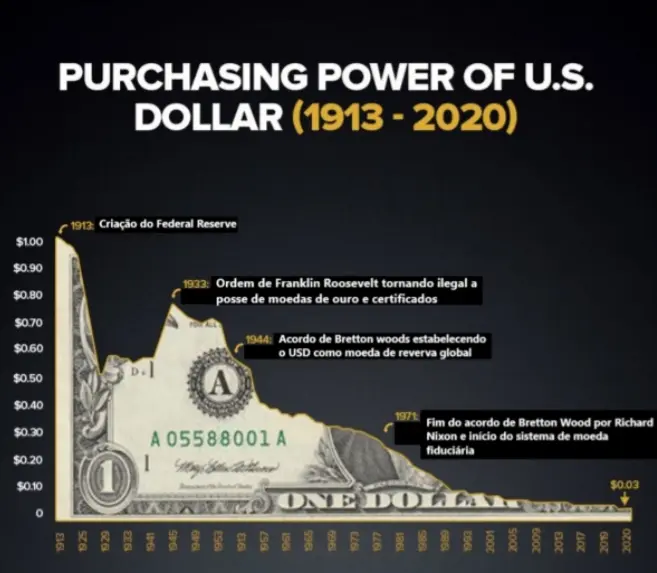
Would the dollar be Sound Money?
Notice how it has been losing value over the years.
Fiduciary currency does not have the characteristics of Sound Money because they are manipulated by central banks, with the aim of providing "growth" or "stability" to the economy.
The consequence is the distortion generated by the imbalance between supply and demand, causing inflation and devaluation of the currency's purchasing power.
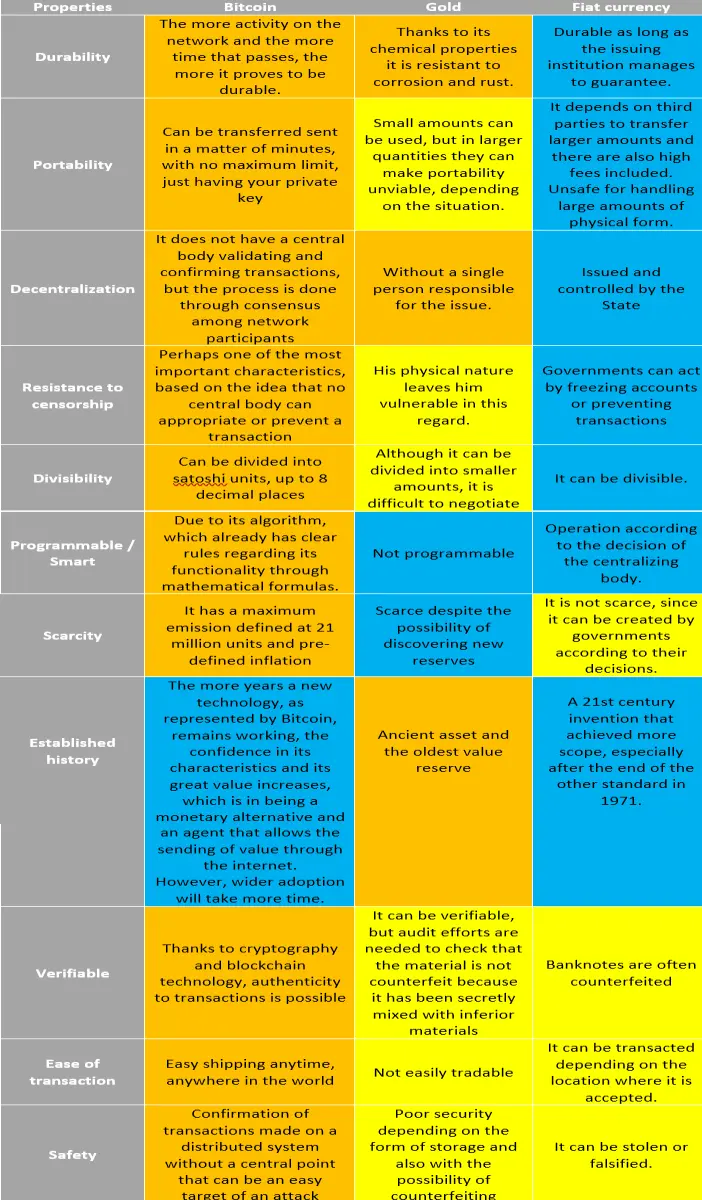
Below is a comparative table that will help you in your analysis of the characteristics of strong money

Paralleling the present, we will analyse the news involving the jewellery maker Kingold Jewerly, one of the largest in China.
The company in Wuhan, the city where the first cases of Covid-19 emerged, which is listed on the American NASDAQ exchange, is accused of practicing fraud involving the use of fake gold and causing billionaire losses.
For several years, the company used an alleged stockpile of 83 tonnes of gold, valued at 20.6 billion yuan (US $ 4.2 billion), as a security deposit to access loans, without leaving suspicions of irregularities.
The scam was discovered when a creditor decided to liquidate the gold given as warranty due to the non-payment of a loan.
The story was released after a Beijing website investigated the complaints and published the news on the headline: "The mystery $ 2 billion in loans secured by fake gold."
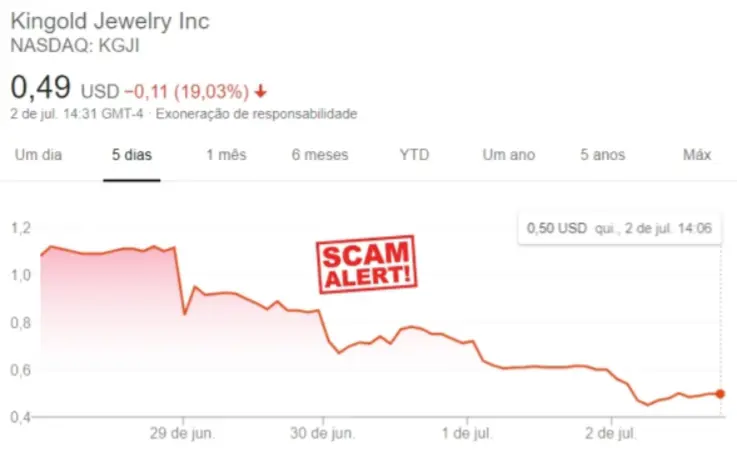
After a creditor had access to the material, it was found to be nothing more than gold-painted copper, which led other creditors to request an audit of the gold.
An investigation was initiated by the government and it was discovered that the company's total reserve, covered by the policy of the state insurance company PICC P&C, was falsified, which generated enormous damage. The company defended itself by saying that counterfeit gold from an older low-purity purchase.
And so there remains the doubt about the veracity of the proportion of the alleged other detainee from the company and about the need for constant auditing for the oldest reserve of value against this type of fraud.
This is not the first scandal of its kind: in 2016, the "gold" bars issued as collateral to 19 creditors in Shaanxi province were also tampered with, in which case the core of the bars consisted of tungsten.
The fear is that other Chinese producers and jewellers may also be involved in similar fraud.





