
Harvest Finance's decentralized financing protocol suffered a hacker attack in which approximately $25 million in crypto were stolen.
Twitter's defiprime profile reported at 7 pm on October 25, Sunday, that something strange was happening with the protocol.
"Something obscure is happening with Harvest Finance and there are huge obstacles between Harvest and Curve. It is a developing situation and needs to be monitored closely." by defiprime
An hour after the alert issued by the defiprime it was the turn of the jiecut profile to corroborate that an attack was taking place.
Due to the withdrawal of funds from Harvest Finance's liquidity pools, its stable security Token (fUSDT) was devalued by -13.7%, being quoted at US $0.8447 cents.

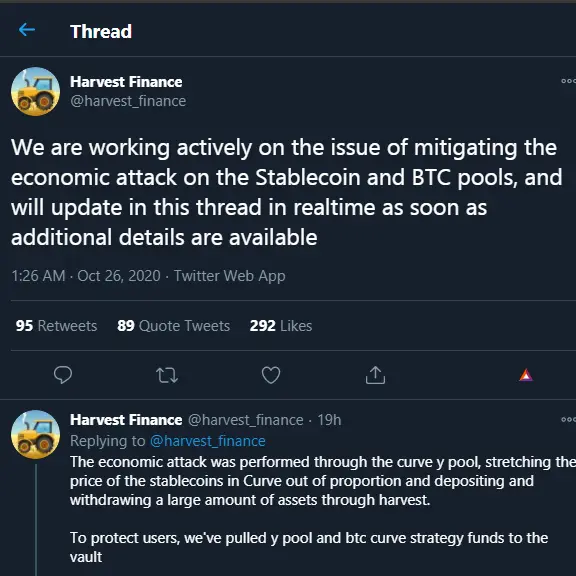
In the early hours of Monday, Harvest Finance itself published the confirmation of the attack on its Twitter account.
Then the project developers published several tweets explaining what happened and the measures that were being taken.
The fact is that attacks on DEX and decentralized finance protocols have been observed almost daily.
The method is practically the same. Hackers engage in an arbitrage attack, where they take out a large loan on the platform and use the amount to manipulate prices.
In the case of Harvest, the price of the fUSDT and fUSDC assets was manipulated, and the profit was converted into renBTC, one of the existing types of tokenized Bitcoin.
The attack took approximately 7 minutes, giving the Harvest Finance team no time to react against the attack.
After detecting the attack, the protocol blocked deposits in the BTC and stablecoin pools, and also withdrew all remaining funds from these liquidity pools to the cold-walled vaults.
As is also the case, the attackers themselves sent back approximately $ 2.48 million in USDT and USDC tokens back to the protocol.
According to the managers of Harvest Finance, these amounts will be used to reimburse the affected users.
Shortly after the attack, the volume of transactions on the Uniswap and Curve protocols increased considerably, and the hypothesis is that these protocols are being used to wash the stolen cryptography.






