
This is a term coined by Vitalik Buterin and refers to the trade-offs that projects must make when deciding how to optimize their blockchain architecture, to seek a balance. It is similar to the phrase "you cannot have everything".
THIS TRILEME INVOLVES THREE COMPONENTS: DECENTRALIZATION, SECURITY AND SCALABILITY.

When analyzing a blockchain, it is necessary to understand which aspects the project intends to optimize and which are aligned with its value and use proposal. In the case of Ethereum and Bitcoin, the priority is for security and decentralization.
Thus, when an attempt is made to increase scalability, one of the two will be put at risk.
FOR EXAMPLE:
to increase the scalability of the network, the block gas limit can be increased, which would also generate more security, as it would demand more in terms of hardware, because the higher the requirements for operating a node, the fewer participants there will be, however this means less decentralization.
To try to solve the issues related to scalability and other considerable limitations existing on the network today, keeping it sufficiently decentralized, a large set of updates, known as Ethereum 2.0, was proposed.
The network has already undergone several minor updates that have improved its usability and scalability, but Ethereum 2.0 will implement much larger changes, which, if successfully implemented, should considerably improve the performance of the network.

Due to the complexity of relaunching a new version of the network, Ethereum 2.0 will be phased out in the same way that Ethereum was first launched in 2015. The graph shows the development phases.
TECHNICALLY, SERENETY OR ETHEREUM 2.0 IS THE LAST PHASE OF ORIGINAL DEVELOPMENT.
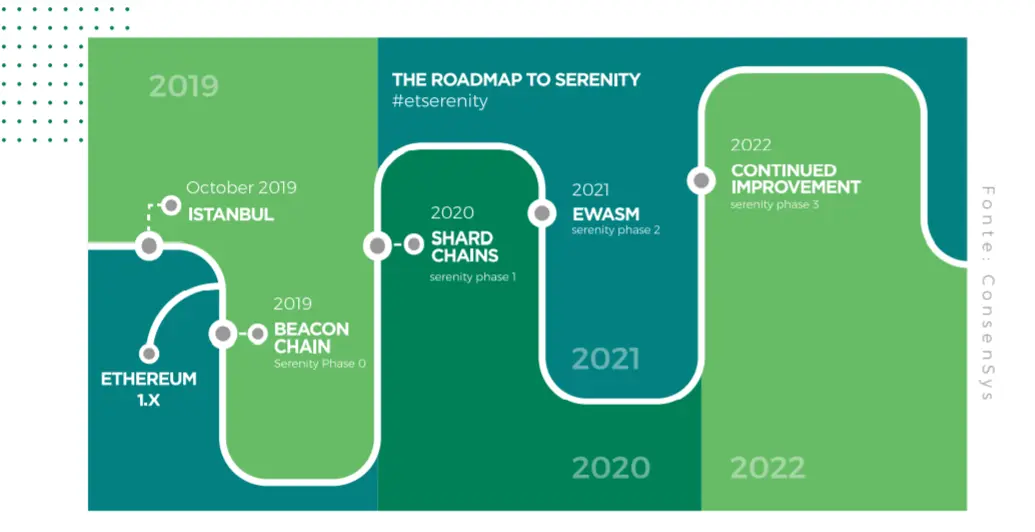

Among the changes is the change in the form of block validation, moving from POW to POS. Through the implementation called Casper, the network will start to use the algorithm of Proof of Stake consensus in place of Proof of Work for block validation, dividing the network into subsets of nodes by means of a method called sharding and out-of-chain sizing solutions, such as Plasma.
This form of validation is not done by those who have the most powerful, but based on who has more stake, that is, greater participation in tokens.
One of the reasons for this change is the excessive expense that POW validation requires for electricity.
PLASMA:
Among the alternatives being tested to try to improve scalability is Plasma, which proposes to be a platform of side chains that communicate with the main platform, easing the load of the main chain, which could process more transactions by second.
A smaller amount of data for the nodes to store is very important for scalability.

SHARDING:
Sharding also aims to improve the scalability of the Ethereum network. It results in the fragmentation of the network into 64 separate chains (called shard chains) that are parallel to each other and interact perfectly.
Each of these shards processes its own transactions and contracts, but can still communicate with the shard network.
If sharding is implemented successfully, it can bring scalability to blockchains without compromising its decentralization or security, contributing a lot to sustainable adoption by the general public.

In order not to stick to technical explanations, we can say that Ethereum has the potential to revolutionize the way we interact with the world. But to drive widespread adoption, it’s crucial to eliminate the challenges you’re facing and successfully implement updates. Therefore, the technical inefficiencies that have been mentioned need to be eradicated to create a perfect infrastructure. Otherwise, competing platforms will have a good chance of replacing it in the future.
The testnet, which is an almost identical copy of Ethereum's blockchain and capable of running large-scale tests of Ethereum 2.0, is working and the Proof of Stake is expected to be implemented on the mainnet later this year.
Enthusiasts and users are responsible for monitoring the implementations, as if successful they will allow Ethereum to scale and grow to accommodate DeFi, dApps and countless other use cases that will build the decentralized future.






