
Two assets, one target price, and two different answers to the question: “Why should I believe this is worth a dollar?” Here is how USDT and USDC differ in reserves, reporting, liquidity, and real-world use, and what those differences mean in practice.
Updated: September 7, 2026
Reviewed by: Rick Cramer, Head of Analytics at SimpleSwap
USDT (Tether) and USDC (Circle) are both designed to stay at $1. USDT is the largest and most heavily traded stablecoin. As of September 6, 2026, CoinGecko reported USDT’s market cap at about $183.4 billion, compared with $74.6 billion for USDC, and noted that USDT also had a much higher daily trading volume. That scale and liquidity help explain USDT’s market dominance, but they do not, on their own, make it more trusted. The key question is what backs each coin, how often reserves are disclosed, and how much confidence users place in the issuer’s reporting.
Their reserve and reporting models differ. Tether's disclosures are weighted toward U.S. government securities and related instruments, but they also include other assets and exposures such as Bitcoin, gold, and secured lending. Tether publishes quarterly reserve attestations, and in August 2026, KPMG U.S. completed a full independent audit of Tether International's 2025 financial statements and issued an unqualified opinion.
USDC is backed by highly liquid dollar-denominated assets, including bank deposits, short-dated U.S. Treasuries, and overnight U.S. Treasury repurchase agreements. Most reserves sit in the Circle Reserve Fund, a government money-market fund managed by BlackRock. Circle reports reserve holdings weekly and receives monthly third-party assurance from a Big Four accounting firm; Deloitte also audits Circle's corporate financial statements.
If you want the broadest trading coverage and deepest liquidity across global crypto markets, USDT usually has the edge. If you care more about a simpler reserve structure, more frequent reporting, or MiCA-compliant issuance in the EEA, USDC is stronger on those points. In the end, neither one is automatically “safer” than the other.
What is USDT?
USDT is a US-dollar stablecoin issued by Tether. Tether was founded in 2014 as Realcoin and was renamed Tether shortly thereafter.
Tether relocated its principal issuing entity to El Salvador in 2025 after obtaining local regulatory approvals.
USDT exists on several blockchains, including Ethereum, TRON, Solana, TON, and Avalanche. Tether treats USDT on supported networks as having the same value, but you still have to choose the right network when sending it: USDT on one blockchain cannot be sent to an address on another without a supported cross-chain mechanism.
What is USDC?
USDC is Circle’s U.S. dollar stablecoin, launched in 2018. It was first governed by the Center Consortium, which Circle and Coinbase created together. In 2023, Center was shut down as a standalone organization, and Circle took full control of USDC issuance and governance.
Since July 2024, Circle Internet Financial Europe SAS has served as a second issuer of USDC for the EEA, alongside Circle Internet Financial, LLC. Circle Internet Group, Inc., the group's parent company, began trading on the New York Stock Exchange under the ticker CRCL on June 5, 2025.
USDC is natively available on Ethereum, Solana, Base, Arbitrum, and many other networks. Circle's Cross-Chain Transfer Protocol (CCTP) lets native USDC move between supported blockchains by burning it on the source chain and minting an equivalent amount on the destination chain, eliminating the need for wrapped tokens or bridge liquidity pools.
USDT vs USDC: reserves and audits
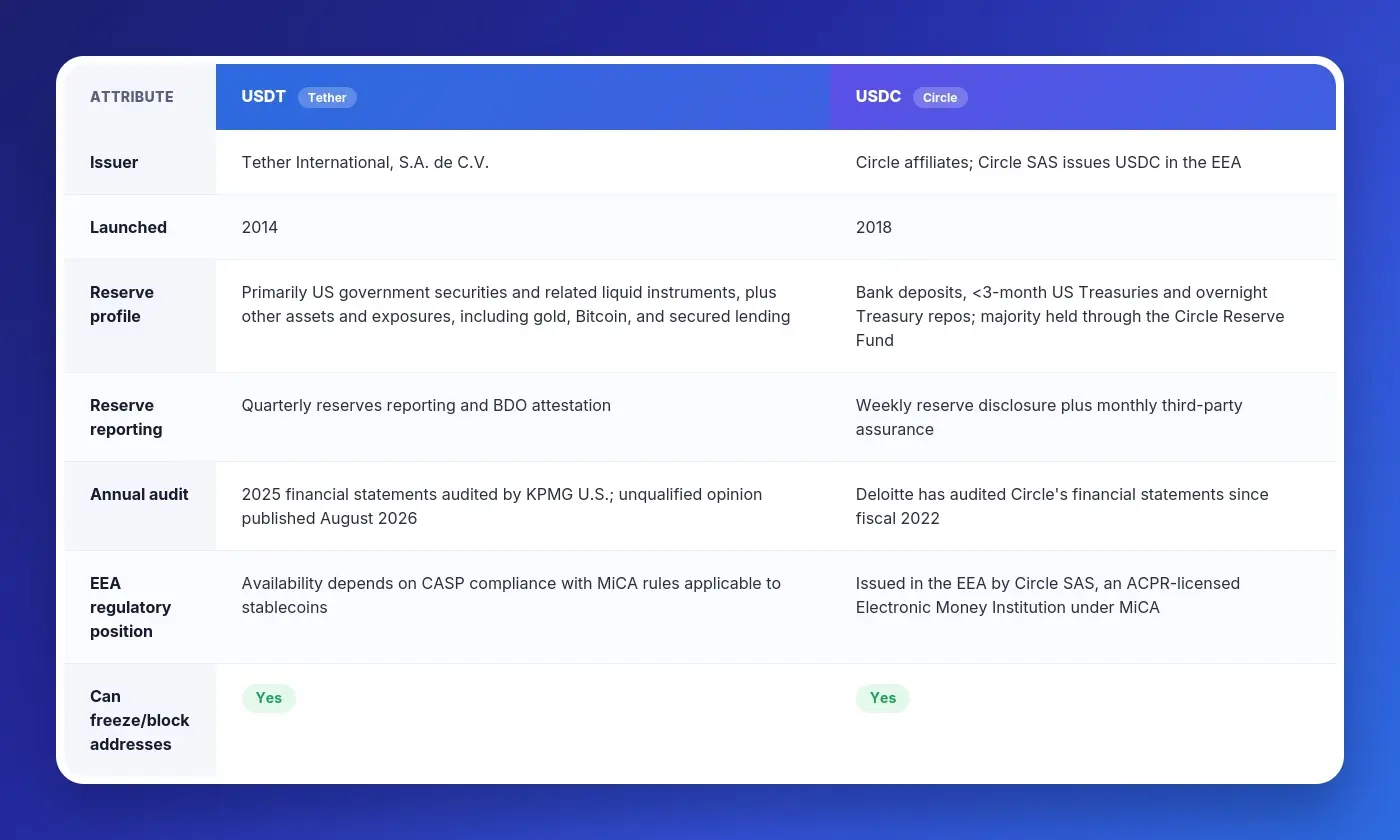
Two distinctions are important here.
A reserve attestation is not the same thing as an annual financial statement audit. Tether's quarterly BDO attestations and Circle's monthly USDC reserve assurances test specific reserve information. Separately, both companies now have audited corporate financial statements. The important update for 2026 is that Tether can no longer accurately be described as a company that has “never completed a full audit”: KPMG U.S. audited Tether International's financial statements for the year ended December 31, 2025, and issued an unqualified opinion in August 2026.
Reserve composition is still where the approaches differ most clearly. Circle concentrates USDC reserves in cash and highly liquid short-duration US government instruments. Tether's reserves are also heavily weighted toward government securities but include additional asset classes and credit exposures. Those additions can introduce market or credit risk that cash and short-term government securities do not carry to the same degree. Tether, in turn, points to its excess reserve buffer and broader balance sheet as sources of resilience.
The track record: what has actually gone wrong
Neither issuer has a spotless history, but their most visible historical failure modes have differed.
Tether's major historical issue was the accuracy of its backing and disclosure claims. In 2021, Tether and Bitfinex reached an $18.5 million settlement with the New York Attorney General after an investigation found false statements concerning Tether's backing. In the same year, the CFTC ordered Tether to pay $41 million for misleading claims that USDT was fully backed by US dollars; the CFTC found that sufficient fiat reserves were held for only 27.6% of days in a 26-month sample from 2016 to 2018.
Tether's disclosure regime has changed substantially since then. It now publishes regular reserve information and quarterly attestations, and in August 2026, it added a KPMG audit of its 2025 financial statements.
Circle's most visible stress event involved banking concentration. In March 2023, Circle disclosed that $3.3 billion of USDC reserves were held at Silicon Valley Bank after the bank failed. USDC temporarily traded as low as roughly $0.87. The peg recovered after US authorities announced that all SVB depositors would have access to their funds.
Circle's current reserve structure relies heavily on short-dated Treasuries, overnight Treasury repos and cash held at regulated financial institutions, with the majority of the reserve held through the BlackRock-managed Circle Reserve Fund.
The lesson is not that one issuer is trustworthy and the other is not. The point is that stablecoin risk can reside in different areas: reserve assets, banks, liquidity, regulatory exposure, operational controls, and the issuer itself.
USDT vs USDC: liquidity and where each is used
USDT leads in overall market liquidity. It has a much larger market capitalization and significantly higher global trading volume than USDC, and it is widely used as a quote and settlement asset across centralized crypto markets.
USDT on TRON is also widely used as a transfer rail. The network has become particularly important for dollar-denominated crypto transfers and has substantial adoption in emerging-market use cases. Actual transaction costs, however, depend on TRON resource availability and network conditions rather than being universally “cheap.”
USDC is deeply integrated into regulated fintech, institutional settlement, and DeFi infrastructure. It is natively available on Ethereum, Solana, Base, Arbitrum, and numerous other chains and is supported by Circle's cross-chain infrastructure. It is better to describe USDC as having deep liquidity and protocol integration on networks such as Solana rather than claiming that it universally “dominates” Solana DeFi.
In the EEA, USDC has a clear regulatory footing: Circle SAS is an ACPR-licensed Electronic Money Institution and issues USDC under MiCA. ESMA has also required CASPs to address services involving non-MiCA-compliant stablecoins by the end of Q1 2025, making issuer status increasingly important for EEA platforms.
SimpleSwap's H1 2026 data reflects the importance of USDT on TRON, but the metric needs to be stated precisely. USDT on TRON was the largest single net gainer in the report, up 6.0 percentage points when measured as the difference between its share of received volume and its share of sent volume. It was not identified as the largest asset in terms of absolute platform volume.
Trading vs holding: which stablecoin fits which job
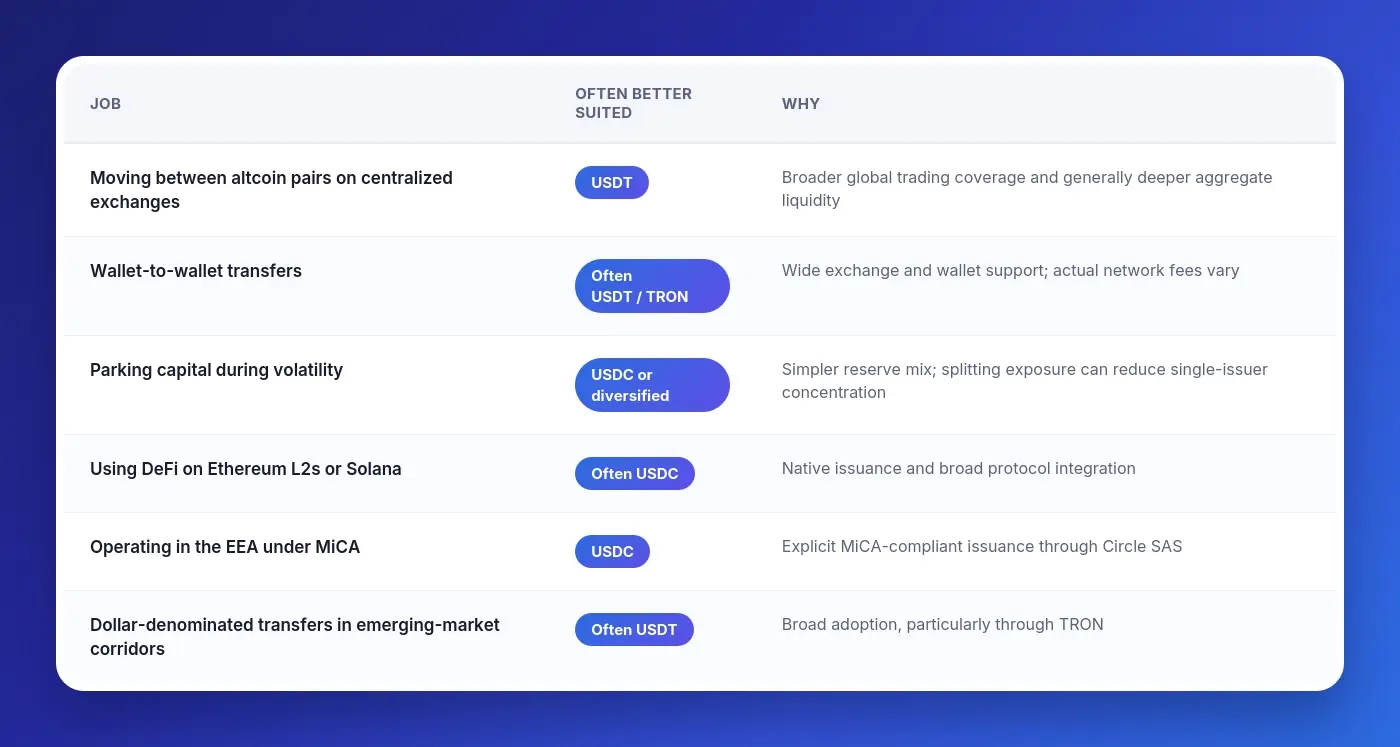
Holding both can reduce concentration in a single issuer, but it does not eliminate stablecoin risk. It simply distributes that exposure across two issuers and reserve structures.
Risks USDT and USDC share
Both issuers have the technical ability to block or freeze tokens at specific addresses. Circle's terms expressly permit address blocking in connection with illegal activity and valid government orders; Tether likewise freezes USDT in coordination with law enforcement and sanctions enforcement.
Both stablecoins can temporarily deviate from $1 during periods of market stress. Both depend on reserve management, redemption liquidity, and functioning banking and financial-market infrastructure. And both expose users to the ordinary operational risks of blockchain transactions: choosing the wrong network, entering the wrong address, interacting with phishing sites, or compromising wallet credentials.
A dollar stablecoin is designed to reduce exposure to the price volatility typical of cryptocurrencies such as BTC or ETH. It does not eliminate depeg risk, issuer risk, liquidity risk, regulatory risk, or user error.
How to swap USDT to USDC with SimpleSwap
SimpleSwap is a self-custodial multi-source swap aggregator that draws liquidity from more than 20 CEX and DEX providers.
To swap USDT to USDC, or the reverse:
-
Select the asset and network for each side, for example, USDT (TRC20) to USDC (Solana).
-
Choose a fixed or floating rate. A fixed rate is locked for 20 minutes; to keep that rate, the deposit must arrive and receive the required blockchain confirmation within the time window. A floating rate is calculated when the swap is processed and may change with the market.
-
Enter the receiving wallet address, and make sure the selected network matches the destination wallet's network.
-
Send USDT to the deposit address generated for the order.
-
After the deposit is confirmed and the exchange is processed, USDC is sent to the receiving wallet. The exchange can be tracked using its Exchange ID.
SimpleSwap uses an all-in exchange rate rather than adding a separate percentage trading fee on top. Pricing is dynamic and depends on the pair, liquidity, market conditions, network fees, and routing; for some assets, the cost may start from 0.2%. The receiving-side network fee is included in the amount shown, while the network fee charged by the user's wallet for sending the initial deposit is separate.
Most crypto-to-crypto exchanges can be started without signing up. However, “no KYC” applies only to transactions assessed as low risk. SimpleSwap may require mandatory KYC or additional information for any transaction when risk, AML, compliance, or other applicable triggers are met, and the transaction may be temporarily paused for review. No public percentage should be attached to how often this happens unless supporting data is available.
SimpleSwap does not maintain permanent customer crypto balances between swaps. Its only official website is simpleswap.io.
FAQ: USDT vs USDC
Is USDC safer than USDT?
There is no universal answer. USDC has a simpler reserve composition focused on cash and highly liquid US government instruments, more frequent reserve disclosure, and explicit MiCA-compliant issuance in the EEA. USDT has a longer operating history and substantially greater aggregate market liquidity. Tether also completed its first full independent financial-statement audit in August 2026. The relevant question is which risk matters most to you: issuer concentration, reserve composition, liquidity, jurisdiction, redemption access, or operational exposure.
Which stablecoin is more liquid, USDT or USDC?
Overall, USDT. As of September 2026, it has a substantially larger market capitalization and higher global trading volume. USDC can still have deeper or more convenient liquidity for particular protocols, networks, or regulated venues.
Are USDT and USDC audited?
The word “audited” needs qualification. Tether continues to publish quarterly reserve attestations from BDO, and it now also has a full KPMG U.S. audit of Tether International's 2025 financial statements, with an unqualified opinion. Circle publishes weekly reserve data and monthly third-party reserve assurances, while Deloitte has audited Circle's corporate financial statements since fiscal 2022. Reserve attestations and annual financial-statement audits are different forms of assurance.
Can USDT or USDC be frozen?
Yes. Both issuers have mechanisms that can block or freeze tokens at specific addresses, including in connection with sanctions, suspected illegal activity, or valid law-enforcement requests.
Can I swap USDT to USDC without an exchange account?
On SimpleSwap, most crypto-to-crypto swaps can be initiated without signing up. However, risk-based compliance checks still apply, and SimpleSwap may require KYC or supporting information where its monitoring or compliance procedures trigger additional review.
What happened to USDC in March 2023?
Circle disclosed that $3.3 billion of USDC reserves were held at the failed Silicon Valley Bank. USDC temporarily fell to roughly $0.87 before returning toward its $1 peg after US authorities announced measures protecting all SVB depositors.
Should I hold USDT or USDC long term?
There is no universally correct choice. USDC currently has a simpler reserve profile and reports reserves more frequently, while USDT has significantly greater aggregate liquidity and a longer operating history. Splitting exposure between them can reduce concentration risk in a single issuer, but it does not eliminate stablecoin, network, custody, or regulatory risk.
This article is for educational purposes only and is not financial or investment advice. Stablecoin reserves, reporting practices, regulatory status, network support, and exchange availability can change. Check the issuers' latest disclosures and the rules applicable in your jurisdiction before relying on them. SimpleSwap's only official domain is simpleswap.io.
Sources:






