
In his recent interview with the Financial Times, Mark Zuckerberg once again made some bold claims. The Meta CEO suggested that the company had reached the true technological frontier and that its AI was already ahead of every other model. But let's look beyond Zuckerberg's optimism and examine whether Meta's AI really lives up to these ambitious claims.
Let's start with the fact that Zuckerberg himself acknowledged in the interview that Meta's leadership is based on certain benchmarks, meaning its AI only has an advantage on specific tests. This makes his claims sound somewhat exaggerated. Analysts and critics have also taken notice, interpreting his comments as a sign that Meta simply selected the benchmarks that made its models look best.
On top of that, the rollout of the updated system was accompanied by bugs and technical issues, with users and developers reporting widespread problems with usage limits. And since its previous model, Muse Spark, lagged behind competitors - one of the reasons Meta's AI has faced heavy criticism in the media - investors and customers will need time to regain confidence in the company and put the new model to the test.
Another important factor is Meta's shift in business strategy. I want to point out a recurring pattern here: Zuckerberg has changed the direction of the entire ship more than once. For a long time, Meta positioned itself as one of the leading advocates of open-source AI through its Llama family of models. Today, however, its most advanced versions are becoming closed-source, with businesses being offered paid access instead.
One example is Meta's new Muse Wonder model, introduced on October 12-13, 2026. It already comes with a clearly defined pricing structure:
- Starting at $0.20 per million tokens for developers using the API.
- $200 per month for a premium subscription aimed at enterprise customers.
This marks Meta's first serious attempt to monetize AI directly as a SaaS platform rather than relying primarily on targeted advertising across its social networks.
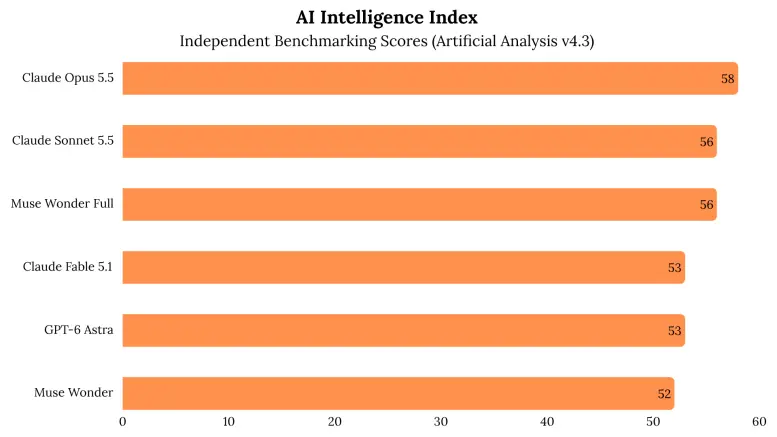
While Meta’s top-tier Muse Wonder Full matches Anthropic’s powerhouse Sonnet 5.5 at 56 points, it remains locked behind a premium $200/mo subscription. Meanwhile, the standalone Muse Wonder model lags behind Sonnet 5.5, despite costing twice as much per million tokens.
Considering this new strategy and the experience of competitors such as Anthropic and OpenAI, both of which have established themselves in the market, secured long-term contracts, and built recognizable brands, an important question arises: can subscriptions and API access generate enough revenue to justify the capital investment?
If we compare the AI market to Coca-Cola and Pepsi, OpenAI and Anthropic have already become recognizable brands. I apologize in advance if the comparison is a little awkward, but it was the first one that came to mind.
At the same time, I want to avoid an overly pessimistic or biased assessment of Meta's business. We should not overlook the company's biggest advantage: distribution. The Muse app remains one of the most popular apps in US app stores. This means Zuckerberg does not have to build an audience from scratch, as his ecosystem already reaches billions of people.
That is one reason Wall Street has responded positively to Meta's push into AI. Since the beginning of September, the company's shares have gained nearly 10%. This suggests that investors have confidence in Meta and its ability to scale its products.
The race between tech giants also reveals the different philosophies driving their strategies. While OpenAI and Anthropic are focusing on automating office work and developing agents for design, programming, and business analytics, Zuckerberg's vision revolves around personal superintelligence for everyday users.
And for a social media empire like Meta, which specializes in communication and content, this is a fairly logical choice. Just think about it: 3.64 billion people use Instagram, WhatsApp, and Facebook every day.
However, this raises a key question. If OpenAI and Anthropic are targeting businesses, where monetization is relatively straightforward, how exactly will Zuckerberg turn personal superintelligence into a profitable business? For now, this remains one of Meta's biggest financial challenges.
Nevertheless, Zuckerberg has made it clear that the company has no intention of slowing down. The next model is already in active development, and according to him, the pace of development will only accelerate. Meta's projected capital expenditure on AI infrastructure has already risen to $135-145 billion, while the company plans to raise an additional $95 billion through the issuance of a new class of shares to finance this race.
Clearly, cost-cutting is unlikely to be a priority in the near future. Zuckerberg is making one of the biggest bets in Meta's history. At the same time, rapidly rising expenses are already putting pressure on the company's operating margins.
Will Meta's strategy of bringing personal AI to the masses deliver the expected returns and compete with the enterprise-focused tools offered by its rivals? Only time will tell.
Thank you for taking the time to read. Have a great day!






