
What is tokenization?
if you're wondering what the heck is tokenization, don't worry, we're here to unravel that mystery together with you. So, get your magic wands (or cell phones) ready and embark on this journey with us to understand how tokenization can help protect your data and online transactions in a practical and safe way!
Let's start with an analogy: Imagine you have a magic wand (or credit card hehe) that can turn your dreams into reality, allowing you to buy everything you've ever wanted. Now, imagine that this magic wand is very valuable and can be easily stolen or copied. Bad, right? That's where tokenization comes in! It is like a magical ward that transforms the information from your magic wand into a secret code known as a token. This token is like a disguised copy of your magic wand that can be used to shop online, for example. But if the token is stolen or copied, it doesn't have the same value as the original magic wand as it doesn't contain the sensitive information from it.
In more technical terms, Tokenization is a security technique used to protect sensitive payment information, such as credit card numbers, during online transactions or storage in databases. It consists of replacing this sensitive data with a secret code, called a token, which does not contain the original information.
Cryptocurrency Tokenization
Cryptocurrency tokenization is a process that consists of transforming real or virtual assets into digital tokens that can be traded on the blockchain. Tokens are created through smart contracts, which establish trading and governance rules. For example, imagine that a company that issues stock decides to become a tokenized company. In that case, she could create a token representing each issued share, allowing those shares to be traded directly on the blockchain. The tokens could be traded on a cryptocurrency exchange, similar to shares traded on stock exchanges.
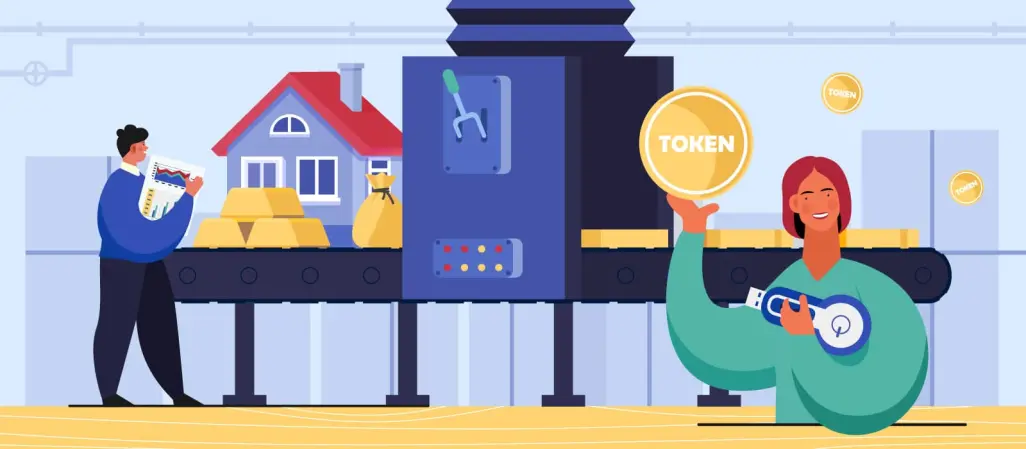
In addition to stocks, other types of assets can be tokenized, such as real estate, artwork, fiat currencies, and even other tokens. Tokenization makes these assets more accessible and tradable, as they can be bought and sold with ease, without the barriers of entry and time and cost constraints associated with traditional transactions.
Tokenization in cryptocurrencies also offers advantages in terms of transparency and security, since all transactions are recorded on the blockchain, which is a distributed and decentralized network. This makes it more difficult to defraud or corrupt transactions, as the information is immutably recorded. In addition, smart contracts allow for token trading and governance rules to be programmed in advance, which helps ensure the integrity and transparency of transactions. For example, contracts can specify trading conditions, transaction fees, governance rules and other information relevant to investors.
What is the technical tokenization process like?
The cryptocurrency tokenization process involves two main parties: the token issuer and the investor. The token issuer is responsible for creating and managing the token, while the investor is responsible for buying and trading the token on the blockchain.
To better understand how the tokenization process works, let's assume that a company that issues shares has decided to become a tokenized company. The first step is to create a smart contract that establishes the token's trading and governance rules. The smart contract must contain information such as the number of tokens issued, the price of each token, trading conditions, transaction fees, governance rules and other information relevant to investors. The contract is then published on the blockchain, where it can be accessed by anyone who wants to buy or trade the token.
Once the contract has been published on the blockchain, the company issues the tokens and distributes them to investors who bought the token. Investors can buy the tokens directly from the company or on a cryptocurrency exchange, where they are listed and traded like any other cryptocurrency. When an investor buys a token, he receives a private key that gives him the right to own and trade the token on the blockchain. The private key must be stored securely as it is required to access and transfer the tokens.
The tokens are then traded on the blockchain through transactions, which are recorded and verified through a process known as mining. Each transaction is validated by a network of computers that work together to verify the authenticity of the transaction. By trading tokens on the blockchain, investors can easily buy and sell their tokens without the barriers of entry and time and cost limitations associated with traditional transactions. Tokenization of cryptocurrencies makes investing in assets more accessible and tradable, as well as offering advantages in terms of transparency and security.
Token types
There are different types of cryptocurrency tokens, which are classified according to the asset they represent and their specific characteristics. Here are some examples:
Utility Tokens: These tokens are used to access services or resources on a platform or network. They are generally not considered securities, but rather a kind of "internal currency" that can be used to pay transaction fees, operating expenses or other services. Examples of utility tokens include Brave Browser's BAT and Decentraland's MANA.
Security tokens: Also known as investment tokens, these tokens represent a stake in an asset or company and are considered securities. They are usually issued during an initial coin offering (ICO) or security token offering (STO), and provide investors with access to ownership rights, profits, and other benefits. Examples of security tokens include Overstock.com's tZERO and Spice VC.
Payment Tokens: These tokens are designed to be used as a medium of exchange, similar to cash. They can be used to pay for goods and services on a specific network, or as a form of payment to transfer value from one person to another. Examples of payment tokens include Bitcoin, Litecoin and Ripple's XRP.
Commodity Tokens: These tokens are used to represent real assets such as gold, silver or oil. They allow investors to buy and sell these assets on a global market, without the need to physically own the asset. Examples of commodity tokens include DigixDAO's DGX and OilCoin's OIL.
Governance Tokens: These tokens are used to vote on important decisions on the network or platform. They allow token holders to actively participate in the governance process and influence the decisions made by the network. Examples of governance tokens include MakerDAO's MKR and Augur's REP.
These are just a few examples of categories of tokens in cryptocurrencies, but there are many other types of tokens with different functions and features. Each token type has its own characteristics and purposes, and it is important to understand the differences between them before investing in any specific project or token.
Advantages of investing in tokenized assets
Diversification: Asset tokenization offers more opportunities to diversify investments. Both traditional assets, such as stocks, commodities and bonds, and innovative categories, such as athlete rights and intellectual property, can be tokenized and made available to more people and companies.
Accessibility: Tokenization facilitates access by small investors to high-performance assets, which until then were only available to large investors and companies. The wide variety of alternative products, with a lower initial cost and an uncomplicated process, contributes to the democratization of investments.
More liquidity: By being tokenized, assets that were previously restricted to a small group of institutions are now traded more easily and quickly by a larger number of people and at any time of the day, as the crypto market is uninterrupted, unlike the traditional banking hours. In this way, investors and issuers now have more liquidity.
Practicality and security: The crypto market reduces bureaucracy, while reinforcing the security of investments. It is possible to trade and transfer funds 24/7 around the world, without depending on the intervention of a central agent. Everything is done in a decentralized, automated and secure way through Blockchain.
You now have a solid understanding of what tokenization is, how it works in cryptocurrencies, and the types of tokens that exist. Additionally, you learned about the advantages of investing in tokenized assets, such as transparency, decentralization, and global market access.
If you're still feeling a bit intimidated by the world of cryptocurrencies, don't worry! Just like learning to ride a bicycle, the important thing is to start slowly, learn the basic techniques, and then gradually build up speed.





