
The Week That Changed Digital Money Forever
Here's something that should make every stablecoin holder stop and think.
In the span of five days, the banking system quietly built the infrastructure to compete with stablecoins. And it did it without a single crypto native in the room.
On September 22, six major Canadian banks announced they were exploring Canadian dollar-based tokenized deposits.
On September 24, The Clearing House, the oldest banking association and payments company in the United States, selected Quant to power its On-Chain Money Initiative, a new interoperable payments network for tokenized deposit transactions.
That same day, seven UK banks completed the world's first live interbank transactions using tokenized sterling deposits. Barclays, Lloyds, and NatWest executed two mortgage transactions. HSBC and two others tested a simulated marketplace purchase.
On September 26, the CFTC updated its guidance to allow registered derivatives brokers to hold tokenized money market funds as customer funds.
The crypto market noticed. Quant (QNT) surged 185% in a week. Ethena (ENA) jumped 49%.
But most people are still watching stablecoin regulation and missing the bigger story. Banks aren't trying to join the crypto ecosystem. They're building their own version of it, on their own terms, with their own rules.
What Are Tokenized Deposits? (And Why Banks Love Them)
Let's start with the basics, because the terminology matters.
A tokenized deposit is an ordinary bank deposit recorded on a blockchain or shared digital ledger. That's it. You deposit $1,000 at your bank. The bank records that deposit on a distributed ledger instead of a traditional database. You still have $1,000. The bank still owes you $1,000. The FDIC still insures it. Nothing changes except the record-keeping.
But that one change, moving the ledger to a shared, programmable infrastructure, unlocks everything.
Tokenized deposits can be programmed. They can be locked in a buyer's account and released automatically once conditions are met. They can move between banks instantly, settling in seconds instead of days. They can connect to existing payment systems like RTP and CHIPS, as The Clearing House plans to do.
The Singleness of Money Problem
There's a concept in monetary economics called "singleness of money." It means all forms of money should be interchangeable at par. A dollar in your checking account should be worth the same as a dollar in someone else's checking account at a different bank.
Stablecoins struggle with this. A USDC from Circle and a USDT from Tether are both supposed to be worth $1, but they're issued by different companies with different reserves, different audit standards, and different redemption mechanisms. They're not the same thing.
Tokenized deposits don't have this problem. A tokenized dollar from Barclays and a tokenized dollar from Lloyds are both claims on regulated banks, both backed by the same deposit insurance schemes, both subject to the same regulatory oversight. They're genuinely interchangeable.
This is why banks are choosing tokenized deposits over stablecoins. It preserves the monetary system's foundations while capturing the efficiency benefits of blockchain technology.
Programmability and Conditional Payments
The most compelling feature of tokenized deposits isn't speed or cost. It's programmability.
Imagine a real estate transaction. The buyer deposits funds into an escrow account. The funds are tokenized. The smart contract holds them. When the title transfer is confirmed, the funds release automatically. No escrow agent. No wire transfer delays. No manual verification.
This isn't theoretical. The UK banks that completed tokenized deposit trials did exactly this. As UK Finance described it, the programmable tokenized deposits enabled money to be "locked" in the buyer's account and released only once all conditions were met.
Now consider what this means for corporate treasury, supply chain finance, and cross-border payments. Any transaction with conditional logic becomes programmable.
Tokenized Deposits vs. Stablecoins - The Real Difference
Here's the comparison that matters.
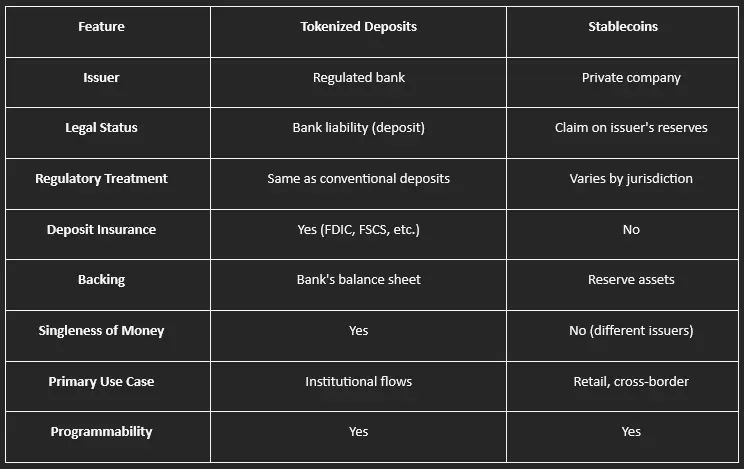
The key insight: tokenized deposits and stablecoins aren't substitutes. They're different instruments serving different purposes.
Analysts at the Institute of International Finance argue that "views of tokenized deposits as exact substitutes for stablecoins are likely mistaken." Their view, echoed by the Bank for International Settlements, is that both will develop alongside each other.
Stablecoins will serve retail users, cross-border remittances, and DeFi composability. Tokenized deposits will serve institutional flows, interbank settlement, and regulated financial infrastructure.
The question isn't which one wins. It's which one dominates which use case.
The Players Building This Infrastructure
Quant's Interoperability Layer
The biggest winner from this week's news was Quant Network.
Quant provides the interoperability layer that enables tokenized deposits issued by one bank to move freely across the banking system. The Clearing House selected Quant to power its On-Chain Money Initiative, which will connect banks of all sizes to clear and settle tokenized deposit transactions.
Quant's technology connects to existing payment systems including RTP and CHIPS. The network is expected to become available to participating banks in the first half of 2027.
The market's response was immediate. QNT surged 185% over the week. Active addresses spiked to 2,064 on September 24, the highest level in nearly a year.
Quant had already been working on a similar project with UK banks. The US selection validated its technology for the world's largest banking market.
The UK's "Great British Tokenised Deposit" Project
The UK isn't waiting for the US.
The "Great British Tokenised Deposit" project, run by UK Finance, completed the world's first live interbank transactions using tokenized sterling deposits on September 24.
Seven banks participated: Barclays, HSBC UK, Lloyds Banking Group, Monzo, Nationwide, NatWest, and Santander. The transactions included two mortgage remortgages and a person-to-person payment simulating an online marketplace purchase.
The banks involved plan to issue three digital bonds in the first quarter of 2027 that can be traded and settled with tokenized deposits. This isn't a pilot that disappears into a research paper. It's a live infrastructure project with a clear timeline.
Canada's Big Six Join the Fray
Six major Canadian banks announced their own tokenized deposit initiative on September 22. The plan is to develop Canadian dollar-based digital money solutions, starting with tokenized deposits, to deliver faster, more efficient, and programmable payments.
The Canadian banks cited the same motivations: efficiency, programmability, and regulatory compliance. They see tokenized deposits as a way to modernize payments without disrupting the existing banking system.
The Regulatory Green Light
The CFTC's September 26 guidance was less dramatic than the Quant news but equally important.
The agency updated its FAQs to clarify that registered derivatives brokers can hold tokenized money market fund shares and other compliant customer fund investments as if they were traditional assets. CFTC staff also said they don't object to using blockchain or distributed ledger technology to maintain records required under federal law.
This matters because it legitimizes tokenized assets in a regulated financial context. If a futures broker can hold tokenized money market funds as customer funds, those funds become part of the regulated financial system.
The SEC issued its own clarification the same day. The Division of Corporation Finance updated its crypto FAQs to state that token buybacks and network upgrades on functioning crypto networks don't automatically make tokens securities.
Together, these two updates signal that regulators are comfortable with tokenization as long as it fits within existing frameworks.
What This Means for Crypto
The tokenized deposit story has direct implications for crypto investors.
Quant (QNT) is the obvious beneficiary. If The Clearing House's On-Chain Money Initiative succeeds, Quant becomes the interoperability layer for the US banking system's digital money infrastructure. That's a massive addressable market.
Ethena (ENA) benefits from a different angle. The protocol expanded its USDe backing strategy into tokenized US equities on Binance, using bStocks as spot collateral and hedging with equity perpetual futures. This opens a much larger market for Ethena's basis trade, which was previously limited to crypto perpetuals.
The broader implication is that crypto infrastructure is becoming institutional infrastructure. The same blockchain technology that powers DeFi protocols is now powering interbank settlement. The same tokenization concepts that enable RWA markets are now enabling tokenized deposits.
What This Means for You
So where does this leave you?
First, understand that tokenized deposits and stablecoins aren't competing for the same users. If you're a retail user, stablecoins remain your best option. If you're an institution, tokenized deposits are the compliant path.
Second, recognize that the infrastructure being built now will matter more than the tokens that surged on the news. Quant's 185% weekly gain is impressive, but the real value is the network being built for 2027.
Third, think about timing. The Clearing House network launches in 2027. The UK digital bond issuance is Q1 2027. The infrastructure is being built now, but the payoff is still ahead.
Fourth, don't dismiss stablecoins. They're not going away. They're finding their own place in the ecosystem, serving retail users and cross-border payments while tokenized deposits serve institutional flows.
The Bottom Line
The banking system just built its own digital money infrastructure.
The Clearing House selected Quant. UK banks completed live tokenized deposit transactions. Canadian banks announced their own initiative. The CFTC greenlit tokenized funds.
Quant surged 185%. Ethena jumped 49%.
This isn't crypto infiltrating banks. It's banks becoming crypto, on their own terms, with their own rules and their own infrastructure.
The stablecoin era isn't over. But the tokenized deposit era has begun. And the banks are running it.
The question isn't whether this shift is real. It is. The question is whether you're paying attention to the infrastructure being built, or just the tokens that surged on the news.
FAQ’s:
Q: What are tokenized deposits?
Tokenized deposits are ordinary bank deposits recorded on a blockchain or shared digital ledger, retaining the same legal and regulatory protections as conventional deposits while enabling programmability and faster settlement.
Q: How do tokenized deposits differ from stablecoins?
Stablecoins are issued by private companies and backed by reserves; tokenized deposits are bank liabilities recorded on a distributed ledger. The key difference is who owes you the money: a stablecoin issuer or a regulated bank.
Q: What is The Clearing House On-Chain Money Initiative?
A new interoperable payments network announced September 24, 2026, enabling financial institutions to clear and settle tokenized deposit transactions. Quant was selected to power the network.
Q: What did UK banks achieve with tokenized deposits?
Seven UK banks completed the world's first live interbank transactions using tokenized sterling deposits on September 24, 2026, including two mortgage transactions and a simulated marketplace purchase.
Q: Why did Quant (QNT) surge 185%?
The Clearing House selected Quant to power its On-Chain Money Initiative for US banks, and UK banks completed tokenized deposit trials involving Quant's technology.
Q: What is the CFTC's guidance on tokenized assets?
The CFTC updated its FAQs to allow registered derivatives brokers to hold tokenized money market fund shares as customer funds, recognizing blockchain records for compliance purposes.
Q: What did the SEC clarify about token buybacks?
SEC staff said token buybacks and network upgrades on functioning crypto networks don't automatically make tokens securities, providing clarity for token projects.
Q: What are Canadian banks doing with tokenized deposits?
Six major Canadian banks announced on September 22, 2026, they're exploring Canadian dollar-based tokenized deposits for faster, programmable payments.
Q: What is Ethena's expansion into tokenized stocks?
Ethena partnered with Binance to use bStocks (tokenized US equities) as spot collateral for USDe, hedging exposure with equity perpetual futures.
Q: What is the "Great British Tokenised Deposit" project?
A UK Finance initiative involving Barclays, HSBC, Lloyds, Monzo, Nationwide, NatWest, and Santander to pilot tokenized sterling deposits.
Q: What is Quant Network's role in tokenized deposits?
Quant provides the interoperability layer enabling tokenized deposits issued by one bank to move freely across the banking system.
Q: When will The Clearing House network launch?
The network is expected to become available to participating banks in the first half of 2027.
Key Takeaways:
- The Clearing House selected Quant to power its On-Chain Money Initiative for tokenized deposit settlement.
- Seven UK banks completed the world's first live interbank tokenized deposit transactions on September 24.
- Six Canadian banks announced their own tokenized deposit initiative on September 22.
- The CFTC greenlit tokenized money market funds as eligible customer funds on September 26.
- Quant (QNT) surged 185% in a week on the news.
- Ethena (ENA) jumped 49% after expanding USDe backing into tokenized stocks.
- Tokenized deposits are bank liabilities; stablecoins are private-issued tokens. The difference matters for regulation and deposit insurance.
- Both instruments will coexist, with tokenized deposits serving institutional flows and stablecoins serving retail and cross-border use cases.
- The infrastructure is being built now, with launches expected in 2027.
- Banks aren't joining crypto, they're building their own version of it on their own terms.





