
It is world suicide prevention week. And one of the major risk factors for suicide is depression. There I decided that as my first post on the platform I will share my article on depression.

The biological underpinnings of depression
Sketched by me| Originally shared in my facebook
"Hey you have a fever, why don't you just lower your temperature and hang out with us!"
Now, that is not something you tell a person who has a fever. But doesn't it sound familiar? Something you were told if you ever suffered clinical depression or something you told someone who had clinical depression?
I mean the utter disregard for the fact that depression is a disease that arises from the body's physiology, is ridiculously huge. I mean think about it, thoughts and feelings don't arise in thin air. They have certain physiology associated with it. Everything that happens around you affects your muscle tension, your heart rate, your hormones, and your neuronal firing. The sum of it makes up the feelings or emotions
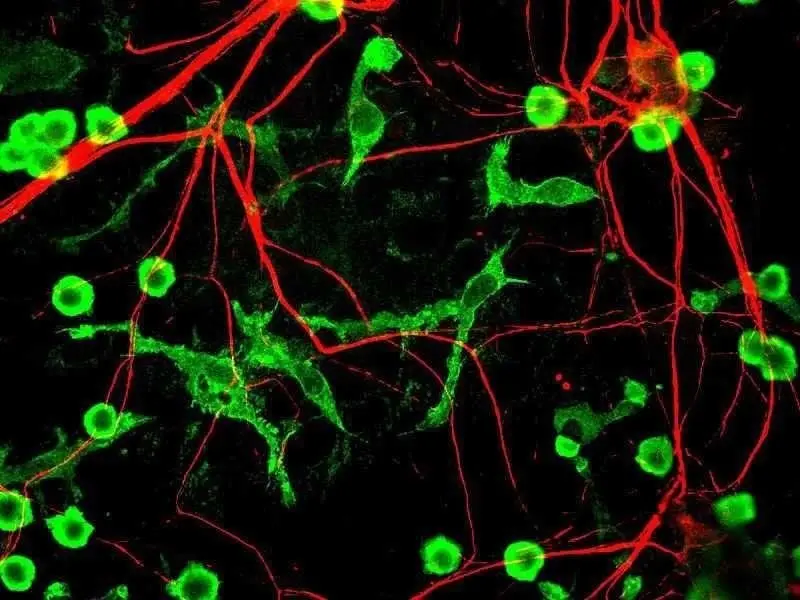
Microglia(green) cells, the immune cells in brain
Source
Author - GerryShaw
CC BY-SA 3.0
The pathology of depression
Sadness, grief and depression are inherently different in their details, nonetheless, they all have underlying physiology associated with them. (Be it the physiology of your brain, body or just hormones going nuts). The physiology of depression is nonetheless pathological and its pathogenesis is the motive of this post.
If you were to peek inside the brain of a person suffering from depression, the more you zoom in the more differences you will find in comparison to a healthy person. For instance, even if you were to take a rodent model for depression used in the lab, you will see that their depression-like behaviour is associated with changes in dendritic spines. (For those who don't know dendritic spines are an extension of membranes on neurons that receive a signal from a previous neuron at the synapse). So depressed animals have more dendritic spines in the amygdala (the fear centre) and nucleus acumens (this part of your brain is famous for anticipating rewards). However, they have decreased density and altered morphology in the hippocampus (the learning and memory centre) (Qiao et al., 2016). Even humans suffering from depression show reduced hippocampal volume.
Pathogenesis of depression
Then not only do you have altered brain physiology associated with depression, but the pathogenesis of depression itself has your immune system contributing to it. For instance, the set of stress response pathways in the body, that regulate the fight or flight response during those rough life situations, also seems to activate the innate immune system in the body. You can find the NfKb signalling activated and these immune cells secreting inflammatory cytokines in response to stress. It is not clear why your body has to start fighting pathogens in response to psychological stress but there are a few hypotheses out there if you want to read (see Miller and Raison, 2016). I think it might just be an ancient evolutionary adaptation. Unlike most humans who get stressed just by thinking about the price of Steem falling, animals get stressed when they are being chased by predators, or by social defeat from a more dominant competitor. I think it would make sense to turn on the immune system after that fight for life. I mean what if you survived but that wolf left an infection in your body with that bite?
Take the example of people undergoing treatment for chronic hepatitis infection. They receive an inflammatory cytokine, interferon-alpha for treatment. Now, the interferon is generally known for killing the virus-infected cells. But other than that it is also famous for clinically induced depression. Browsing et al, published this year, where they did in vitro experiments to show the mechanism behind this. They claimed that this effect is mediated by Interferon-alpha stopping neurogenesis in the hippocampus and by killing existing cells as well.
Since this was an in-vitro study(that is it was done on cultured cells and not mice), I would have just ignored it. But then last month Nie et al., published in Neuron and made the chronic inflammation and depression link more convincing. They show that repeated social defeat stress activates Toll-like receptors(TLR) in the microglia of the prefrontal cortex in mice. The microglia then showed increased expression of inflammatory cytokinesis such as TNF-alpha. And if you made a genetically modified mouse without TLR, the mice did not develop depression-like symptoms. (If you are lost then the prefrontal cortex is part of the brain that mostly controls social interaction. Microglia have the brain's immune compartment consisting of resident macrophages. TLR are receptors on macrophages that usually bind to bacterial patterns such as lipopolysaccharide.)
Now if you know a bit of a history of depression and inflammation you may ask then what about lymphopenia(decrease in the number of lymphocytes), that is associated with depression in humans? On one hand, you have a weak immune system with fewer lymphocytes and on another hand, I am telling you that chronic inflammation in the brain is the cause of your depression. Well along with Nie et al., there was yet another interesting paper published last month by Laumet et al., The paper highlighted that T lymphocytes are rather important in the resolution of this inflammation. They show that Rag1 null mice, which lack an adaptive immune system and hence T lymphocytes have worse depression-like symptoms.
The non-psychological pathogenesis of depression?
Finally, in another blog of mine about Type 2 diabetes, I highlighted the role of obesity and the gut microbiome in causing low-grade inflammation in the body. I even talked about TLR signalling by bacterial LPS and free fatty acids causing inflammation in the hypothalamus, which can cause compulsive eating. Now gut microbiome has been linked to causing depression and anxiety, as well (See Evrensel and Ceylan, 2015). This makes me wonder if depression always has psychological stress at its basis or if sometimes it could be triggered by other physiological conditions. What about autoimmune disorders? What about people with the HLA B27 variant who suffer from ankylosing spondylitis? How much of their depression is contributed by rouge immune cells secreting TNFalpha? I will post another blog discussing closer links between depression and inflmmation in the body to highlight these points.
So next time you are depressed, and someone tells you why can't you just be happy, do show them the research articles mentioned here. In case they still act thick ask them why can't they just be intelligent.
References
Disclaimer: This is a repost of my blog originally shared on PeakD (Link: https://peakd.com/steemstem/@scienceblocks/this-is-what-depression-is-made-of-the-biological-underpinnings-of-depressiom-ae2bc65b32b23)







