
By summer we’d reached flatlands, once the farmlands of America. Now they were grasslands dotted with woods and lakes and crisscrossed with streams. In some places we came upon forests of young trees. The rainfall of the last decade, along with the exodus of man, was changing the face of the land. In our scouting we came across several herds of buffalo and one of wild horses. There were also large packs of wolves. We never saw them but heard the howling at night.
Finally my scouts reported that there was a large city ahead. Its towers were visible from a great distance. From our calculations the engineer guessed that it was the old city of Saint Paul, the most western of the old, central confederacy. I picked out eight riders and we set off across the prairie, straight towards it. We rode all afternoon and by dusk we reached the outskirts. For many miles before the city we must have crossed over what had once been suburbs but devastated by innumerable fires.
The ground was littered with rubble, overgrown with brush and grass, except here and there where the hulk of a car or a brick wall still rose a few feet above the leveled waste. We could hardly make out the old streets. In places where the grass was thin we could see that the ground was blackened and strewn with the burnt remains of toys and tires and broken plates, a sight all the more ghastly in the fading twilight.
Though we were tired, we elected to go into the city that night. Our highway crews were heading straight towards it and we had to determine quickly if it was populated. This was a dangerous mission at any hour, but we hoped it would be safer at night, when we might escape any ambush in the darkness. We rode up to the blocks where the streets were more clear, and where buildings were standing, though most of them were gutted. The streets seemed ghostly and were marred with torched vehicles. We saw no lights and heard only the sound of the all-too-loud echo of our horse’s footfalls.
Either the place was deserted or its inhabitants too few or too timid to confront us. After an hour of this nervous prowling we turned around and galloped back out of the city and the suburbs, away from the ruin to camp on a grassy knoll, posting watches for safety.
The next day we decided that we’d have to enter the city again to bring back precise information. We again toured through the streets of tall skyscrapers, gun in hand, and found, in one large plaza, what looked like a newly built and then demolished temple complex. We dismounted and went in pairs through it and some of the taller structures around.
The temple had been burned, except for the brick walls. But in many of the buildings some levels, especially the basements, had been spared from fire. In these places we found human skeletons behind rude barricades of furniture. They seemed to have died violently. Doors and windows were smashed, and every room pillaged for valuables.
I could only guess that the city had suffered some catastrophic fire in the first year of the revolution, and that afterwards chaos reigned. Of the people who escaped the fire, gang warfare or in-fighting must have finished them off. We found no signs of recent habitation.
We set off again to rejoin our crew. We decided in a meeting that there was no danger to the place, but that the sight of it was so gloomy we should avoid it anyways. It was hard to imagine the number of people and the years it would take to clean up those ruins. We directed our highway to the south, and from a distance of some twenty miles, our closest approach, the towers sparkled brightly in the daylight. They reminded me of some lone dinosaur, a thing from another era, impervious to time in its skeleton.
On one hill still in view of these towers and beside a wide river we built an especially large fortress. There was a narrow bridge nearby which needed some repair. On the other side we found a campsite which looked like it had been used within the last year. From now on I kept most of my soldiers in readiness for battle, surrounding our crews as we pushed ahead as fast as we could, towards the crews of the East.
My soldiers were growing nervous in this strange land, months away from their distant home. There were many more abandoned towns in our way and silos and barns and old farm machinery all along the road we were repairing. But we were heartened one morning by the sudden reappearance of our youthful commissioner, wearing a fine white cloak and helmet, and accompanied by a bodyguard of forty horsemen. The chief engineer and I were as surprised as anyone by this strange sight.
He leapt off his horse right between us and announced in a loud voice that we were going to war. We retired to a nearby tree to hear the news. He produced a strange map, sketched on a leather skin with white chalk, which indicated that we weren’t far away from the eastern crews. He told us that as soon as we joined up, our orders were to go to war with rebels to the north. The road workers were to be trained and formed into one great army that would reconquer the region for the Church and rid the world of its last outlaws. We would then proceed to the Capitol, and after a glorious parade receive the commendations and gratitude of the Church Fathers themselves.
All this sounded very neat and pleasant, until I asked about the strength of the enemy we faced. Of this he had no idea. The eastern crew had met with a fight in only one city. But they’d detoured all the others in their rush to join up with us, so that a bigger campaign could be mounted against the unknown foe.
Our commissioner showed us a charter that nominated him the "Grand Marshall of the Western Army". He assigned me the rank of general and also our engineer. His men were to receive weapons and several hours of training each day, to start immediately. We looked back at him in mute astonishment, not altogether easy with such titles and prospects.
Our leader was younger than either of us by at least five years. He was tall and slender and handsome, and visibly ambitious. He seemed completely confident of his own powers, but also naive and hasty in every way; a dangerous person, I thought, to be leading us into battle.
He was a mass of nervous energy to be sure. From that very first day and all his questions, we had fears he would meddle and alter every system we had carefully designed. But thankfully he didn’t. He’d inspect and dissect my drills and formations, but as long as I could justify them, by postulating the types of battles we were likely to face, he would smile and be satisfied, until the next hour, when different exercises and new questions engaged his mind. He had no more idea than I did of what we’d run into, but I sounded professional, and by his nods and silences I slowly gained his respect.
To distract our new leader from these inspections I convinced him to accompany me on a scouting expedition. I could tell from his character that he’d enjoy hunting. When we ran across a small herd of buffalo his talk was diverted for days from war to the pleasures of the chase. He sent back his honor guard with the spoils of our hunt and then set out with me alone, to study the art of scouting. He was fascinated with every detail of hunting and living off the land, fishing, skinning animals and making camp. I doubt that twenty students could have troubled me with so many questions. But I played the teacher and grew in his esteem, so much so that I was treated like an advisor from then on in matters far beyond my ken.
A week after our camping trip our advance scouts met the eastern road crews, a few days directly to the east of us. We rode out the next morning to meet with them and to determine the final link in our highway. It was a memorable occasion. Word was sent back in both directions that the glorious object of the Church had been achieved. Next morning our crews rolled up behind us and a great shout was heard as hundreds of men who had never met ran up to hug their brothers-in-labor, in the middle of a long-neglected field of western Illinois.
There was a river to the east of this spot and our combined crews built a fortress there, collecting trees from miles around. The organization of our two groups was somewhat different and our commander was jealous of any loss of authority through a merger, so it was decided to keep our forces separate.
This was a good idea, because the army of the East was slower and more encumbered than our own. They had their artillery pieces and were better fitted for a siege or a defensive role than an assault. Our troops were light and quick, as we often demonstrated in exercises before the others. My men were trained to work in squads that could merge or disperse in an instant, run up a hill in units, fire at a superior force and evenly retreat, still firing, while our cavalry dashed right and left in maneuvers to support them. The Church officials who watched these displays agreed to keep us as a separate, offensive force. A few days later they sent us off to explore a large city to the north. The rest of the army would follow a few days behind.
With no knowledge of what was out there, our plan was to build a camp at the edge of the city and probe from there. But when we drew near the place and surveyed its vastness, I convinced our young commander to halt and send out the scouts. He agreed and nominated me to pick out ten horsemen and do the job.
Here again there was nothing to do but ride in and see if anyone would shoot us, hardly a pleasant task. Again we crossed over miles of burnt and leveled suburbs, a soft cover of vegetation masking the unlovely remains. Where this carpet ended and the streets resumed a tattered semblance of their former selves, we drew our pistols and rode in like fools at a gallop, to get the reckless business over with all the sooner.
The center of this city was deserted, but not nearly as ravaged as the last one. Except for the street level, the windows of these skyscrapers were intact and the streets empty of vehicles, as if the place had been cleaned up. We found the temple complex right on the shore of the lake. Here we could see some signs of violence. Two wings of the structure had been burned and lay in ruins, as were the rows of glasshouses along the shore.
We dismounted and explored the standing parts. We found no bodies and much good furniture and materials in the rooms. The place must have been a going concern before its wreck. Evening was approaching and I sent back two of my men with the news of our discoveries. The rest of us camped in the open courtyard of the temple. It was a balmy night. I posted guards and slept soundly.
The next morning I planned to look around some more before returning. We trotted up and down the streets and searched a few buildings and found only two skeletons in one ransacked basement. But on our return to the south, along the lake shore, one of my men noticed a faint plume of smoke across the tip of the lake. We rode hard and reached this place in several hours.
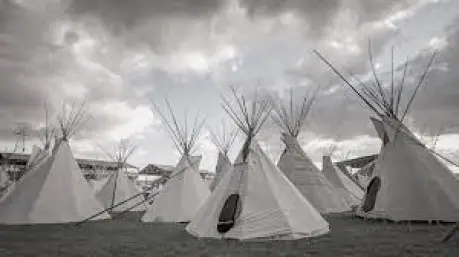
When we came up we met with the sight of a small clan of people, living in what looked like an Indian village. They’d made tepees out of canvass and skins. Small children were playing and women worked by open fires along the lake shore. An old man waved to some open boats not far out on the lake when he saw us coming. A few other men came running up to meet us at the edge of the camp. They were unarmed and begged us not to harm them as we dismounted.






