
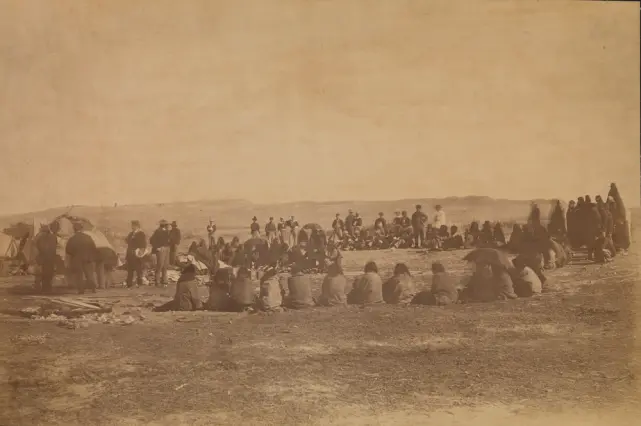
I could see right away that these people were not Indians. Nor were they scrupulously white. Their skins were tan and without ointment. We could see this because the men were shirtless and in shorts. The women also wore shorts and colorful tops, light blouses or bras, such as I hadn’t seen in a long time. The children ran naked.
I told them we intended no harm but needed to talk. We proceeded to a central spot and the whole village gathered around us. The boats came in with their small load of fishermen. One of them, a barrel-chested, middle-aged man with a trim beard stepped forward and acted as their leader. There were about fifty of these half-naked people surrounding us.
"We know who you are," he said, "and welcome you to our village. Does the Church flourish?"
"It flourishes enough to visit this region with an army," I replied. "Do you have any weapons?"
"No," he replied, "and nothing worth stealing. Three years ago our bullets ran out, and since then we’ve been at peace with all the world, and it, with us."
They seemed peaceable enough, as we sat down and shared food. It struck me as curious that these people, without their city and guns, had returned to the same life and even looks of the Indians that once ruled the area, as if the land itself fashioned our lives and looks. Their leader told us that there were four more tribes like them further to the north. Two of these tribes had been their enemies in the city, but they’d now made peace. They hunted with bows and arrows and fished a great deal. The land and the lake supported them. They planted vegetables. He said they traded with the other tribes and gathered each fall for an annual celebration.
I asked him if he ever thought of returning to the city.
"No," he told me. “It has too many thieving ghosts."
By this he meant that stray, probably half-demented people were still living there in the countless shadows, pilfering whatever they could from the ruins. We were told of the fire in the year after the first exodus. But the winds off the lake had preserved the temple, blowing the flames away from it. Then there was a time of bloody warfare, when outcasts collected into bands and fought over food. When the glasshouses were destroyed, almost everyone left.
The feuding with others continued in the wilds, until all sides decided it was suicidal to waste their last ammunition on each other when they needed it to hunt. They made peace and divided up the territory around the lakes and even split up their own groups. The land could support them better in smaller units. They passed a few hard winters when the bullets ran out. But now they thrived, as the forests and lakes were rich again.
I felt a sigh of relief upon hearing this. Our glorious reconquest wouldn’t be so bloody. I told these people of our armies, and that I would intercept them and intercede with all my influence and sue for peace. It was too late in the day to depart, so we stayed and ate a fine meal at their campfire. We kept our guns at our sides and camped that night a few hundred yards from their tents. I posted two sentries, just in case.
The next morning I bid goodbye and said I would be back soon with my superiors. I also mentioned that it would go best for them if they could manage to clothe themselves in white and whiten up their camp as much as possible. We gave them all the ointment we had and then rode off. But I left four of my men on a nearby hill to keep watch on these people until we returned.
That afternoon I returned to our main force. A council was held to hear my findings. Our hot-blooded Marshall seemed somewhat disconsolate that no gory battle was at hand. But the Church superiors with us were glad of such an easy success and consented to negotiate with this peaceful, lost tribe of the Church, and win the glory of bringing them back into the fold.
The next day we marched to the shore of the lake and built a grand camp in full view of the city across the waters. The lost tribe was welcomed with open arms. They played their part well and ran up to the Church officials and kissed their feet, as if the day of deliverance had arrived. I wondered what revolutions of fear and hope had motivated their submission. They would, no doubt, lose a sort of vagrant freedom and simplicity, and only gain the security of a rule-ridden, complicated, bullying society of their fellow man.
Commander hot head was soon dispatched with most of the Western Army, including my engineer friend and his men, to reconnoiter the other cities to the east. I was sent with my horsemen to the north to find the other lost tribes and bring them home. Meanwhile, the eastern group would repair the highway to the city and prepare for the repopulation of it, with the people we found, and with all who would be asked to immigrate from East and West, for the greater glory and expansion of the Church.
I spent the next month slowly skirting the lake shore to the north. I found the tribes I’d been told about, over two hundred people all together. They received us peaceably and I told them their new situation. The Church was moving back into the region and they would either have to rejoin it, with full clemency for all past deeds, or vanish into the wilderness to the north where no one would find them.
This wasn’t exactly what I’d been instructed to tell these people, but they reminded me of my own clan and I didn’t want to see this mode of life disappear entirely. I revealed these sentiments to them privately and rode away to let each group settle the matter.
Meanwhile our bellicose Marshall had found his battle, and a bloody one at that. While I was in the north he’d taken his army to the old city of Detroit. There he found an armed and hostile camp that wouldn’t even speak with our Church. The center of the city had been barricaded, and the people within that circle seemed to have all they needed to support a long siege.
They certainly had a supply of weapons. On the first approach of the Marshall's army shots rang out from the tall buildings on every side and fifteen of our men fell wounded or dead without firing a single shot in return. The next day a full-scale assault by our foot soldiers was attempted, along the widest avenues. This attack failed too, with all the casualties on our side. Two more attempts, including a night battle, also ended in disaster. Now the town stood in a state of siege, with our forces scattered around it in four camps, awaiting the Army of the East and its heavy guns.






