The House in the Woods, My health restored. Chapter one.
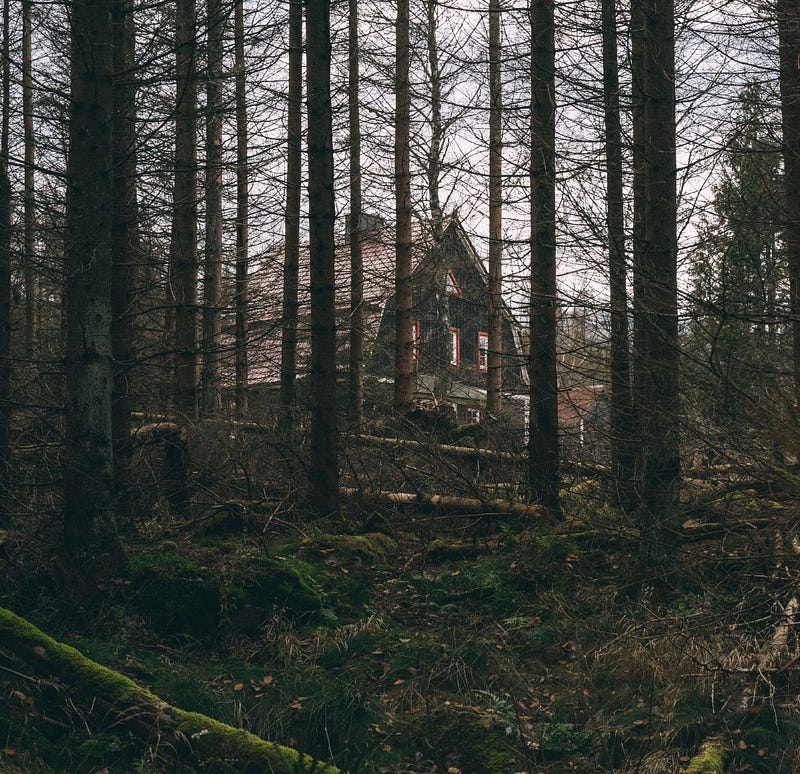
Kanan Khasmamadov on Unsplash
The house was deep in the woods, bought two months previous from the money of my two books earned. It was mine yet I never asked for it, and it cost two million, they said. But my agent had the rosiest expectations. They were so rich by me they spared no expense on it. This was the place and the solitude I needed to get well again and finish the last book. Four months in New York had nearly killed me.
They had it patched up painted and cleaned up by an out of state contractor. His men and supplies had to be flown in by helicopter. That must have cost a fortune. Power was restored with two large generators flown in, far enough away in the woods you couldn’t hear them, with a huge tank for gas that would last months. Water was easier. There was a well and with one good pump and some plumbing work they had all the faucets flowing. The place was still furnished with the ancient stuff. Some rich, old recluse had died there thirty years earlier. Then I was flown in with the nurse when the crew were flown home. The road to the place was impassable.
The next morning I forced myself to get up and limp with a cane through all the rooms and inspect my so-called purchase. But I was pleasantly surprised with the elegance of the high ceilings, the fine furnishings, the carpeted staircases, the balustrades, the moldings and medallions above the chandeliers. It was late Victorian architecture with Gothic touches and no expenses spared.
The fireplace in the living room was majestic, its tile work masterly, the same with the kitchen counters and bathrooms, hand painted tiles, checkerboards of darker colors, greens, reds and blacks, with a dark green carpet to match. But the study was the ‘tour de force.’ The desk was a huge, curved, smooth dark mahogany, matching all the trim and shelves that lined its four walls, full of old volumes with gold-edged pages, many of them rebound in matching, marbled covers, the bookplate and family crest of one “Edward H. Gilford” inside each.
I’d have to inspect each volume with care. But judging from the titles I quickly scanned they were mostly classics, my favorites in history, poetry, novels, with some books on religion, collections of sermons and dated scientific works mixed in, all of them at least eighty years old. At first glance I knew I could do some fine work in this room, surrounded by such treasures of wisdom. I suppose my agent knew it too. Besides being a witch, she was wise.
The only thing wrong was the nurse. She didn’t last long. I didn’t like her. She was old, cranky and hated solitude, complained about drafts and claimed the place was haunted. My agent and publisher saw this on their first visit and a week later, when my arm cast was removed, and with one long phone call, she was gone. I told them I wanted a nurse my age to take care of me, one who could chop wood and live in the woods, or else no writing would ensue.
I was well enough now to limp around and manage on my own. I was alone the following days and spent them exploring my new library. It could have been weeks or months for all I cared. But I still needed pills and was told someone to my liking would soon be here. I had a mild Fentanyl addiction to get over and low blood iron from my wild nights in New York. In the hospital, the first days, I thought I was going to die. Now it just felt like I had a bad flu and absolutely no energy, besides the cast on my leg. My one allowance, to be taken with dinner, was red wine, limited to a half-liter a day, according to the doctor’s instructions. But I was never good at those. My stimulants to get over this lassitude were cigarettes and coffee, to be modestly consumed they told me, an instruction equally ignored.
I fell in love with the place and demanded over the phone that if they wanted a quality third novel that the mansion be put in my name. I didn’t care about much else, except a decent sum in a bank account, a hundred thousand, which they agreed to so quickly, it made me think I could have asked for ten times that. But it came with strings attached, the promise that I would finish the book within four months or the bank deposit would revert and I’d be stuck without supplies or money in the middle of nowhere.
They were clever, those two. I wondered why they didn’t write books. But then I figured that composing novels and manipulating and using people were two very different skill sets. They certainly had me where they wanted, almost in a prison. Up to now I let them handle all my affairs. I just signed papers without reading them. I only read what I liked, and I liked literature, not legalese. But that was soon to change.
My nearest neighbors lived in a small town some twenty miles away, down the winding trace of a dirt road so rutted with age no one thought it was passable, with thick wooded hills on each side. It had been abandoned for many years. Even the old-timers had forgotten about it.
I fell in love with the place, the huge fireplace in the front room, the upholstered chairs, the rugs, the couch, all faded in their beauty but still comfortable. I felt right at home in my bathrobe and slippers. I used an antique cane I found in my bedroom closet. I smoked two packs of cigarettes a day but almost felt like I should switch to a pipe, to complete the Victorian persona.
After five days of this fleeting love affair with idleness and silence my new nurse appeared, driving a loud vehicle right up to the front porch. I rose from the couch, limped to the door and opened it. She was wearing jeans and a white tank top. The jeep was all scratched up and she had cuts on her hands and blood on her jeans.
She was angry but beautiful in her fury. She gave me a quick, disrespectful look, my odd dress and cane, cigarette in hand. Then she stepped by me in her muddy shoes, walked right past me without a word, gazed around and then proceeded upstairs. I suppose she was glad to have made it.
I stepped out to look at her jeep. It was a souped-up, off-road Wrangler, probably brand-new a day ago but now dented and covered in mud. I figured this was the cause of her anger. They gave it to her so she could make it up the forgotten road. She was a real sport to drive it. I don’t know how they found her or talked her into the job. It must have been bribing money. But she was pretty, had a beautiful athletic build, was plainly full of energy, a country girl and a licensed nurse besides. I hoped right away she would stay; silence be damned.

Nancy, my nurse.
It must have been a horrific drive winding through the steep hills of backwoods Vermont on a long-abandoned trail. I was told even the PO box was gone and forgotten.
But I needed this degree of privacy if I were to write. I was ill and famous. The paparazzi and former dates that pursued me through New York would never find me here. If they did it would kill me. But it would kill them trying to get here. They’d have to fly in, and this place wasn’t on the map.
Besides, there were no music systems, no wide screen TVs. There was the phone line repaired by the construction crew and an old radio, my only contact with the outside world, all I wanted. Only two people knew my number so it didn’t ring that often, maybe once a week. These thoughts raced through my mind until she came back downstairs.
After her brisk tour she returned to me and smiled. She said she liked the place, the well-stocked kitchen and pantry, the basement with boxes of supplies, a comfortable four poster bed upstairs in a spare room, much like mine, and the fireplace in the living room, which I hadn’t lit yet, unable to carry in the wood.
She loved the furniture, especially the antique writing desk in my study, its curves and many drawers and compartments. It must be Mahogany or some other rare hardwood, she said, as it was in perfect condition after all these years, still glossy, and probably worth a fortune.
Then she told me the news. The deal for her was to drive here three times a week, give me my injections, bring food supplies and whatever else I needed, report on my health and let me be, to write my book.
She said the trip was supposed to take her four hours, but it took eight. She had to turn around part way here, to buy a chain saw, and had to cut up five fallen trees along the way. The path was so rutted she said her suspension might be damaged. It was her new jeep. Such repeat trips were not a possibility. One look at the glare in her eyes and some blood on her arm told me that.
She asked to use the phone, still angry. The call lasted four hours with many interruptions, someone calling someone else. We even made dinner and ate during these breaks, I helping as much as I could and limping out of the room when she talked, as it was a private conversation.
By nine that night a new deal was brokered, through my agent’s many connections. The nurse, Nancy, was going to live here for a time, her shifts at the hospital deleted. She would make an inventory, and a helicopter would come by a week from now with supplies for a month. I had all the medicine I needed till then. She had just parleyed herself into a three-month long vacation, with full nurse pay, and upon completion of the book, the Wrangler was hers.
She came into the living room with a real smile. An hour earlier she’d helped me build a fire. Now she sat on the couch beside me and told me the news. She was to be my nurse and housekeeper and our relationship to remain platonic, while I write the book. She was a little off in that prediction. But she really loved that Wrangler and wanted to earn it.
I insisted we celebrate the good news with a glass of wine, by the fireside. One glass turned into two and three as she told me the story of her long, hellish drive here, how she was stuck in ditches and mud, using her suitcase at one point to get a tire out. She had to cut up so much timber to clear the way, she said, it could last this fireplace a month. She was very chatty.
She had an apartment in the city and told me she’d been working seven days a week during the first wave. She made great money. She mentioned the time spent here would seem like a well-needed vacation and it was lucky we were over the first wave and the hospital half-empty again. That's why they were able to spare her.
She said it was just as I described in my book and wondered how I wrote it before it happened. She seemed puzzled at this, curiously staring at me. I could only shrug my shoulders and say I didn’t know either. Then she proceeded, skipping over that point and admitted it was engaging to read and my second part even better, hard to put down.
It was well past midnight and we were both tired. She hoped my predictions in the second book would never happen, three more waves, variants and demonstrations, riots and shutdowns, the child epidemic, the vaccines failing and a few million more casualties.
The first lockdown had just been lifted. Schools and factories were re-opening, along with restaurants and theaters, the virus now at bay with the summer weather, at least in our Northern Hemisphere. She said with a yawn she desperately needed this break, though she enjoyed her work as a nurse, helping the sick.
In response I told her she could nurse me, as I was still sick.
Our glasses were empty, the fire just embers, and we left it at that. At the top of the stairs, heading to our separate bedrooms, she turned and asked me in the sweetest voice, “please make your next novel more upbeat. That would make me happy."
“But it’s fiction, Nancy. I’m glad you liked it. It has to go where it will, where my fancy dictates. It’s beyond my control. I close my eyes and follow the ideas. That’s the way I write. We’ll just have to wait and see where it takes me. I have no idea where it goes next”.
She didn’t know I was thinking of the virus, not the book.
My thoughts on that subject were dark. And I thought about it constantly.
“Well, I hope the world doesn’t follow in the footsteps of your last novel, like before, she said blithely, turning swiftly at the top of the staircase to her bedroom, like a ballerina spinning on her toe, while I limped to the other. I could tell she was happy.
From the written agreement I’d signed in a hospital bed in New York, I had a little over three months to complete another novel of similar length to the two before it; another colorful, detailed story, predicting where the pandemic would take us, in other words the fate of the whole human race.
I hadn’t written a sentence yet, nor thought about it. I was still recouping my strength, gathering my wits one might say, exploring this strange new space the last two weeks and now this new nurse, so enchanting. She quickly became my next fascination and an equally potent distraction from any thoughts of fiction. She was real and tangible. Some little voice in the back of my head told me that in this situation I’d never finish the book on time.
This thought came to me the following morning. I was just waking up and heard the sounds of activity downstairs, from the kitchen. A few minutes later there was a tap on my door. Nancy came in with a tray, set it on its legs on my lap, then propped me up on my pillow and left the room. A complete breakfast, bacon, toast, eggs and coffee, butter, jam and cream offered their confluence of aromas, inviting me to eat, which I did, thinking how much better she was than the last nurse, who never came till I called and asked for something. Nancy was provident. But I also saw that if she pampered me like this, I’d hardly leave the bedroom. A beautiful woman fulfilling all my needs, without even a call to her was a find too good to pass up, a genie in a bottle. I would lie in bed forever in blissful dreams, just picturing her.
From our talk the night before, side by side on the couch, while I stared into her eyes as she talked, and her warm arm around my waist helping me up when it was over, I knew I was falling in love.
Eight weeks later I was reclining on that couch, blowing smoke rings into the still air towards the high ceiling, watching them drift away and evanesce, just like my love dream, reliving once again the chain of events that left me here alone in semi-darkness.
And once again, as with Naomi, it seemed like I’d just shattered that bright future. Was my love life always going to end in a car crash?
A few minutes earlier the front door had slammed shut and the sound of her Wrangler roared away and then faded as she drove home without a word. A few minutes later I rose from the couch, shook my head in disbelief, stumbled to my den and began to write.






