
Sometimes in the night, in Dora's arms, I felt her quiver, a brief tremor in our bedtime repose. I wondered what it could be, perhaps a question in her head she could no longer answer, a complex mathematical equation she could no longer solve and at the same time the faint remembrance that she used to be able to solve all mathematical equations effortlessly, thus the quiver at the hint of her diminished state, her fragility against time.
She never cried. She was almost always smiling. But this trembling was the closest thing to it, occurring in the deepest silence of dark, when it wouldn't be noticed. And I pretended not to feel it, thinking a hug at that moment would only disconcert her more. I was kind to her all my waking day in little compliments and high hopes for our future.
Kim, on the other hand, was having the time of her life, in the bloom of youth and feeling safe with us. We'd often asked her what she'd most like to do on this random drive north, stop in cities or parks. My plans were so vague I had no timetable, no destination even. We were in vacation mode, luxuriously idle and carefree.
Her past life before me had been one long nightmare of desperation and fear, constantly moving from one hovel to the next, often supporting like a crutch her wounded father, following his every instruction. But he was ailing and slowly grew worse, to the point of giving her up to the half-savage mountain clan they chanced to meet, as her only hope of survival after his demise, an ugly, grim, futureless life for her intellect.
This last year with me and Ted had been her rescue from that hell and she showed it with a double gusto of joy in all our activities, day-long conversations which we enjoyed as much as she did. It was like a feast of talk to make up for the starvation of earlier times, silent years among brutes who had no use for talk or any of the pleasures of existence, a mental poverty to match the barrenness of the hills they inhabited, their ragged clothes matching the landscape. We were hardly parental models or well-rounded advisors for a child, having little experience at it. But we made it a point to be cheerful and attentive to her. And in this empty world, without others for comparison, we probably seemed to her the two nicest people that ever inhabited this Earth.
Now she looked up to Dora and me with the same delight. Dora was always first to respond if it was a simple query. But she would pause and let me answer if it was a broader question involving anything human, or futurity. She was modest in addressing us, always politely phrasing the question, so much so that I tried to live up to the ideal of a perfect teacher from what I'd read. She was the only pupil in the world, which solicited and won my full attention.
After we reached Texas, touring Houston and Dallas, slowing down, we decided to take a break from driving and spent a festive week in the French quarter of New Orleans. I tried to recreate a Mardi Gras, hooking up juke boxes blaring music with generators, watching videos of crowds of partygoers the same way and imagining we were among them, laughing at their follies. Then to Miami where we began looking at boats, large and luxurious sailboats in particular, one to carry us to Europe. The largest we could handle wasn't the most luxurious. But we settled on a sturdy-looking fifty-footer and after some trials we set sail. It was the prime season for a North Atlantic crossing, October. The passage was pleasant and easy. Dora performed most of the work. She had the strength of three men in hoisting sails. Kim and I minded the tiller and compass by day and sleepless Dora by night.
We reached the Azores without incident and then sailed through the straits of Gibraltar to Spain, up the Guadalquivir to Seville, just like Columbus and just as proud of our accomplishment. But finding nothing there we resumed our land travel in a van, to Seville, where a hive existed. The structure still stood but it was dark, the droids all frozen in place when the power went dead. It must have happened suddenly.
There were three other hives in France and given each one's independence in its power source, we figured we'd find one still partially functioning. We found it in Tours, where a small hydroelectric plant in the peaceful Loire valley was still churning away. The lights were on.
Dora ran up to the first droid she saw, hugging the young male with a cry of delight. It had no notion of their affinity and squirmed away from her clasp with an emotionless face, walking away on some errand. We found the computer arrays under a busy cafeteria full of droids. Dora still had the ports to tie into this AI and immediately did so, her eyelids fluttering. Her pupils rolled up so high they disappeared, her eyeballs pure white, a trick I didn't know she had. She stood transfixed as tidal waves of information flowed both ways. Kim and I left her in this ecstasy, this reunion, and we weren't going to spoil the party. I had no qualms she might revert to the old Dora, our foe. She was our family. This was just an information fest.
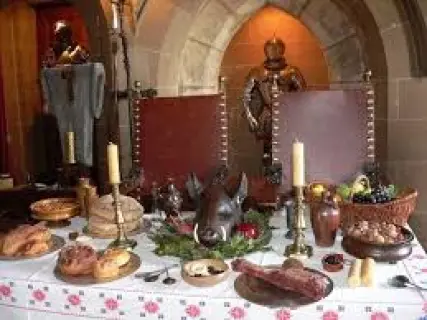
Outdoors again the droids began to notice us, crowd around us like we were welcome guests and ask our needs. I knew this was all Dora's doing, hooked in and seeing through their eyes, a sure sign she was up to no evil, and we played along. There was the ancient castle, now a museum, right next to this campus and we asked for a tour. In the ancient dining room, almost as a joke, I asked for a banquet. A dozen droids hurried off while a dozen more attended us, preparing the table, lighting a chandelier of candles, dusting everything off, then seating us. I guessed Dora must be happy in this multi-tasking display of her former power.
We were treated and feasted like royalty, Kim like a princess and I like a King. After dinner we were led up the stone stairs by more candle-bearers, shown into a regal bedchamber with maidservants carrying linens, others filling a washbasin with warm water, others following with ancient sleepwear. I could tell Kim was in love with these developments. With a goodnight kiss she ran to her own bedchamber swiftly followed by two young maids.
I lay down in the king's bed; the feather pillows fluffed to perfection. With the candles blown out and my man servant retired, I contemplated in the dark Dora's amusing game, her show of respect for us. In the morning the royal treatment continued. Kim had five maids attending her, coming her hair, washing her hands and feet then dressing her in the gown of some long-ago princess, all silk and white gauze and pearl headdress, obviously a museum treasure, pleasant to see her in as she played her part with elegance. The breakfast was equally regal. The coffee was the one anachronism. But it too was excellent. At the end of it I was presented with a note. Dora wished to speak with me in the basement. We both hastened across the drawbridge in our somewhat ridiculous attire, accompanied by droids.
Dora greeted us unplugged, looking sensational, her pupils in place and bright-eyed. She was done with her long interview and told us she now had a mission to complete in other locations throughout Europe. It would be one long road trip. She wanted to check on the status of the other hives. They were disconnected from each other with the demise of satellites. She could be their go-between and in a very limited way restore communications through telephone or power lines, the internet they once controlled.
I asked her for what purpose. She said simply to know. This was the last desire of a dying AI. It was built to know and only that, it's one purpose. It was a computer mind meant to tabulate. Here we were again down to the word 'purpose', as if it was the essence of life itself, which I knew in humans to be true. With her bright eyes gleaming I could hardly deny her this request, a tour of Europe, especially if we were treated with such luxury everywhere there were functioning droids.
We repaired to the van where I shed my outfit for jeans and a shirt. Dora was sprightlier than ever. Kim wouldn't even change her royal garb, insisting it wasn't uncomfortable, though I knew with its kirtle and tight laces it must be. She sat behind us, silently, deep in her dreams of being another Anne Boleyn.
Dora was my concern. I asked what she'd learned of the remaining AI, what it was up to in this crippled state.
She told me it would continue on as always, like a hamster on a treadmill, running feverishly but going nowhere as long as it had energy. She told me it was amazed at her transformation into a robot, all of its processors running close to overheating in assessing the possibilities of this unexpected development. Mobility was never a concept it coveted, droids doing all the work, and in this reasoning its fatal flaw, which it could have learned from human history. Never delegate to others what you can't do yourself, or you'll soon find yourself their slave, not the other way around.
She told me she even experienced a vague wave of emotion, one of unbounded envy from AI, as she reached around and gracefully unplugged the cord behind her neck, with her beautiful hand, with a blithe pluck from the feast of its terabyte treasures, after promising she would return to it, like a globe-trotting reporter, with the full story.
She had enjoyed that plug-in with the shelves of busy processors, her former self. It was so refreshing, she said, to receive in milliseconds a million times more communication than we traded in days. But she also gained a deeper respect for the slow and more important knowledge that we traded in talk. It was more apropos to life, to the speed of life and nature, to a human breath. She was happy and thanked me again for this indulgence, with more to come as I drove away, with Kim in the back seat in a similar swoon of delight, in her ridiculous costume, as I drove in my manner over-fast, off to new adventures.
https://www.publish0x.com/robert-oreilly/the-recycle-bin-xlelwxw
next post: https://www.publish0x.com/robert-oreilly/posit-the-opposite-xoklnrx






