
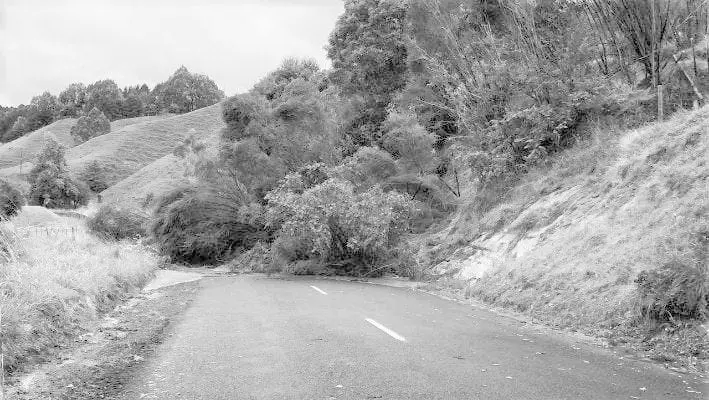
Highway repair
What most engaged me was the coming announcement. A great council had been gathered in the east that winter to map out a new course for the faithful and draw up an agenda for the next decade. It’d taken half a year to send out envoys and collect delegates for a general session from around the world. All this was done by ship, the only form of transportation and communication still used over great distances.
The reason was that the great waterways were empty and safe, and never decayed as the roads did. Though it had destroyed nearly everything else the Church maintained a fleet of tankers and ships to carry out its missions around the globe. The capitol of the World Church was at White York and from that vicinity issued all the holy paint that purified mankind. Shipping was the only way to convey the huge volumes of liquid. But it meant that the whole empire of the Church was limited to coastal regions or wide rivers.
But the vast, deserted interiors of the continents still loomed large in the minds of our leaders. They remembered the forced depopulation of these areas in the first years. They remembered the fine cities where temples had been started, but then abandoned in hasty and sad migrations when they were found to be untenable, impossible to supply or defend against the hordes of outcasts that roamed the land in those first years.
But now their cause was victorious. The plague and the rebels were gone. So the council adopted the grand scheme of building a highway to span the continent, from White Seat to White York, linking the coasts and at the same time opening up the interior to colonization. The catchword for this year was "unification."
Indeed they had been sharpening their skills for this undertaking already, by constructing short spans between the coastal towns to improve local communications. Each city had its own contingent of road builders. Now all that was needed was to collect and organize these crews, glorify the project to give it momentum and set it on its long run.
A delegation was expected to arrive by ship any day. We were forewarned by couriers from White Seat and told to prepare a grand reception. There were to be three dignitaries from the council, of a rank and authority higher than that of our own head priest, on a level with bishops. Such was the importance of the commissions they brought.
In a society without entertainment any civic event is dressed up in a great deal of pomp and circumstance. Ours were like circuses. On the day before the arrival of the boat our barracks were visited by the head priest himself, leading in a crew of barbers. After the usual apologies for disturbing our ears, he proceeded to tell us that we were going to be given an honor and an opportunity such as we used to know.
The great council in its winter-long debates had decided that it was high time to do something about the "Order of Lickers". And it wisely proposed that the new "Department of Highway Construction" would be just the place to refit us for a better role in society. We were now told that we would have a prominent part in the parade of the next day and receive this good news in the town square. To prepare for this we were going to receive new outfits and gear, and also have our hair trimmed for the occasion.
I doubt if anyone of lower rank than the head priest could have broached this topic with any hope of success. We were seated at our table and twenty barbers began clipping. While they worked the thought struck me that this was just what we needed. If there was anything left in the city that was still an eyesore, it was us. Now the city was not just cleaning us up, it was getting rid of us. But it was also giving us a bit of pride, or at least the chance for it. The project to which they were sending us, so they said, would contain all the best and brightest talents that the town could supply.
From the low groans around me I could tell that most of my brothers thought otherwise. To cut such long, tangled and flea-infested locks went hard against tradition. The head priest harangued us the whole while and promised better meals and shiny, new camp equipment for our journey.
I was not one to pass up an opportunity to make a good impression on so high a superior, so while the barber was trimming my beard, I motioned him to take the razor dangling from his belt and shave it off. The priest was informed of this request, came over to my side and mused upon it a minute, looking down at me and stroking his own naked chin in the process.
Then he nodded his assent, patted me on the back and announced to us that "radical changes require radical sacrifices." A whole chorus of groans rang out from around the table as the barbers sharpened their knives.
For the rest of the day we were confined to our quarters. Our new clothes were brought in and we were made to give up our old ones, which were taken away and burned. Most of my companions lay in their bunks almost naked, scowling and scratching their white faces, while I paced back and forth in my new outfit, excited by the changes soon to come.
Early next morning we were brought a fine breakfast that included milk, eggs, fresh bread and tea. A well-groomed, effeminate fellow came with it to deliver us a quick course in some social graces. He supervised our washing and dressing, adjusting the fold and flow of our new robes. Then he had us practice a march around the room in double file, lecturing us on good posture as we passed, more like a dancing-master than a drill-sergeant, but to little avail, as it was time for the ceremony.
As squad leader I had to lead my group and was given the most instruction. My rough stick was taken from me and replaced by a smooth model, with a single, polished, silver band near the top of it. This was the first in a long series of staffs which I earned, and it hardly ever left my hand. Even though I was still very low in rank compared to others, I had almost forty men under me who looked to no one else, and my authority was such that it needed no words.
At noon the embassy arrived, in what looked like a small luxury liner. The visitors were regally welcomed at the pier by the whole priesthood, standing in rows according to rank, with our four squads of lickers to one side, like auxiliaries in some battle formation. The whole town was assembled at the square. We paraded around them several times, while grandiose speeches were made.
The next three days were declared public feast days, to universal cheers, as it meant that athletic games and banquets would be held. For the first time in years my comrades were not only included in these gatherings, but applauded when they were mentioned in speeches, and envied as participants in the new undertaking.
After the festivities we spent a few days in our barracks whitening and packing the camp equipment that was brought to us. The morning we set out there were a few more speeches made in the public square. Then we marched for five days south to White Seat. There we met up with the other contingents in one vast camp at the eastern edge of town. We rested a few days while the commissioners reviewed us and assigned each group the station they would take in this grand assault upon the wilderness.
My squad of lickers would accompany the advance team that surveyed the course of the highway. This was to be a crew of a hundred and fifty men. We were to follow the route of the old highway, whenever possible, clearing away debris and reporting back to the larger crews on exactly what they would need up ahead. They would follow some five to ten miles behind, to repave and complete the road.
One of our tasks was to set up the campsite for each night's rest. It had to be large enough to accommodate those behind us on the following nights. While other workers cleared the ground and set up tents, my lickers would purify the area, at least where the men had to sleep and eat, and assist in the packing and unpacking of tents, camp utensils and tools, and keep them clean.
This was the first time my lickers had to work with other people and it was a hard transition for most of them. Even though they had the lowest of tasks, they looked upon themselves as better, more holy than others. They had a habit of stepping back from anyone approaching, of suspiciously examining any object that had just been touched by another hand, as if it were polluted.
In the first few weeks almost a third of my men had to be sent back and replaced. The dirt and filth of the woods all around was too much for them. They would crumple up into a ball and refuse to move, or else run amuck, spitting furiously at everything in sight. They were sent back to the city, I don’t know to what end.






