
The Socratic method refers to a mode of cooperative argumentation or discourse between two or more individuals (in good will, that presupposition is really important - that is, the argumentation's purpose is to discover the truth, not to win an argument), based on asking and answering questions back and forth in order to stimulate critical thinking, delineate and crystallize and extract ideas (non-muddled in their purity), underlying axioms, first principles, assumptions, presuppositions and beliefs from statements and claims. The method, attributed to Socrates, was first formalized in prose by Plato in his Theaetetus. The Socratic method is a one of hypothesis elimination in the process of gradually fleshing out better grounded ones, as identifying paradoxes, inconsistencies and self-contradictions.
The Socratic method seeks to seize and capture common sense truths that shape beliefs and proceeds to scrutinize them to determine their consistency with other beliefs. The basic format takes place as series of questions meant to test the implicit logic of assumptions, beliefs and claims and help a person or a group come to better understand and their beliefs and ideas in relation to other things and concepts.
Now, this of course can in practice often be pretty annoying or even uncomfortable for most, but luckily everything and everybody nowadays is so corrupt that it's unlikely that adopting the Socratic method would put one at risk of being sentenced to drinking hemlock for disrupting the social order of things. But it does occur to me that this method can be taken up in our everyday lives in a way which accomplishes much better results than some such self-centered pseudo-science bourgeois hoaxes like psychoanalysis, which always centers and revolves around the ego, neurosis, always coming back, and paying to be manipulated "for your own good" in a good patriarchical analyst/patient relationship.
A Socratic method asks questions like "what does that even mean?" and can be taken up as a tactic against obscurantism and obfuscation, which is another favorite tactic of advertisers, PR people, politicians and their rhetoric and whoever is trying to sell you on to something. It seems to share a lot in common with Korzybski's general semantics which asks similar questions, but goes much deeper into things like levels of abstraction and the dangerous implications of the verb "to be" in all its forms of use. Both are therapeutically applicable in how they assume that psycho-logical and/or psycho-emotional problems and issue stem from muddled and/or faulty understanding of reality and the manner in which we interpret, articulate and conclude things in ways which do not correspond to what we think they refer to or contradict the facts of reality.
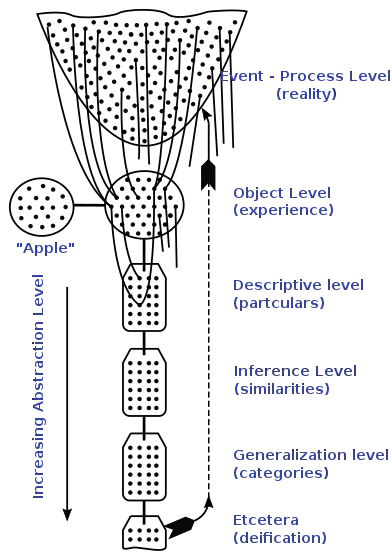
Korzybski uses what he calls the structural differential, the above diagram, as a device used to remind and recognize the levels of human abstraction - and how each level subtracts from the one before in order to arrive at the concrete statement or observation in a specific context, illustrating how any knowledge we may have about anything can only be partial and analysis utilitarian in its purpose, therefore also limited to its specific need or use with circumstances that require it. The parabola in the structural differential - that is, the top most part, indicating dynamic process reality of the sub-microscopic world or the event (in the sense of Alfred Whitehead's event-based or process-based ontology of constant flux and dynamic interrelations).
The disc below it then represents the non-verbal experience of that reality, the sense, feel and perception of what is going on and how we register it in reacting to the stimuli. And finally, the labels represent






