![Occam's Razor: Law of Parsimony [Useful conceptual heuristics and tools for thought]](https://www.publish0x.com/img/100146.webp?action=resize&ar=1&enc=webp&inv=0&ori=1&st=1&up=1&w=1140&signature=3375dd73d7ca485813b02e8b8a8662a09d9b44683173767512c2f82a228819ad)
Occam's razor (novacula Occami) is a sense-making/problem-solving principle attributed to 13th century theologian and scholastic philosopher William of Ockham which states that "entities should not be multiplied without necessity" (or "plurality must never be posited without necessity",numquam ponenda est pluralitas sine necessitate) or more precisely that when presented with a number of competing hypotheses making the same predictions or claims, one should choose the solution which makes the fewest assumptions. In the scientific method Occam's razor is a loose heuristic applied in the development of theoretical models and not an actual strict arbiter of candidate models or an irrefutable principle of logic.
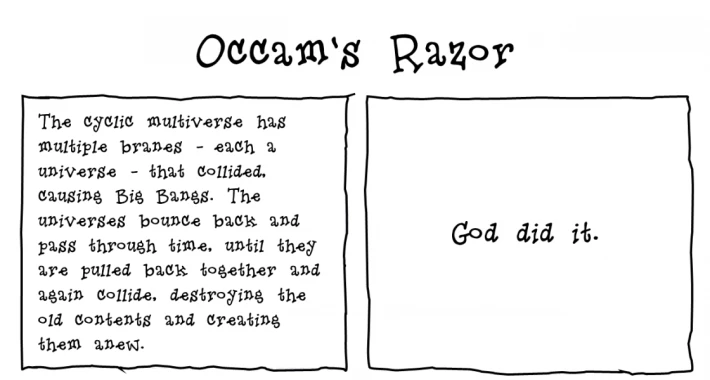
The scientific preference for simplicity is mostly to do with the falsifiability criterion for what classifies as science/scientific and what doesn't or constitutes pseudo-science (basically, scientific theories need to be provably wrong in some circumstances or exceptions where they happen to not apply, while things such as psychoanalysis or Marxist theory constitute pseudo-science according to the definition, since nothing about them can either be confirmed/proven or denied). Thus, simpler theories tend to often be preferable because they are more testable and therefore reliable in constructing valid claims and useful working models. This obviously is not always the case and the razor does not universally generalize across the board since it is often the case that as more data becomes available with time simpler explanations become ruled out in favor of more complex theories.
Occam's razor stands somewhat in contrast to the principle of plenitude which can be traced from Plato (as "the necessarily complete translation of all the ideal possibilities into actuality") and found in such Enlightenment figures as Leibniz and Spinoza. The principle of plenitude states that the universe contains all possible forms of existence, thus every explanation of a thing may be in itself valid or true, if not in its concrete instance in the universe at the given point in time, then in another one elsewhere at another time, but also there are always more than a single explanation of a thing. Another, more extreme and mocking anti-razor is Alfred Jarry's pataphysics, the "science of the particular" or "science of imaginary solutions" which constitutes the ultimate anti-reductionism, as it "seeks no less than to view each event in the universe as completely unique, subject to no laws but its own."
In approaching complex systems (which are most systems in the world and around us), we proceed heuristically in an inter-disciplinary and somewhat ad hoc manner, drawing upon a range of diverse domains, areas and fields of knowledge, expertise and practice, experience and intuition as we gradually and slowly probe things gently and on a smaller scale to test the effects, potential vectors and possible consequences. Or, to cite Paul Feyerabend:
"Knowledge is not a series of self-consistent theories that converges toward an ideal view; it is rather an ever increasing ocean of mutually incompatible (and perhaps even incommensurable) alternatives, each single theory, each fairy tale, each myth that is part of the collection forcing the others into greater articulation and all of them contributing, via this process of competition, to the development of our consciousness."
Thus, Occam's razor may be another useful heuristic in our arsenal of tools and concepts for dealing with the surrounding world and certainly a good guiding principle when initially approaching something or beginning to build a model or a theory from scratch and need to grab on to a few simple valid statements, claims or facts from which to further proceed and build upon.






