
Just read through this published paper from the Journal of Cliodynamics.
Cliodynamics (/ˌkliːoʊdaɪˈnæmɪks/) is a transdisciplinary area of research integrating cultural evolution, economic history/cliometrics, macrosociology, the mathematical modeling of historical processes during the longue durée, and the construction and analysis of historical databases. Cliodynamics treats history as science. Its practitioners develop theories that explain such dynamical processes as the rise and fall of empires, population booms and busts, spread and disappearance of religions. These theories are translated into mathematical models. Finally, model predictions are tested against data. Thus, building and analyzing massive databases of historical and archaeological information is one of the most important goals of cliodynamics.
- Source: Wikipedia.
Been following things in that area over the last two years or so. Here's the selections of the paper I copy/pasted for myself in my notes:
The premise of this paper is that a transdisciplinary approach to forecasting social breakdown, recovery, and resilience is entirely feasible, as a result of recent breakthroughs in statistical analysis of large-scale historical data, the qualitative insights of historical and semiotic investigations, and agent-based models that translate between micro-dynamics of interacting individuals and the collective macro-level events emerging from these interactions. Our goal is to construct a series of *probabilistic scenarios of social breakdown and recovery*, based on historical crises and outcomes, which can aid the analysis of potential outcomes of future crises.
[...]
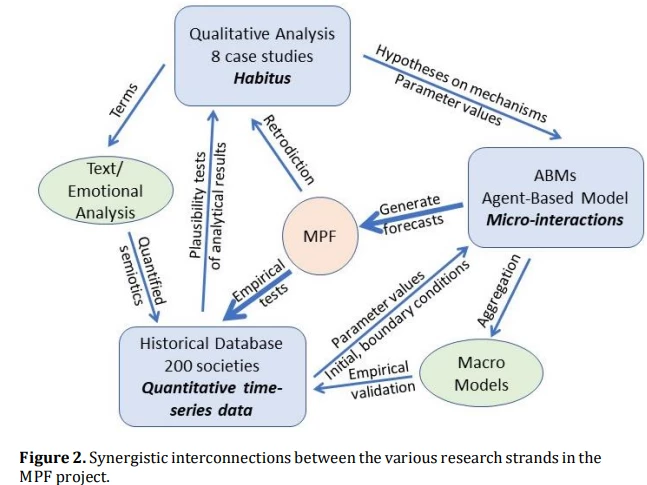
This paper aims to set out the methodological premises and basic stages envisaged to realize this goal within a transdisciplinary research collaboration: first, the statistical analysis of a massive database of past instances of crisis to determine how actual outcomes (the severity of disruption and violence, the speed of resolution) depend on inputs (economic, political, and cultural factors); second, the encoding of these analytical insights into probabilistic, empirically informed computational models of societal breakdown and recovery—the MPF engine; third, testing the MPF engine to “predict” the trajectories and outcomes of another set of past social upheavals, which were not used in building the model.
[...]
The major research challenge in answering this question is that social breakdown results from multiple interacting factors: economic, political, cultural, and emotional. An approach that ignores any of these dimensions is bound to fail. Furthermore, these collective processes operate on multiple levels: from slow structural changes in economy and culture to faster-moving influences that affect the passions and actions of individuals.
[...]
The study of the processes that undermine social resilience has long suffered from the split between “the two cultures” (Snow 1959): humanities and science. However, we are now in a position to bridge this gap by measuring not just demographic and economic trends, but also public sentiments, such as moral outrage, resentment, fear, hope, and enthusiasm which flourish—implicitly or explicitly—in political visions, fill mainstream and social media, and fuel social protest. We will draw on recent literature pointing to the importance of levels of cooperation, trust, and feelings of (in)justice in explaining both social crisis and renewal (Witoszek 2013; Turchin 2016; Witoszek 2018; Witoszek and Midttun 2018). We can identify and study these narratives, images, and habits, which influence broad-based social cooperation, or conversely, foster partisan or polarizing agendas. In this sense, we propose a “holistic” approach to understanding and modeling the resilience/fragility of social systems, which investigates economic trends, power dynamics, cultural influences, and individual passions. Only a “disciplinary fusion” can lead to a better understanding of the linkage between micro-behaviors and emergent macro-effects.
[...]
There is a recent rich, but separate scholarly literature drawing attention to the importance of “irrational” motives: the “geopolitics of emotions,” the “culture of fear,” “cultures of resentment,” and “schools of hate” (Moisi 2010; Nussbaum 2016; Mishra 2017; Davies 2018; Furedi 2018). Finally, while there is an abundance of approaches asking why and how societies slide into a revolution or civil war, the opposite dynamics—emergence from crisis and re-establishment of social order and communal cohesion—has been relatively neglected (Goldstone 2002: Chapter 5).
[...]
Previous work, thus, has been conducted largely by political theorists, policy analysts, sociologists, historians, and computational modelers who worked in isolation from each other with focused, domain-specific data sources. Separately, they all offer intriguing insights and have produced important discoveries, but ultimately each can provide only one piece of the puzzle. The critical next step, which has yet to be attempted in large-scale, systematic manner, is to fit these different disciplinary research strains together into a single, coherent, theoretical framework (Turchin et al. 2017). Indeed, any successful tool framework for estimating the risk of state breakdown needs to integrate the study of macro- and micro-levels of social unrest. Similarly, understanding and formulating informed responses to nascent crises should draw on an empirical knowledge of processes that enable societies to recover from crises. Such integration should include structural components, transient and emergent forces, and deeply entrenched cultural traditions, as well as the complex web of interrelationships and network interactions of individuals within social systems.
[...]
Habitus (Bourdieu and Nice 1977) is neither a sole result of free will, nor determined by structures, but is created by the interplay between the two. In the language of complexity science, it is an emergent property. The concept of habitus is similar to the special definition of culture used in the new discipline of Cultural Evolution (Brewer et al. 2017): socially transmitted information that influences human behavior. In addition to the role of economic factors provoking social disruption we will highlight often underresearched cultural accelerators of social unrest and renewal.
[...]
We shall define the elite-driven “vocabulary of crisis and renewal,” i.e. rhetorical ploys, narratives, and behavioral patterns, which influence cooperation or sectarianism, trust or distrust, and thus fuel conflict or forge sustainable recovery. This approach will enable us to answer questions such as: why did the stresses of the 1920s and 1930s result in the rise of fascism in some countries (Germany and Italy most famously), but lead to very different outcomes in others (Norway and the USA)?
A Massive Database of Social Collapse and Recovery
Building on the insights from the first phase, we propose to collect a massive amount of information on 200 past societies over the past five centuries that faced some societal crisis. In each case we will trace the long-term dynamics of both entry into a crisis and its consequences (recovery, upheaval, complete breakdown). Data collection will focus on the key variables or parameters identified through the case-study analysis, including demographic, economic, institutional, and *habitus* data (entrenched cultural narratives, practices and values forging a cooperative or sectarian ethos). We will take a statistically sound sampling approach, encompassing both a global and long-term (longitudinal) view. To accomplish this phase, our team will leverage the considerable experience and methodology developed through work with Seshat: Global History Databank (Turchin et al. 2015), one of the most comprehensive history databases on a societal scale. Although the Seshat project addressed a different set of questions (how large-scale complex societies arose in human history), it pioneered the use of time-resolved (longitudinal) historical data for empirically testing social and historical hypotheses (Mullins et al. 2018; Turchin et al. 2018; Whitehouse et al. 2018). In MPF (*Multipath Forecasting*), we will use Seshat methodology to establish a novel type of historical database, of hitherto unknown scale and comprehensiveness, which will enable us to systematically test hypotheses explaining social resilience and breakdown.
A Socio-computational Approach to Societal Collapse and Recovery
We will use insights about key processes and estimates of parameter values from the empirical approaches (phases 1 and 2) to construct computational agent-based models (ABMs) of individuals; as well as mathematical models of crisis and recovery dynamics operating on a more coarse-grained societal level. Taking advantage of the availability of computing power and progress in statistical and computational methods, it is now, for the first time, possible to build and analyze models of millions of interacting individuals. Pioneering work by Thurner and colleagues (Thurner 2011; Poledna et al. 2018) has demonstrated that these models can be used effectively to assess the complex dynamic interrelationships between individuals and their groups at all different scales. We have previously demonstrated in the context of the financial system that modeling at the individual scale (and taking individual interactions into account) is necessary to understand system-wide collapse (Thurner and Fuchs 2015; Poledna and Thurner 2016).
[...]
Using insights into the social mechanisms of crisis and recovery from the empirical analyses, we will construct a series of mathematical models that are able to describe the crisis dynamics and outcomes in the eight in-depth case-studies. We use a multilevel approach, combining micro- and macro-level models. The micromodels will take the form of agent-based simulations involving large numbers of interacting agents and their organizations/institutions. Macro-models operate on coarse-grained variables (averaged and aggregated quantities) that can be directly compared with the data. Typically, the macro-models will take the form of phenomenological non-linear differential equations that link the essential variables (Turchin 2005). The goal is to make the micro-models compatible with the macro-models. In other words, the aggregated results from the micro-model should predict the dynamics of the macro-variables. We will select an extra set of four cases outside Europe that will serve as an “out-of-sample” performance test of the MPF engine.
Witoszek (2003, 2018; Witoszek and Midttun 2018) has found that semiotic-emotional clusters are powerful triggers of social breakdown and recovery. Her research shows the potency of metaphors and cultures’ founding narratives that have historically influenced levels of cooperation, trust, and perceived injustice. Drawing on her work, we shall ask how culturally significant and emotionally charged stories and practices have been used and abused by elites and politicians, and how they relate to national traditions. What is their power to polarize or unite the community? We shall also build on Witoszek’s (2018) research on the catalyzing role of cultural outliers and innovators in the stabilization of chaos and stimulating social recovery.
[...]
The novelty of our approach is both methodological and conceptual, and lies in the new way it couples qualitative and quantitative empirical information on past societies. It combines thick description of cultural norms and values that influence social crisis and resilience with big data analytics to detect their actual dynamics in a multitude of cultures. Further, it links micro-social behavior of individuals with collective macro-level societal dynamics. We explicitly incorporate into our mathematical and computational models the mechanisms drawn from sociological, anthropological, and semiotic research about cultural expectations, norms, and values, as well as under which conditions and how these aspects of habitus break down.
The Feasibility of the Approach
The prediction of possible future trajectories of sociopolitical instability is a very ambitious goal. It is therefore legitimate to ask whether such a goal is achievable, especially given that such predictability has eluded seers, social scientists, and even well-funded government agencies in the past. Karl Popper (1957) argued that a science of history is impossible and, under the influence of poststructuralism, historians have largely abandoned “grand theory” be it in the guise of Marxism, Social Darwinism, or Postmodernism (Darnton 1999).
[...]
However, such “grand” qualitative theory is not what we intend to do. Neither do we aim to predict detailed future paths of history, or unique events. Instead, we want to understand which factors (economic, social, cultural, emotional, psychological, group-dynamical), and which combinations of them, create environments where social breakdown is highly likely. Many of these factors change gradually and can be observed with the present availability of data. Data on many of the factors are also available for historical societies, so that the intended “retrodiction” with our computational models should be feasible. Thus, we emphasize the foresight in our conception of forecast, because the focus is on scenario exploration rather than on “hard” prediction. Our MPF is an entirely different beast from the data-poor and speculative qualitative and teleological historical narratives that Popper derided as “historicist.” We have entered a new research era, characterized by previously unimaginable computational power, readily available or “obtainable” data, and, most importantly, novel conceptual and theoretical tools with which to study complex systems.
Sharing this not just because it is in itself really fascinating, but also because I find it corresponds to and ties together with Holochain (and its broader concept of Ceptr). Holochain is similarly an agent-based model which weaves and maps out complex webs of social relationships and correlations in the process of revealing similar dynamics and insights into the factors and forces that come into play in shaping our socio-technical systems (and their erosion and collapse or level of resilience and health, etc.)





