
Zen blog post in Russian
https://dzen.ru/a/agA7MbHSbCnaW_tw
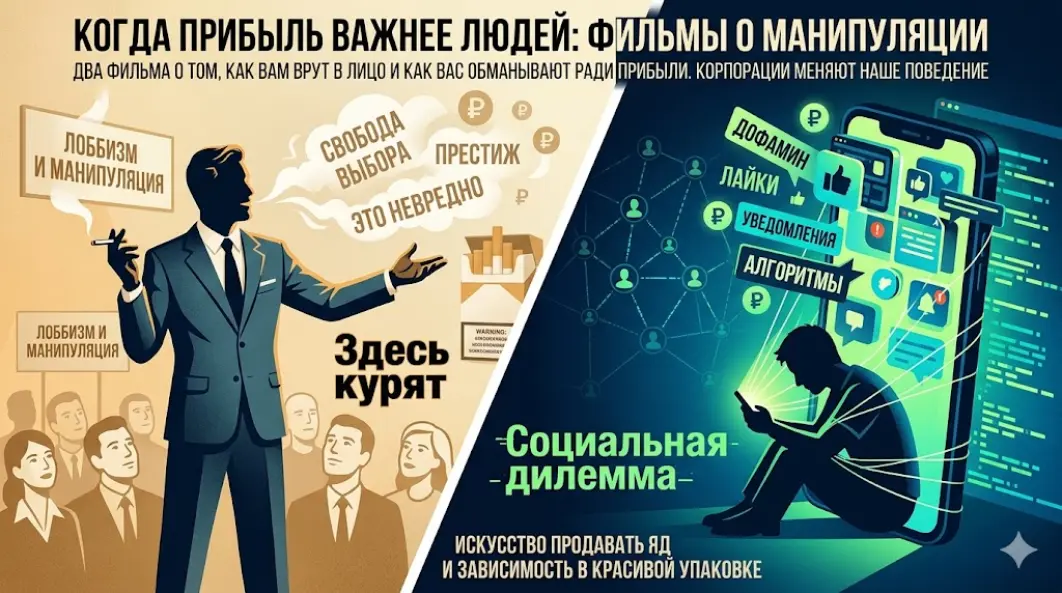
Films about how the addiction and influence industries manipulate society for profit. Films about how corporations are changing our behavior.
Two films about how people lie to your face and how we are deceived for the sake of profit.
Despite the difference in genres (documentary and satirical comedy), these two films share themes of mind manipulation, propaganda, and ethical communication dilemmas.
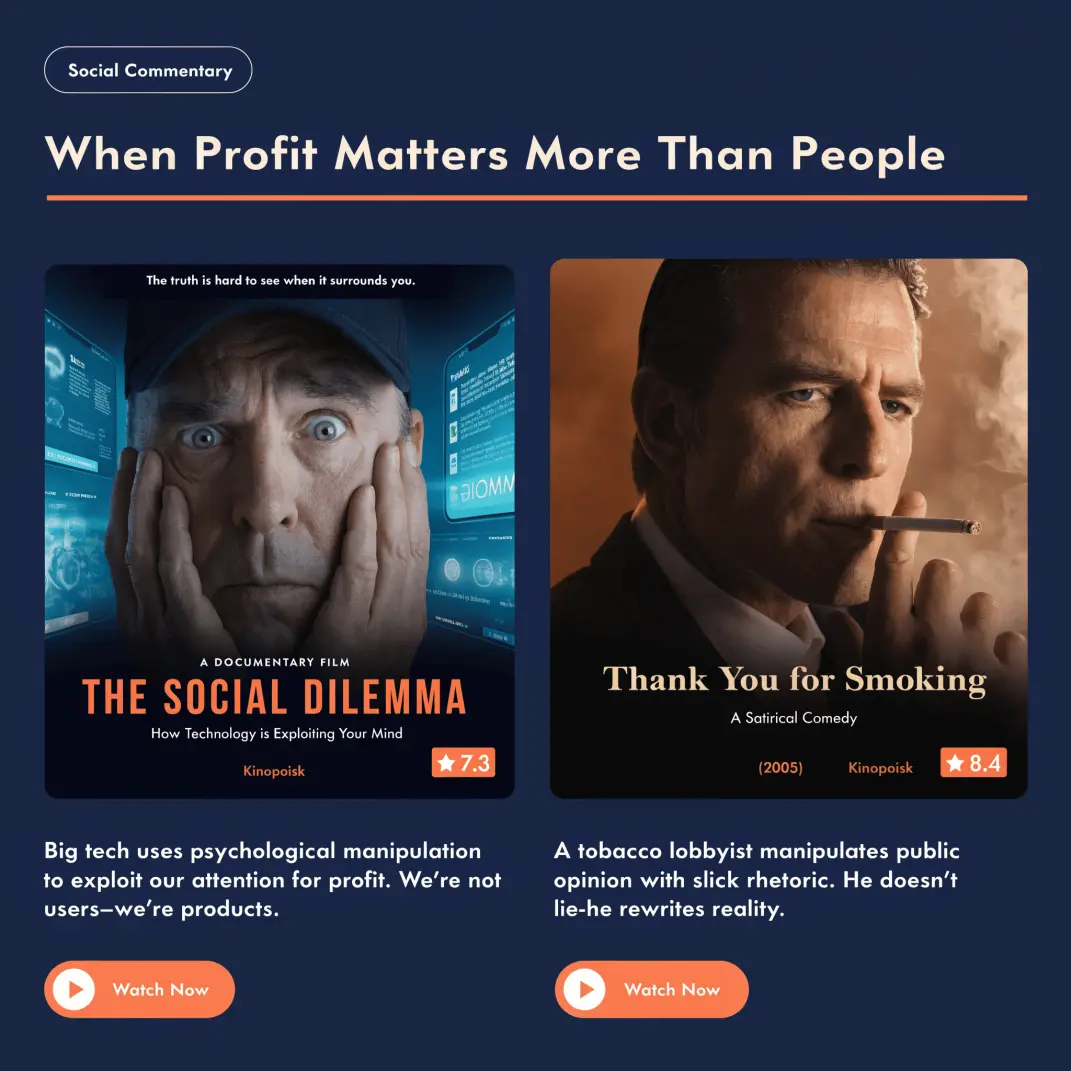
"They smoke Here" (Thank You for Smoking) is about how the tobacco industry and lobbying protect a harmful product with the help of beautiful words and media manipulation.
"The Social Dilemma" is about how social networks and technology platforms use psychological mechanisms to hold attention, form addiction, and influence behavior.
Both tapes show how corporations package a potentially harmful product (cigarettes or social media algorithms) in an attractive wrapper. This is a story about how professionals force us to love what harms us.
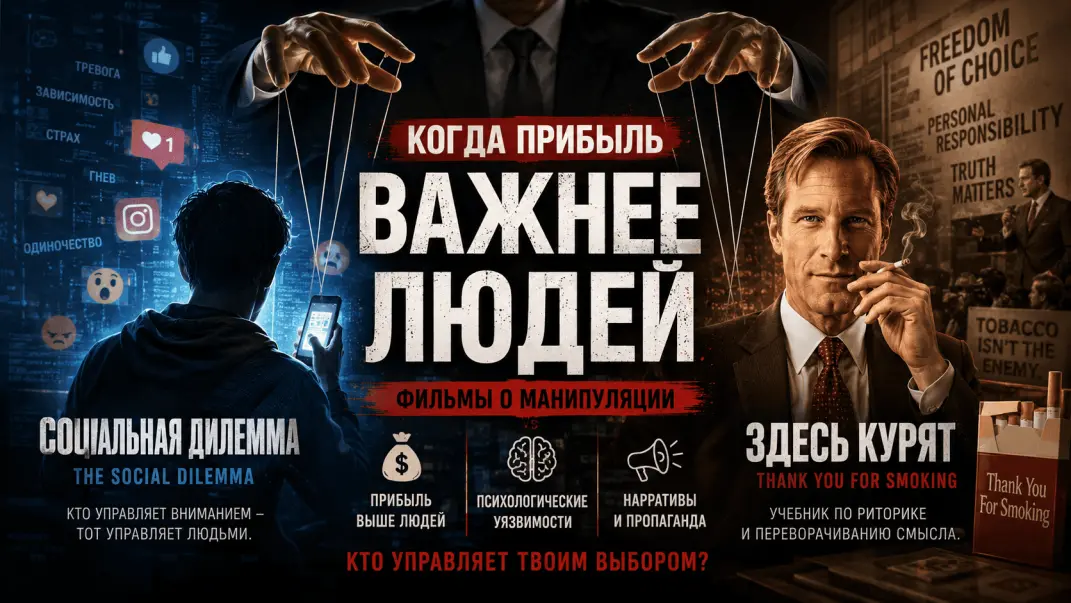
Both films explore how large industries (social media and tobacco) create systems that:
- they put profit above the public good;
- exploiting people's psychological vulnerabilities;
- create narratives justifying their activities.
Both films raise the question: where is the boundary between freedom of choice, business and ethical responsibility?
The films analyze exactly how human behavior changes under the influence of external propaganda or code, and how the personal benefit of corporations becomes higher than the interests of society.
1. The Social Dilemma (2020). Politics is already in the algorithms. Whoever controls attention controls people.
You wake up in the morning and the first thing you do is reach for a rectangle with black glass. Automatically. Almost reflexively. Like a man who hasn't opened his eyes yet, but is already looking for a dose. You call it a phone. A tool. A means of communication. Convenience.
But the "Social Dilemma" rips off this beautiful packaging in one motion and reveals the truth: it is not a tool. It is a perfectly polished cage in which a person is allowed to feel free.
There is no soulless code behind this glass. There's an insatiable mechanism in there, trained to absorb the most valuable thing you have—attention. Not money. Not data. That's attention. Because attention is a new oil, a new religion and a new form of slavery at the same time.
Each swipe is like a coin toss into the mouth of a huge digital machine. Each like is a small drop of blood that the system receives voluntarily. While you're eating, talking to your loved ones, falling in love, and being silent in front of the window of the night city, the algorithms continue to work. Cold. No sleep. Without pity. They study you better than you've studied yourself in your entire life.
"The Social Dilemma" is not a documentary. This is an X-ray of modern humanity. Rude, painful, merciless. After it, it feels like your head has been opened and the contents poured onto a metal table under a bright light. And there are too many alien thoughts among them.
The scariest thing is that the creators of social networks don't look like cartoon villains. They are calm, intelligent people with soft voices and sweet smiles. Former architects of Google, Facebook, Twitter. People who once realized that the human brain can be hacked just like a program.
They studied the physics of fear.
The mathematics of loneliness.
The chemistry of dopamine.
And they built an empire on it.
They're not showing you what's true. They show you something that will keep you going longer. Anger holds you back. Fear holds you back. Hate is the best deterrent. That's why social media feeds don't look like a window into the world, but like a room with crooked mirrors where people have long since stopped seeing each other. Now everyone looks only at the reflection of their own beliefs.
We argue, swear, and fight in the comments, and the algorithms watch it like Roman emperors watching gladiators in the arena. The more rage, the higher the engagement. The more chaos, the more expensive the advertising.
And at some point, it's not the technology that gets scary. But for the man.
Because the film asks a question that makes you feel cold inside: if artificial intelligence knows how to hold your attention better than you know how to hold yourself, then who really controls your life?
We live in an era where truth has lost out to speed. Where emotion is more important than fact. Where a person no longer chooses information, information chooses a person.
Your phone has turned into a one-armed bandit embedded right in the palm of your hand. Each notification is a calculated blow to the nervous system. A small electrical impulse: "Come back. Check. Maybe there's something important there." And billions of people are coming back. Again. And again. And again.
The most powerful thing about the "Social Dilemma" is not even the revelations. And the moment of recognition. When you suddenly realize that the movie is not about them. It's about you.
About how difficult it has become to sit in silence.
How scary it is to leave your phone screen down.
It's like a hand reaching out to check something that doesn't matter.
It's not a technology anymore. This is the digital training of humanity.
And, perhaps, the main idea of the film sounds terribly simple: you are a commodity.
Watch the "Social Dilemma" not for the sake of benefit and not for the sake of fashionable "conscious viewing." Watch it for the sake of one rare feeling — disgust. The system that turned human attention into a farm. And to myself for how easily we allowed ourselves to be put on this leash.
And then try to turn off notifications.
At least for three days.
The first hours will be like withdrawal. The world will become unusually quiet. Your fingers will search for the screen, like a smoker searching for a pack in an empty pocket.
But if you hold out, one day you'll catch yourself feeling strange.: You belong to yourself again.
And in a world where there is a war going on for your attention every second, this is already a small victory.
2. They Smoke Here (Thank You for Smoking) (2005). Textbook on rhetoric and inversion of meaning.
There are films that make you want to be silent.
And there are films after which you start to suspect every person in an expensive suit.
"They smoke here" is exactly like that.
This movie is not about cigarettes. The cigarettes there are just props. Like a gun in the hands of a magician. The real theme of the film is much dirtier and more dangerous: the art of selling poison to people so that they thank them for the packaging.
The main character is not a villain in the usual sense. He doesn't strangle people in alleys or brandish guns. He makes things scarier. He's smiling. He's joking. It's convincing.
Nick Naylor is a man who is able to sell a fire to someone who is already burning.
And the most unpleasant thing is that you start to admire him.
While some are shouting about morality, he's playing with words like a cardsharper playing with a deck. Easy. Elegant. Without a drop of sweat. He does not prove that cigarettes are useful. He does a much more subtle thing — he turns the truth into something secondary.
Because in the world of big money, the winner is not the one who is right. The one who controls the conversation wins.
"Thank You for Smoking" shows a modern society without makeup: corporations have not sold goods here for a long time. They sell the feeling. Style. The illusion of freedom. And if this requires convincing a person to voluntarily inhale their own death, well, the marketing department will simply select the right slogan.
This is a film about a time when morality became a decorative vase in a meeting room office. It stands beautifully in the corner, but no one needs it.
Every dialogue here is like a shot from a weapon with a silencer. No screaming, but definitely in the head. You laugh at the wit of the characters, and a second later you catch yourself thinking vile thoughts: this is exactly how the real world works.
Politicians. Advertisement. News. Social network.
Everyone has been trading attention, not facts, for a long time. Not with truth, but with emotion.
They don't sell you cigarettes.
They sell you the image of a man who smokes at a night bar with jazz and looks free.
They don't sell you a phone.
You're being sold a sense of self-importance.
They don't sell you war.
They sell you a sense of the right side.
And this is the main horror of the film: it shows how easily a person allows a beautifully packaged lie to settle in his head.
"They smoke here" is a satirical scalpel that reveals the era of consumption. An era where eloquence became a weapon of mass destruction.
After this movie, you start to look at advertising differently. For an interview. For a political debate. People who talk too smoothly.
Because the most dangerous predators of our time have long stopped baring their teeth.
Now they wear perfectly pressed suits, speak in a calm voice, and call manipulation communication.
And when the movie ends, one unpleasant thought remains.:
if a person is able to justify anything with beautiful words, it means that civilization can even be persuaded to self—destruction.
The main thing is to choose the right tone of advertising.
Smoking is bad. You must watch this movie.
Reviews of serious cinema by Violetta Wennman
I am studying at the Academy of Arts at the Faculty of Film and Arts Industry, I am a producer. And I'll tell you about a serious movie. If the movie is not serious, I will tell you how it got into this collection. Look at the truth before you become part of the lie.
I write and shoot. Join me
Author's video content
https://www.youtube.com/c/ViolettaWennman
Political trash
https://www.youtube.com/@Ship-Shard
I invite you to the telegram channel
https://t.me/shipshard
Highly Social on Zen
https://dzen.ru/shipshard
For goodies
https://dzen.ru/shipshard?donate=true
My hobbies are history, philosophy, psychology, music, economics, politics, and sociology. I write about this and much more. Professional model. She has performed at international music festivals (vocals, dancing, imitation of vocalists). I am studying at the Academy of Arts - the film and art industry, I am a producer and the owner of a video studio.
I am glad to see all of you on my blogs.

You won't lose me here. https://t.me/shipshard






