
Zen blog post in Russian
https://dzen.ru/a/agIPpexwrVziHVnZ
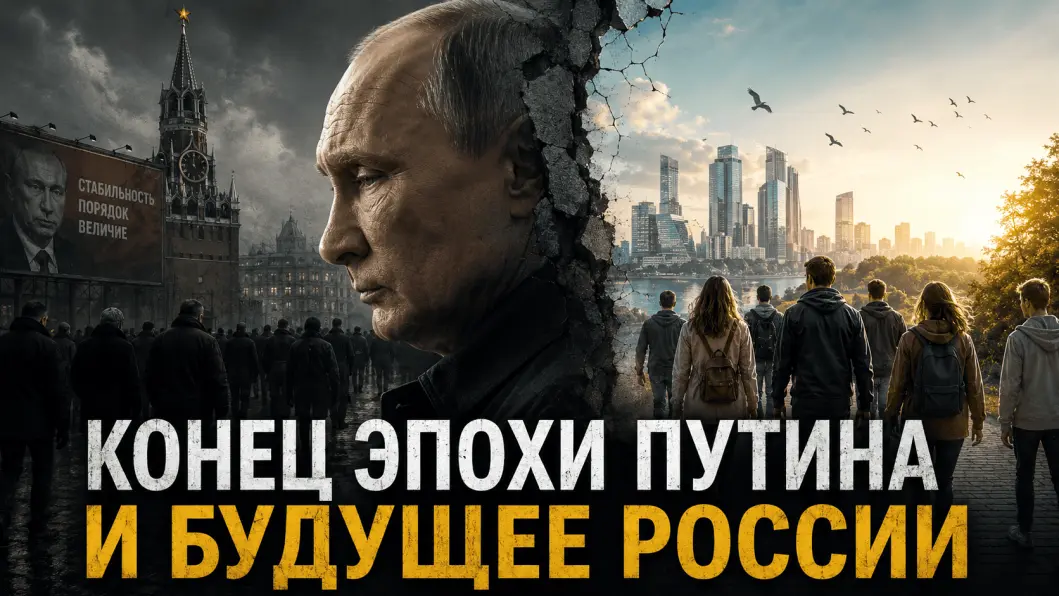
Putin's Russia is a state that has been living in a waiting mode for the future for too long. For twenty-six years, the country has existed between the television past and the postponed tomorrow. Between stories of greatness and fear of reality. Between imperial rhetoric and the fatigue of people who have long since stopped believing the words of power, but continue to pretend to believe it because it's safer that way.
When Vladimir Putin came to power, Russia was a tired country after the chaos of the nineties. People wanted simple things: stability, salaries, a sense that the state exists again. Putin gave exactly that. He built a system based not on freedom, but on exchange: you don't interfere in politics — the state doesn't interfere in your life. While oil prices were rising, this agreement was working. Russia was getting rich, Moscow was shining with glass skyscrapers, the middle class had mortgages, cars, travel and the illusion of normality.
But the problem with any system built around one person is that it gradually begins to work not for the sake of the country, but for the sake of its own preservation.
Russia under Putin has turned into more than just an authoritarian state. It has become a personalized system of government, where institutions exist only insofar as they serve the vertical. Parliament has ceased to be a place of discussion. The court is a place of justice. Elections are a mechanism for the change of power. Politics has disappeared as a phenomenon, giving way to loyalty management. Even the elites have ceased to be independent: governors, ministers, businesses, law enforcement agencies — everything is built into a system of personal dependence on the Kremlin.
The main ideology of Putin's Russia has become the fear of change. The state has been convincing society for decades that any alternative is worse. That without Putin, chaos will begin. That democracy is a weakness. That freedom leads to disintegration. That the whole world wants to destroy Russia. And the longer this system existed, the more it depended on a constant sense of threat.
That is why modern Russia exists in a state of endless mobilization — emotional, informational, and military. The country needs an enemy all the time. External or internal. Ukraine, the West, “traitors,“ "foreign agents," independent journalists, the opposition, the Internet, and their own citizens — the list has been expanding over the years. Because a system built on fear cannot allow society to calm down and start asking questions.
The war was not a deviation from Putin's model, but its logical continuation.
The year 2022 has completely changed Russia. After the outbreak of a full—scale war, the country entered a new historical stage - the era of a closed militarized state. The government began to demand from society not just passive loyalty, but participation: tacit consent, ideological discipline, and willingness to tolerate poverty, censorship, and isolation in the name of a “higher purpose.” Repression has ceased to be targeted and has become the norm of political life.
The most dangerous thing for Putin's system today is not even sanctions or war. The most dangerous thing is the disappearance of the image of the future.
Russia at the beginning of the noughties at least promised to move forward. Russia in 2026 is living in an atmosphere of historical freeze. The state no longer offers a dream. It offers patience. Not development, but survival. Not freedom, but stability at any cost. Not the future, but the endless past, turned into a cult.
That is why more and more people, even those loyal to the system, are beginning to feel an internal impasse. According to analytical materials from recent months, tension is growing within the elites: the war has dragged on, the economy is increasingly dependent on military spending and manual control, the struggle of various Kremlin groups is intensifying, and the system itself is becoming more nervous and suspicious.
At the same time, Putin's Russia remains stable. It is important to understand this. It won't collapse tomorrow morning. Authoritarian regimes rarely fall beautifully and quickly. More often than not, they rot from the inside for a long time, preserving their external monumentality. The USSR also seemed eternal a few years before the collapse.
But the longer such a system exists, the more devastating the consequences of its final crisis.
Russia's main problem after Putin will be that Putin has destroyed almost all the mechanisms of normal transit of power. There are no independent institutions in the country that society would trust. There is no free political competition. There is no habit of changing power. There is no strong parliament. There is no independent court. Everything has been based for decades on the construction of one person's personal power.
This means that after Putin, Russia will almost certainly face a period of turbulence.
There may be several scenarios.
The first is controlled transit. The Kremlin will try to transfer power to a “successor” while keeping the system almost unchanged. This is the mildest option, but even it does not guarantee stability: the successor will inevitably be weaker than Putin and will face a struggle of the elites for influence and resources.
The second scenario is an internal split of the system. Conflict between security forces, technocrats, regional groups, and economic elites can lead to a protracted crisis of power. Analysts are already detecting signs of hidden tension within the Russian leadership.
The third scenario is slow liberalization under the pressure of societal fatigue and economic reality. But this will not be a romantic “awakening of democracy,” but a difficult and painful process. After decades of propaganda, repression, and war, the country will have to relearn how to tell the truth to itself.
That will be the most difficult part.
The Putin era has not only changed the state, it has changed society. Millions of people are used to living in an atmosphere of cynicism, where no one believes the official words, but everyone continues to participate in the play. Where lying has become a part of everyday life. Where politics is perceived as dirt and danger. Where a person learns to be silent before thinking.
The consequences of this will be felt for decades.
After Putin, Russia will not automatically become free, rich, and democratic. On the contrary, the country is facing a difficult period of moral, political and economic disintegration of the old system. New repressions are possible. There may be attempts at an even tougher revenge. Russia's history shows that after periods of stagnation, the country often rushes from one extreme to the other.
But it is after Putin that, for the first time in many years, Russia will have a chance.
A chance to stop living in the past.
A chance to abandon the idea of an eternal besieged fortress.
A chance to understand that the greatness of a state is measured not by the fear of neighbors and the number of missiles, but by the quality of life of its own people, freedom, the law and human dignity.
Putin will go down in history as a man who managed to build an extremely stable system of government — and at the same time as the man under whom Russia lost historical time. A country with huge resources, talented people and enormous potential has spent decades not on developing the future, but on preserving the power of the past.
And when the Putin era ends, the main question will no longer be “who will come after him.”
The main question will be whether, after so many years of fear, war, propaganda and isolation, Russia will be able to learn to be a normal country again.
I write and shoot. Join me
Author's video content
https://www.youtube.com/c/ViolettaWennman
Political trash
https://www.youtube.com/@Ship-Shard
I invite you to the telegram channel
https://t.me/shipshard
Highly Social on Zen
https://dzen.ru/shipshard
For goodies
https://dzen.ru/shipshard?donate=true
My hobbies are history, philosophy, psychology, music, economics, politics, and sociology. I write about this and much more. Professional model. She has performed at international music festivals (vocals, dancing, imitation of vocalists). I am studying at the Academy of Arts - the film and art industry, I am a producer and the owner of a video studio.
I am glad to see all of you in my blogs.
You won't lose me here. https://t.me/shipshard






