
Publication in Russian on the Zen blog
https://dzen.ru/a/ah6-TD3UbHoYV6Vd
The price of "greatness": how military spending robs a country of its future. Fifty trillion dollars and the lost future of the country.
This story is about how the state has eaten away its future, how militarism and state greed are capable of devouring the country's future, turning human lives, science and development into fuel for fear and war. About how the state machine, justifying itself with "great goals," devours living time, human destinies and the future of the country, turning people into expendable material, and the meaning of existence into stupid waiting at the fence.

Introduction
"Reader, do not look for empty fun in this story or a simple mockery of the clerical tribe. This story is not about money or numbers, which departments are so fond of playing with. It's about the most terrible of earthly abysses — how, behind the magnificent decorations of grandeur and the roar of iron, the living human soul imperceptibly disappears, dries up and is blown away by the wind, and with it the only thing that God has given man: his Future."
Dead trillions
In a certain department... however, it's better not to mention which department. There is nothing more irritating than all kinds of departments, regiments, and offices, where the tables are full of their own importance, and the air is so dense with clerical significance that an ordinary fly, having flown in, immediately loses all living thought, becomes silent, and itself becomes like an ink spot on the government bill. There, among the green baize and inkwells that looked like convict burrows, a story happened that the human mind could hardly comprehend. However, in our evil times, the incomprehensible has become so settled between us that it has become the air we breathe, completely oblivious to its rotten, bureaucratic sweetness.
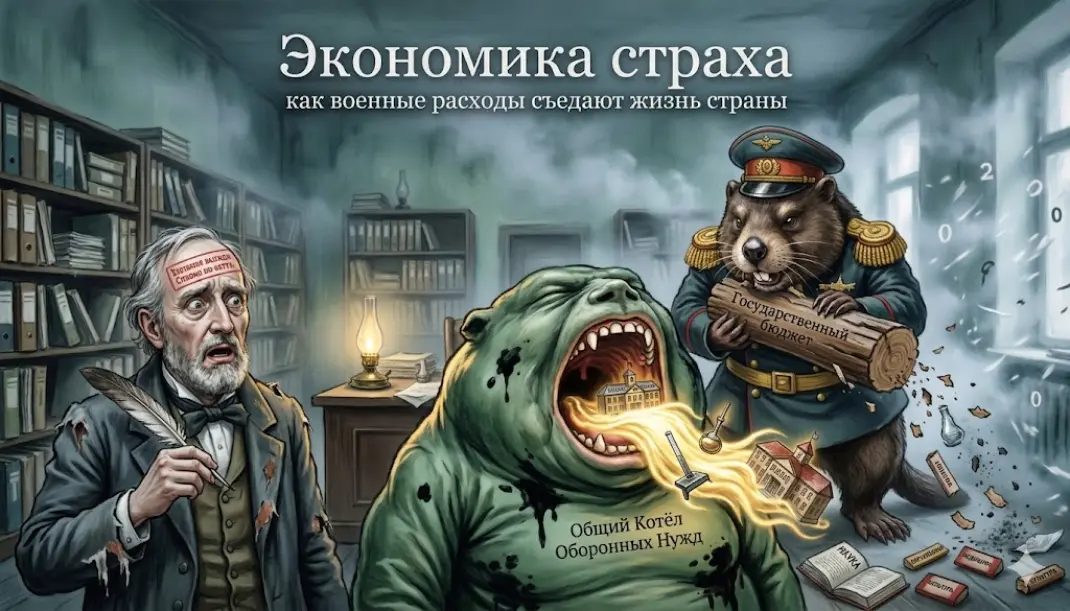
Once upon a time there was a collegiate assessor in this department… But no! The old one, poor fellow, had long since gone to his grave with his eternal greatcoat, crying so hard that even the harsh executioners blew their noses into their plaid handkerchiefs. The current hero's name was different. His name was the General Cauldron Of Defense Needs. This creature was completely without a face, without arms and without legs, but with such a monstrous, oily, insatiable appetite, which could not be found even in the cathedral archpriest on Shrovetide.
And it all started with the fact that on one damp, truly Petersburg night — or maybe not St. Petersburg, because now all our cities have merged into one endless, cold avenue, littered with wet snow — the phone rang in the office of a Significant Person. A significant Person was significant to an extreme degree that the petty bureaucracy had never dreamed of. There was absolutely nothing expressed on his face, perfect smoothness and mist; but it was in this majestic emptiness that the whole secret of his state power lay.
"Fifty trillion?" "What is it?" the Important Man asked, and his voice cracked like dry government paper soaked in rain. "Excuse me, darling, where am I going to go?"
But the receiver had already been hung up on the other end of the line. And in place of the machine itself, a huge bulletin suddenly appeared, and the numbers on it, with long tails of zeros, began to dance such a frantic cancan that anyone who tried to look at them would feel dizzy, their teeth would ache and any desire to look into tomorrow would disappear.
That's what they decided: so be it.
Fifty trillion is, if you think about it, a divine sum, purely abstract, which cannot be seen with mortal eyes. You can only catch the gray, cold shadow of her. And this shadow fell on the vast expanses of the state, covering the vegetable gardens, huts, booths and the very thoughts of the townsfolk with raw indifference.
At first, it seemed like nothing had happened. Well, just think, a trillion more, a trillion less! It's a familiar thing. But when the gray-haired treasurer opened the main flap with a tremor in his fingers, not a single gold coin fell out of it, not even a small shelf that had been filled up rang. Instead of gold, smoke poured out of the treasury's belly—thick, bluish, suffocating, with a pungent smell of burnt cloth, gunpowder, and fresh printing oil.
And it was here in the city of N (yes, dear readers, the action always takes place in the city of N, because the city of N is any point in Mother Russia where there is at least one block and a wooden fence) that the real devilry began.
The first person to notice something was a university professor of arithmetic, a venerable old man who had been counting other people's millions all his life, not out of greed—God forbid! — and only out of a platonic love for higher numerals. He was sitting in his chest-like room, drinking thin tea, through which Kronstadt was visible, and calculating. In front of him, on old newspapers, sat a skinny cat and, judging by its narrowed pupils, was also engaged in secret addition and subtraction.
The professor suddenly turned as pale as a hospital sheet, grabbed a quill pen and began to draw numbers directly on the tablecloth, which was covered with blueberry ink.
—Have mercy! He shouted at the empty corner where the spiders were dozing. — Why, with these fifty trillion dollars, I could build universities with golden domes, where students would learn only the pure truth! I could pave the streets not with this vile cobblestone, but with the purest crystal! I could give every peasant, every woman, and even a baby in the cradle a bag of pure gold, and there would still be plenty left over for honey cakes and Suzdal pictures!
But as soon as these crazy words left his lips, the room turned dark, as if in a cellar. From all the cracks, from under the baseboards and from old galoshes, small, thimble-sized officials in gray uniforms climbed out. There was so much importance in them that the floorboards cracked under their weight. They climbed onto the table like locusts, surrounded the cup of tea and hissed, splashing ink saliva.:
"Oh, is that how you feel? Don't you sympathize with the greatness of the Common Cauldron? Do you want enlightenment? Are you seeing schools, sir? Hospitals with clean sheets instead of beautiful, menacing, sealed with three wax seals of secret expense items?!
And the roundest of them, with a paunch so tightly covered with government cloth that his buttons squeaked, took a tiny seal out of his pocket and with an effort slapped the professor right in the forehead. An indelible mark was stamped on the forehead of the poor scientist: "Lost profits. Written off according to the act."
From that very moment, a terrible metamorphosis took place with the professor. He stopped seeing the living world. He walked through the streets of the city of N and saw only walking sheets and balance sheets instead of people.
A decrepit old woman in a darned handkerchief walks past him — and he sees not an old woman, but "two kopecks in banknotes for old age," and these kopecks, blown by the wind, immediately turn to dry dust.
A young dandy walks by, and before the professor's eyes flashes a stack of unburned diplomas stacked like firewood.
A child runs with a wooden horse, and instead of the child, an empty wheelchair rolls with the inscription "Count: Demographic loss," and it rolls straight into a ravine.
Beside himself with horror, the unfortunate professor ran to the department. He wanted to fall at the feet of a Significant Person, to shout: "Remember God! After all, these trillions are living souls! Not the dead, who were bought up in the Kherson steppes by the swindler Chichikov, but living, warm souls who could plow the land, sew boots and enjoy the sun!".
But as soon as he opened the heavy oak doors of the reception room, his tongue stuck to his throat.
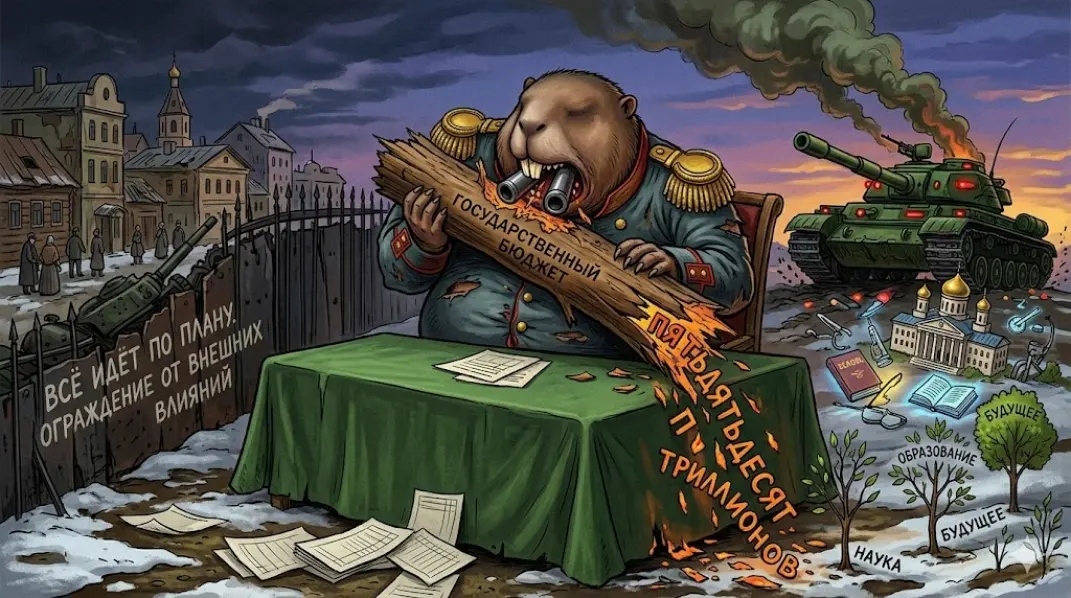
There was no man at all sitting at the table, which was covered with a ministerial-colored cloth. There sat a huge, incredibly thick Beaver, bloated with self-importance. He was wearing a uniform with gold embroidered buttonholes and gnashing his teeth, gnawing on a thick log. The log was nothing more than the state budget. The beaver gnawed on it with such a voluptuous appetite that the chips flew to all ends of the reception area. On one splinter that flew to the threshold, the professor made out the word "Vision", on another — "Scientific research", and on the third, very tiny one — "School textbooks". The beaver had already wrapped his clawed paws around the thickest branch, which was called "The Future," and with a deep rumble he plunged his yellow incisors into it.
— Your Excellency!.. — the professor whispered, crossing himself under the skirts of his coat and hoping that this was just an obsession from bad tea.
Beaver paused in his patriotic occupation and squinted at the newcomer with small, swollen eyes. That look was terrifying — there was such an icy, official emptiness in it that even flies freeze on the fly.
— Why are you talking heresy here, my dear? Beaver asked in a clear, official, even too human voice. — Can't you see that I have a government need? I'm building a fortress! The bulwark!
"But for pity's sake, Your Excellency, your fortress is made of sawdust!" — the professor pleaded, falling to his knees in front of the clerical beast. — It will scatter dust from the first European draft! Give these trillions to the people! Let them build factories, plow wastelands, give birth to small children! Let every person feel like the master of their land — and you will see how our desert will blossom!
The beaver suddenly began to swell, like a frog trying to catch up with an ox. His fur stood on end, turning into a stockade of sharp bayonets. He opened his mouth, but it was not teeth that could be seen in it, but the black, sooty muzzles of cannons, and he laughed so hard that glass rattled all over the block.
"What a fool you are, brother! Are you one of the seminarians? — he roared, enveloping the professor with the smell of gunpowder. — He wants to build me a city with happy people! What do I need with your happy people? A contented person is the most harmful being and incapable of order. He, the rascal, is now starting to ask questions: why are the roads bad, but where did the people's money go? And I, brother, need not to reason! I need them to tremble, pay taxes, and go into the ground without a sound! Your millions to people are pampering and a ticket to anarchy. And my shells are pure eternity. The projectile is a no—brainer, Father. He flies by himself, whistles and does not require any constitutions!
And the Beaver bit into the trunk of the budget with renewed ferocity.
The professor ran out into the street. It was snowing. But it was not divine winter snow, but finely chopped fragments of secret circulars and regulations. The inhabitants of the city of N walked the streets, catching these scraps with their mouths, imagining that it was manna from heaven, but the paper was bitter, like government glue, and left ashes on their lips.
On the main square, where they used to sell rolls, there was now a monument — a huge tank painted with green oil paint. With a deep rumble, he trampled the city's flower bed with Dutch tulips with his caterpillars, and this action was officially called "protecting national identity." Small children were walking around the tank and singing a sad psalm. The professor looked closer and froze: The children had no faces. Instead of eyes, noses, and mouths, they had smooth sheets of writing paper on which the clerk had written in a calligraphic stroke with emphasis: "Human material. It is suitable for general use."
The professor fell right into a dirty snowdrift and sobbed. At that moment, the whole terrible secret of the Common Cauldron was revealed to him. This cauldron didn't need gold coins—money was just a husk, a wrapper. This cauldron was powered by living Time! He devoured the coming years, chewed up the unborn generations, turned them into iron scale and threw them back into the world in the form of suffocating smoke, eternal fear and stupid, senseless pride.
— Nikolai Vasilyevich! The professor shouted into the gray Petersburg sky. — Dear one! Where's your three-piece bird? Where is she going? Give me an answer!
And the sky answered him with the ominous creak of unoiled runners.
Down the main street of the city of N, blowing up snowdrifts of paper junk and official letters, a frenzied, inexplicable, damn troika was rushing. But in the sleigh sat not a dashing coachman with a beard in mittens, but the same bloated Beaver in a ministerial uniform. Instead of reins, he had barbed wire in his paws, which tore the skin from the horses to the very blood.
And the horses… Good God, what horses they were!
Korennik was cast—iron, heavy, with searchlight eyes, spewing not steam from his nostrils, but stinking factory soot; he limped badly on his right leg, on the rump of which was burned: "Inflation."
The horse on the right was a pale, shroud—like mare with crazy, bulging eyes; the brand "Demography" gaped on her side, she wheezed, dropped bloody foam and could barely stand on her hooves.
The horse on the left was a skinny, mangy, starved nag with the stamp of consumption on its muzzle; it was the unfortunate "Science" that the driver was constantly regaling with blows from a heavy official boot.
The troika was rushing straight at the professor, the bell under the arc was filled with crazy, dead laughter. The scientist squeezed his eyes shut, expecting the cast-iron hooves to turn him into a cake. But with a terrible whoosh, the sled swerved and plunged straight into a tarry black hole that opened in the middle of the pavement. This hole led into a clear, hopeless void.
When the smoke cleared, the professor opened his eyes a crack. A brand-new, freshly painted fence stood at the site of the terrible sinkhole. Its planks were fitted so closely to each other that not a single ray of sunlight could break through them. And on the fence it was written in oil paint: "Everything is going according to plan. Protection from external influences."
The old man came closer. It seemed to him that he could hear a soft, plaintive crying coming from behind the boards. He put his ear to the pine gap. No, it wasn't people crying. They were crying unborn babies, unwritten books, undiscovered medicines for serious illnesses, unfinished bridges and unplanted gardens. Fifty trillion dead rubles, reduced to ashes, were crying. They cried that the great land, capable of becoming a garden of eden, had the madness to turn itself into a barren, scorched landfill.
The professor recoiled. A chilling, truly Gogolian thought reached him: the scariest thing in all this was not the Beaver and not his crazy horses. The scariest thing was that all the inhabitants of the city of N — merchants, officials, ladies and coachmen — walked past the fence with cheerful faces, pretending that there was no fence, that the smoke was sweet, and the official bitterness was a new kind of Little Russian honey.
He looked down at his hands, which were old, trembling, and stained with ink. He didn't have trillions to buy the fate of his land from Beaver. He only had the word.
Then he took a pencil stub out of his pocket and, right across the official word "Fence," he wrote in a flourish, clumsily, but boldly, what was burning in his exhausted heart.
He texted: "And the soul was drunk!"
Then he turned and walked away from the city of N, not knowing where he was going, into the dead of winter night. And the wind blew through the desolate squares, covering with snow human footprints and terrible numbers that ceased to be numbers, but became small grave mounds of a missed, deceived and unlooked-for future.
And it became quiet. It's as quiet as it is in public places before the arrival of the strictest, most formidable and inescapable auditor.
Afterword
"That's what a strange story happened in the city of N! Gone are the Chichikovs, who bought up dead revisionist souls for the sake of illusory wealth; now new enlighteners have appeared, ready to buy up and release living souls into the world for the sake of illusory eternity. But no matter how much the fences are painted with oil paint and no matter how loudly the psalms of the iron idols are sung, no one will be able to deceive the Chief Inspector. Therefore, dear reader, after looking into this mirror, do not rush to get angry, but quietly ask yourself in the silence of the night: "Is my soul still alive?""
The most terrible thing begins when the destruction of the future begins to be called order and greatness.
The Dark Art of Dystopia by Violetta Wennman
PARSING, SYMBOLS, MEANINGS.
WE ANALYZE, COMPARE, AND UNDERSTAND.
Welcome to a world where the future is already written.
I write and shoot. Join me
Author's video content
https://www.youtube.com/c/ViolettaWennman
Political trash
https://www.youtube.com/@Ship-Shard
I invite you to the telegram channel
https://t.me/shipshard
Highly Social on Zen
https://dzen.ru/shipshard
For goodies
https://dzen.ru/shipshard?donate=true
My hobbies are history, philosophy, psychology, music, economics, politics, and sociology. I write about this and much more. Professional model. She has performed at international music festivals (vocals, dancing, imitation of vocalists). I am studying at the Academy of Arts - the film and art industry, I am a producer and the owner of a video studio.
I am glad to see all of you in my blogs.

You won't lose me here. https://t.me/shipshard






