
Zen blog post in Russian
https://dzen.ru/a/aeYF1_g7a2H5_N7n
AFTER THAT, ROMANCE DIES.
The list is as dark as possible — without heroes, without hope, without illusions. Here politics is not an institution, but an environment where people survive, break and adapt.
Power is almost always a choice between bad or very bad. If you're looking for "justice" in politics, these films will quickly explain why this is a bad strategy.
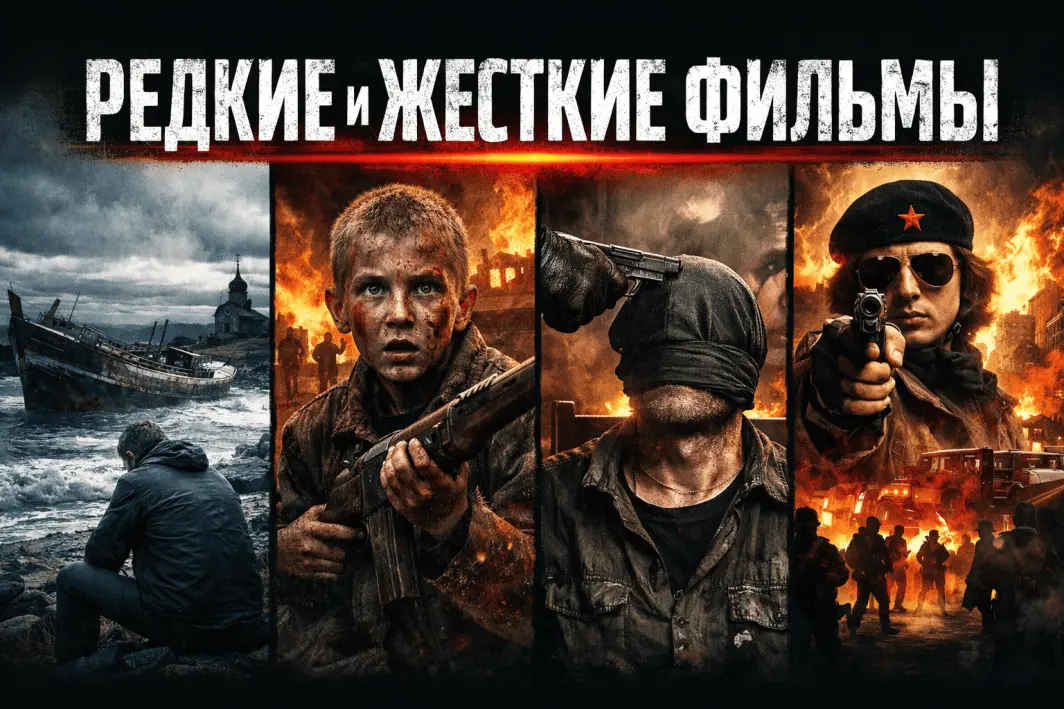
1) Leviathan (2014). Man versus the system is a predictable ending.
"Leviathan" is a cold, merciless analysis of how the system grinds a person, leaving only dust and vodka from him. There are no heroes here. There is no hope. There is only a dull, sticky reality where the truth is worthless, and the law is just a tool for the powerful. And if it seems to you that “it doesn't happen that way”, then you're either lying to yourself, or you're just lucky.
This film is not trying to please or flirt with the audience. It irritates, infuriates, and crushes—and that's why it hits the mark. After Leviathan, I don't want to discuss cinema: it's too recognizable, too honest, too painful.
This is the cold autopsy protocol of a country where a person is expendable, and the system is a god who needs neither proof nor conscience. There are no heroes here, because heroism in such a reality is just a form of suicide. There are only people who are slowly being ground by a machine that runs smoothly and without shame. Every frame is like a blow: a court where the decision is known before the beginning, a government that does not explain, but orders, faith, which has long learned not to save, but to coordinate.
The most annoying thing is that it's not "out there." It's painfully recognizable. "Leviathan" does not comfort or give hope — it simply shows the mechanism, removing the entire decorative layer from it. And the main question after watching it is not "is this a good movie", but "why does it seem so familiar".
It is convenient to call it "denigration". But it's much easier to blame the mirror than to admit that the reflection looks suspiciously like reality.
The film drains all "spirituality" down the toilet. There is no victory of good over evil here. Here, evil eats good for breakfast. You'll be furious. You will be yelling at the screen. You will reach into the refrigerator for the third bottle. Leviathan is not a movie. It's a toxic waste caught on camera. Look strictly at those who are already broken. For the rest, go watch the "Christmas Trees" before you have a heart attack.
Kinopoisk https://www.kinopoisk.ru/film/705356/
2) Come and See (1985). When the state breaks everything that makes a person human.
If you still think that war is about "heroism", "romance" and beautiful shots, just turn it on and try not to break down in the middle. This is not a movie for entertainment — it's filth, fear, screams and hopelessness, from which there is no hiding behind popcorn or pretentious music. There are no convenient characters and "right" emotions here — only reality, which is usually preferred not to notice.
While you're flipping through memes and discussing another "masterpiece" where the war looks like a clip with dramatic music, there is a movie that doesn't show — it burns through. Without special effects, without heroization, without trying to make it beautiful. You're not watching, you're inside. Next to a kid whose childhood disappears in a matter of days and everything human goes out. And this is no longer a metaphor, but an experience that cannot be dismissed with the words "well, this is a movie."
The most inconvenient thing is that there is no escape and there is no habitual meaning. There is not even an illusion that "everything was not in vain." There's a scorched earth, broken people, and you're in front of a screen, suddenly realizing how fake all modern attempts to "show the war" look. Because it's much easier to consume a glossy picture where everything is neat: emotions are on schedule, the characters die "correctly", and the viewer is left with a safe catharsis.
This is not the case here. There is nothing safe here at all. The film does not explain or lead by the hand — it just pokes its face into fear, into the dirt, into how a person turns into a shell in a few days. And after that, any talk about "the beauty of war," "the great mission," and "necessary sacrifices" begins to sound especially empty and disgusting.
While today the war is being sold as a "necessity" or even as content — with drones, graphics and cheerful summaries — here they show how it really ends. Not on the map or in the reports, but in my head. Where everything that makes a child human dies in a few days. And after that, it's impossible to take sterile language like "collateral damage" seriously. There is no "companion". There are people there.
If you feel comfortable living in a version of the world where everything can be beautifully explained, it's better not to include it. Because this movie takes away the most convenient thing — the illusion. And once you see it without filters, it's hard to pretend that "everything is not so clear."
Kinopoisk https://www.kinopoisk.ru/film/42571/
3) State of Siege (State of Siege) (1972). The dirty work of states behind the scenes.
"State of Siege" is a cold shower for those who still believe in fairy tales about "civilized methods" and "soft power." The film neatly, almost documentarily shows how democratic slogans turn into a screen for the dirty work of the special services. Without tantrums and without pathos. It's just the facts that make you feel uneasy. People are being grabbed, tortured, and broken—methodically, systematically, and quietly. And the most unpleasant thing here is not the cruelty itself, but the recognition: schemes, methods, rhetoric — all this has not remained in the past. It still works now, it's just that the packaging has become more modern, and the words are neater.
The film does not show “past dirt,” but a mechanism that is easily recognizable today: a power apparatus, convenient labels for dissenters, and external “legitimacy.” When the government declares any opposition a “security threat,” then arguments are no longer needed — the mopping-up mode is activated. External advisers, “experts" and training centers are being changed to more decent names, but the essence remains the same: security forces are taught not to protect people, but to suppress them. Emergency measures are almost always marketed as temporary, but then somehow become the norm. The most dangerous part is not bullets or arrests, but the language of justification. First, they explain to you why it is “necessary”, and then you already live inside this logic.
"State of Siege" is not scary because it shows a distant dictatorship. He's scary because of how easily he falls for today.: how the government incites fear on society, how repression is packaged into “order”, and how the exception becomes the norm. Flags, faces, and formulations change, but the pattern remains: first declare the enemy, then expand powers, then call violence a necessity.
If, after watching it, you don't have a question about who actually writes the rules of the game, then you weren't looking with your eyes, but with the background. This movie is not about history. This is an instruction for recognizing what is already working next to you again. The hero here is the one who dared to say “enough is enough" to the system, while others like the posts about freedom. And at some point, the film ceases to be an observation from the outside. He quietly throws up uncomfortable questions.: who exactly is considered an “enemy of the state” — the one who destroys the system, or the one who prevents it from destroying others? Where does the “peaceful protest” end and the real action begin? And how safe is the observer's position if the rules of the game are written without your participation? Who is actually called an “enemy of the state” — a murderer or someone who prevents killing? And where would you be if your country was declared a “zone of interest" tomorrow? Do not watch this movie if you are afraid to see in the mirror not the viewer, but an accomplice. "State of Siege" simply captures reality in such a way that it is difficult to pretend after that that you are out of politics. Because politics is no longer somewhere. She's been inside everyday life for a long time. Whether you want it or not.
Kinopoisk https://www.kinopoisk.ru/film/58886/
4) The Baader Meinhof Complex (Baader Meinhof Complex) (2008). Radicalization as a response to the system — and a dead end.
"The Baader Meinhof Complex" is not a film for those who still romanticize the "revolution" as a beautiful poster picture. There are no heroes here. There are people who have decided that their ideology is more important than human life, and step by step they descend into violence, hiding behind loud words. This movie methodically and coldly shows how radicalism is born out of protest, and terror out of radicalism. Where is the line between conviction and fanaticism —and who decides when it can be crossed?
This is not a film about the "romance of protest." This is an autopsy of how terrorists with delusions of self-righteousness grow out of educated and conscious people. When ideology replaces reality, a person starts shooting not at the system, but at random people, just to prove to himself that he is "fighting."
This is a film about how the state raises monsters and then wonders at their fangs. Germany in 1967-1977 was a police state with a glossy wrapper. And the film clearly lays out this reality in layers. First, the violence of the authorities: a shot in the head of a student at a peaceful demonstration, impunity, lack of justice. Then there is the criminalization of protest: laws, prohibitions, searches, surveillance. Civilians turn into illegals, illegals turn into fighters. And finally, escalation is the only language: when you're gagged, you start talking with fire.
The film does not justify the RAF. He shows them hunted down, paranoid, mistaken. But he also honestly shows that there was no other side to the dialogue. The answer is not a conversation, but isolation, prison, and pressure.
The main question that makes one's jaw clench is: who created the RAF — a handful of radicals or a democratic state that abandoned democracy at the first threat? The answer is not spoken out loud. It is lined up in frames — mirrored, almost symmetrically. The methods are different. The logic is the same: "the end justifies the means."
There is no moral solace here. Everyone is either an executioner, a victim, or both. This is a film that leaves not inspiration, but disgust. To everyone. And that's his strength. He shows that terror is not a system failure. This is its continuation. Logic pushed to the limit.
This film is obligatory for those who believe that the authorities are always right. Those who believe that protest should only be peaceful, even when peace is paid for with bullets. And to those who are afraid to honestly answer the question: "What would I do if the state declared me an enemy?"
"The Baader Meinhof Complex" is not about the past. It's about any present where the authorities stop listening and the street stops being afraid.
You can hate the RAF. But if, after watching it, you didn't feel anything for the system that gave rise to them, you either looked inattentively or didn't want to see it. The film is not for the faint of heart. And definitely not for the loyal ones.
Kinopoisk https://www.kinopoisk.ru/film/279756/
Reviews of serious cinema by Violetta Vennman
https://dzen.ru/suite/072e5647-baab-42b2-b25f-82023debee16
I am studying at the Academy of Arts at the Faculty of Film Industry and Arts, I am a producer. And I'll tell you about a serious movie. If the movie is not serious, I will tell you how it got into this collection. Look at the truth before you become part of the lie.
I write and shoot. Join me
Author's video content
https://www.youtube.com/c/ViolettaWennman
Political trash
https://www.youtube.com/@Ship-Shard
I invite you to the telegram channel
https://t.me/shipshard
Highly Social on Zen
https://dzen.ru/shipshard
To buy caramels to ruin your teeth
https://dzen.ru/shipshard?donate=true
My hobbies are history, philosophy, psychology, music, economics, politics, and sociology. I write about this and much more. Professional model. She has performed at international music festivals (vocals, dancing, imitation of vocalists). I am studying at the Academy of Arts - the film and art industry, I am a producer and the owner of a video studio.
I am glad to see all of you in my blogs.


I'm waiting for you here so I don't get lost. https://t.me/shipshard






