
Zen Blog post in Russian
https://dzen.ru/a/aiRrDOWs_RqZ_dow
Russia's economy is at its limit: steady growth or dangerous overheating? The Russian economy is on the "right track": what Putin's statement at the SPIEF hides. On the right track, but not without problems: an analysis of Putin's statements about the economy.
On the sidelines of the St. Petersburg Economic Forum, Vladimir Putin said that the Russian economy is "on the right track" and "feels confident." This statement sounds weighty, especially against the background of past predictions about its imminent collapse, but to what extent does it reflect the real state of affairs? Is the declared confidence an objective fact, or is it just a convenient political assessment for an external and internal audience?
If we discard the official rhetoric, reality turns out to be much more complex and layered. Let's look at what real figures this statement is based on, what it is absolutely true about, and what system challenges and hidden threats official reports prefer to keep silent about.
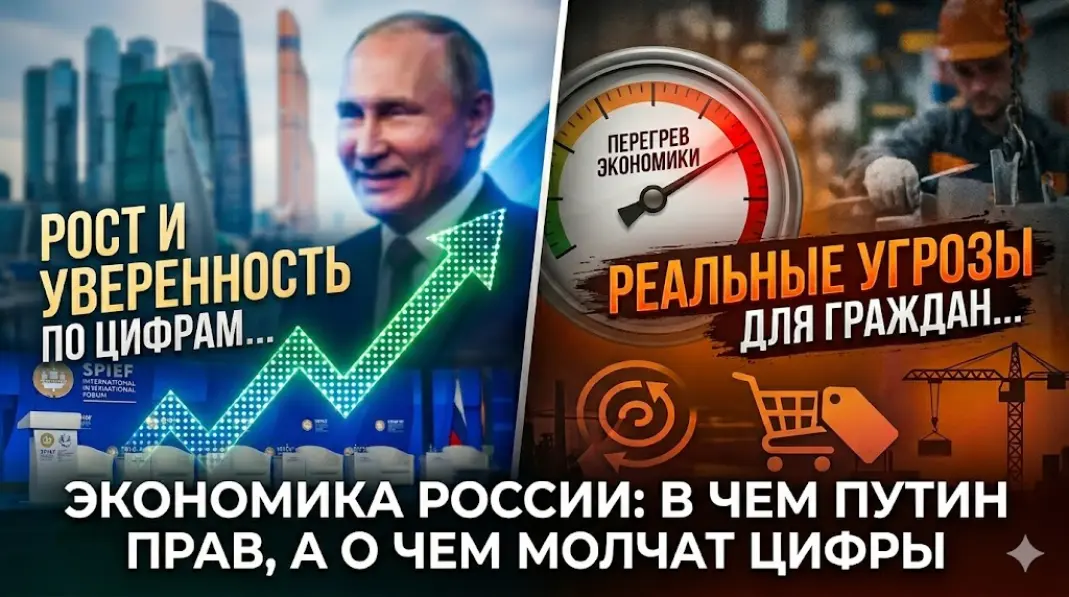
Vladimir Putin's statement at the St. Petersburg International Economic Forum that the Russian economy is "on the right track" and "feels confident" is not just a routine political slogan, but a record of the deep transformation in which the country has been living in recent years. There is a significant amount of truth in these words, confirmed by the dry figures of macro statistics, but they also hide the most complicated underside, which is not customary to talk about in the grand stands. To understand the reality of modern Russia, this statement must be decomposed without illusions, comparing the official facade with the tectonic processes within the system.
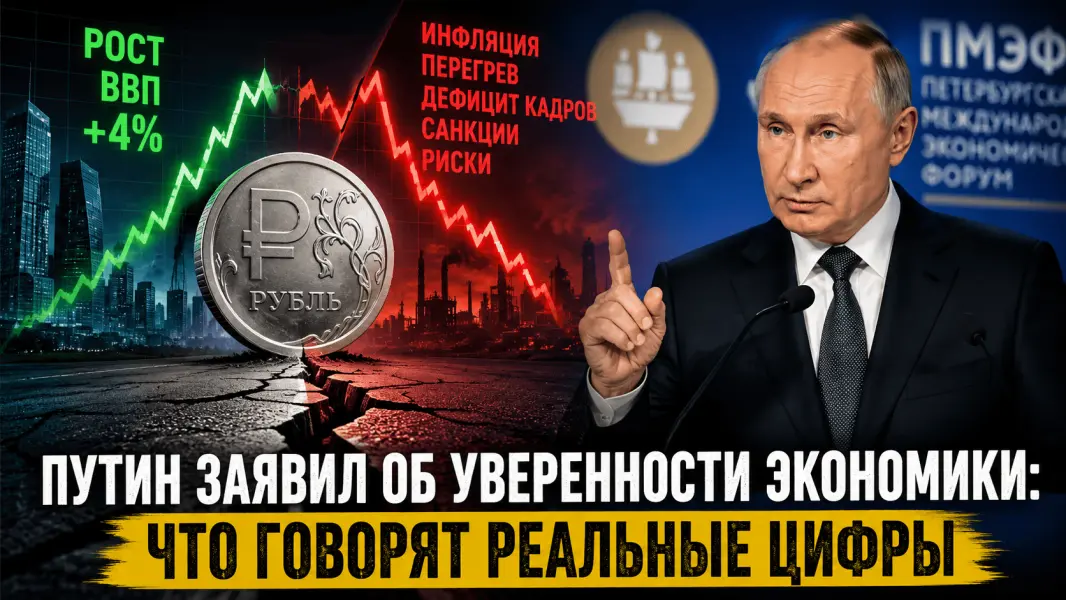
The foundation on which this confidence rests is really strong, and Western forecasts of an imminent collapse, financial crisis, and budget hole have completely failed. The Russian economy has demonstrated an unprecedented level of adaptation, proving its phenomenal resilience. The main driver of today's growth is a huge fiscal boost. After a decline of 1.2% in 2022, GDP showed a steady rebound: 3.6% in 2023 and about 4% in 2024. Even now, at the peak of overheating, the forecasts of the Central Bank and the IMF converge around 1.5–2.5% growth.
The government is investing heavily in the military-industrial complex and related industries, which has triggered a powerful chain reaction along the entire production chain. Manufacturing, metallurgy, mechanical engineering, logistics, and construction are operating at their maximum capacity. This led to a record decrease in unemployment to a historic low of 2.3–2.5%. As a result, fierce competition for staff arose, which triggered a boom in real wages, which grew at double-digit rates (up to 12-18% in some places). Businesses are forced to outbid employees, from qualified engineers to couriers and taxi drivers. In the province, people started receiving money they hadn't seen in years, which spurred consumer activity, retail, and domestic tourism. Additionally, the system insures a current account surplus.: Commodity exports have successfully expanded to the East, and Russian Urals crude oil is steadily selling around $65-70 per barrel, completely ignoring the Western price ceiling. From the point of view of short-term accounting of state corporations, the system demonstrates paradoxical strength.
However, this rapid growth has a hidden, deeply disturbing underside. Economists call what is happening "military Keynesianism" in its purest form. The current upswing is not based on healthy market development, but on a large-scale redistribution of state funds. Defense plants produce products that are disposed of on the battlefield, they do not participate in further economic turnover and do not create a civic benefit. At the same time, record low unemployment is not a sign of health, but a demographic and mobilization disaster. The economy has reached the ceiling of labor resources: mobilization, contract service, emigration and the outflow of hundreds of thousands of the best specialists to military enterprises have drained the civilian sector. There is no one else to grow at the expense of, and the forced wage race is not supported by an increase in labor productivity — we pay much more, but we do not produce more civilian goods.
This is a classic inflationary spiral. Official inflation stubbornly remains above 8-10%, while real inflation, felt by citizens through receipts in stores, is approaching 20%. In an attempt to contain this fire, the Central Bank is forced to tighten the screws, keeping the extreme key rate at 18-21%. Such a tight monetary policy is hitting the non-military sector: commercial loans have become prohibitively expensive, market mortgages have died, and private businesses are cut off from investments for development. At the same time, the declared "technological sovereignty" in fact often turns into a total change of dependence. Depreciation of fixed assets in aviation, complex machine tools and microelectronics has become critical, and "import substitution" has turned into labeling Chinese and Turkish analogues. Even settlements in yuan and rupees are constantly in turmoil due to the risks of secondary sanctions for foreign banks.
A statement at the SPIEF is a session of strategic political optics with specific addressees. For the countries of the Global South, this is a signal that sanctions are not working and Russia remains a reliable partner. For the domestic elite, there is a requirement not to withdraw capital and invest at home, despite the Central Bank's suffocating rate. For the population, legitimization of difficulties: The message is that inflation and expensive loans are a temporary payment for a geopolitical victory.
The bottom line is that the immediate collapse scenario has been completely refuted — the banking system is stable, the ruble is functioning, businesses are operating, and the budget has enough safety margin for the foreseeable future. But to claim that the country has solved the structural problems is manipulation. It is very similar to a marathon runner who has taken powerful stimulants: right now he is running faster than anyone else, his performance on the scoreboard is surprising and exciting, but his body is working to the limit, resources are running out, and there is still a large part of the distance ahead that will have to be overcome without the opportunity to stop and catch his breath.
Afterword
This analysis was written not to take sides in a protracted geopolitical dispute, but to try to capture reality without propaganda noise. The mistake of many critics today is that they continue to predict the imminent collapse of the system, stubbornly ignoring its obvious financial stability and adaptability. The mistake of the official reports is in an attempt to pass off the forced defense overheating as a harmonious and healthy development.
However, as is often the case, it is in the middle and does not fit into black and white schemes. The Russian economy has indeed survived, but it has changed beyond recognition. We have witnessed a unique historical experiment where huge government investments temporarily masked long-standing structural problems. But the laws of economics cannot be deceived: sooner or later you have to pay for any forced breakthrough. And the main question of the coming years is what this price will be when the effect of "stimulants" inevitably begins to weaken.
I write and shoot. Join me
Author's video content
https://www.youtube.com/c/ViolettaWennman
Political trash
https://www.youtube.com/@Ship-Shard
I invite you to the telegram channel
https://t.me/shipshard
Highly Social on Zen
https://dzen.ru/shipshard
For goodies
https://dzen.ru/shipshard?donate=true
My hobbies are history, philosophy, psychology, music, economics, politics, and sociology. I write about this and much more. Professional model. She has performed at international music festivals (vocals, dancing, imitation of vocalists). I am studying at the Academy of Arts - the film and art industry, I am a producer and the owner of a video studio.
I am glad to see all of you in my blogs.

You won't lose me here. https://t.me/shipshard






