The uncomfortable weak point in self-custody is often not the wallet—it’s what happens when the wallet is gone
A few years ago, I thought hardware-wallet security was mostly about the device.
Buy a reputable wallet.
Keep the recovery phrase offline.
Never type it into a website.
Verify transactions on the hardware screen.
Simple enough.
But there is a slightly uncomfortable question that does not get nearly as much attention:
What happens when the hardware wallet is no longer there?
Not hacked.
Not compromised.
Just gone.
And suddenly, the cheapest part of your entire security setup becomes the most important object you own.
【Hypothetical Example】 The Wallet Survived the Plan. The Backup Didn’t.
Imagine someone setting up their first hardware wallet properly.
They write the recovery phrase on the card supplied in the box, place it inside a drawer, and do exactly what they were told: never photograph it, never upload it, never type it into a computer.
Three years pass.
The wallet still works.
Then the owner moves house.
A box gets misplaced. A pipe leaks in storage. The recovery card is eventually found—but several handwritten words are blurred badly enough that the owner cannot confidently distinguish them.
The hardware wallet may still work today.
But the recovery plan is already broken.
That is the part of self-custody people tend to underestimate.
Your Hardware Wallet Is Not Your Backup
A hardware wallet protects the private keys used to authorize transactions.
The recovery phrase serves a different purpose.
It is the information that may allow the wallet to be reconstructed if the original hardware device is:
- Lost
- Damaged
- Reset
- Stolen
- Replaced
- No longer functional
These are two different security layers.
If the device disappears but the recovery phrase is intact, recovery may still be possible.
If the device survives but the only recovery copy is unreadable, the owner is depending increasingly on a single piece of hardware continuing to function indefinitely.
That is not the position I would want to discover five years into self-custody.
Paper Is Remarkably Good—Until It Isn’t
I actually think paper gets criticized too aggressively.
It has some major advantages.
It is inexpensive.
It does not need electricity.
It cannot be remotely hacked.
You can read it without proprietary software.
For a carefully protected backup stored in an appropriate environment, paper can work.
The weakness is that paper and ink were never designed specifically for multi-year disaster-resistant secret storage.
Possible failure modes include:
- Water damage
- Humidity
- Ink fading
- Tearing
- Fire
- Accidental disposal
- Poor handwriting
- Words being copied incorrectly
- Someone finding the sheet and immediately understanding what it is
None of these problems means everyone needs a metal backup.
But once the amount being protected becomes meaningful, it is reasonable to ask whether the physical recovery layer deserves more attention.
Then I Learned Something Interesting About BIP39
Here is the part that initially surprised me.
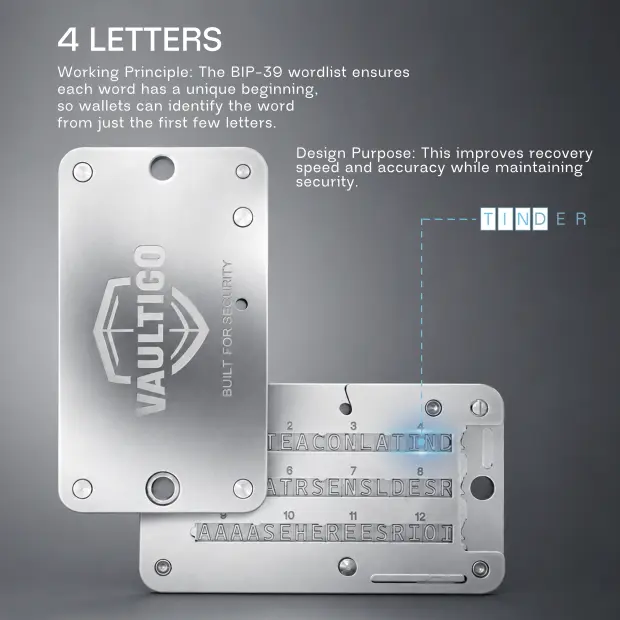
A standard English BIP39 recovery phrase does not necessarily require the entire spelling of every word to identify that word.
The BIP39 word-list design specifies that words can be uniquely identified by their first four characters.
Take a few examples:
aban→ abandonabil→ abilityacce→ accessacci→ accidentacco→ account
That is not a trick invented by a metal-backup manufacturer.
It comes from how the BIP39 word list itself was designed.
And that gave me a different way to think about physical recovery storage.
Instead of asking:
How do I permanently engrave 24 complete words?
You can ask:
How do I preserve the identifying information accurately, physically and offline?
Why the First Four Letters Matter
For a standard English BIP39 phrase, the four-letter approach can make a physical backup considerably more compact.
A 24-word phrase can otherwise mean recording a large number of characters permanently.
Reducing each word to four identifying letters simplifies the physical task while retaining the information required to identify the corresponding BIP39 word. CryptoSafeKit also has a detailed explanation of the four-letter design and its relationship to the standard.
There are still important rules:
- Word order must remain correct.
- Every recorded letter must be checked carefully.
- The system must match the recovery standard you actually use.
- A BIP39 passphrase is a separate secret and is not represented by the mnemonic words.
- You should not assume a four-letter system applies automatically to every proprietary or non-BIP39 recovery format.
Compact does not mean careless.
The backup still deserves the same verification discipline as the original phrase.
This Is Where Our Own Design Came From
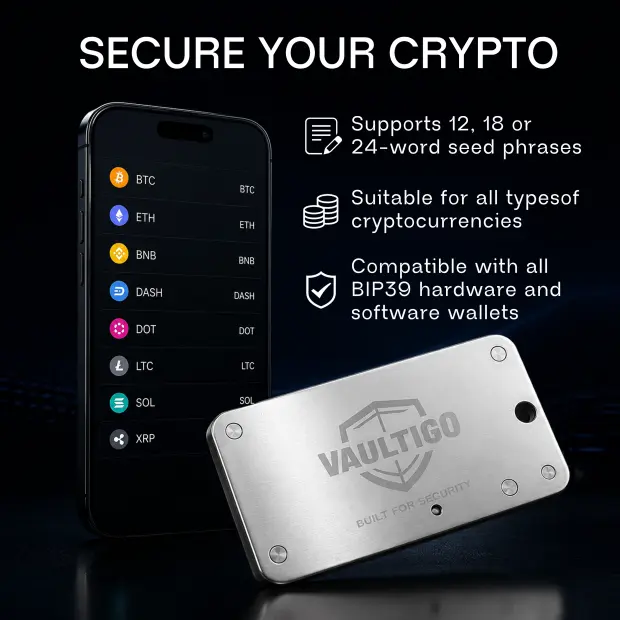
This is also one of the reasons we started offering the VAULTIGO 4-Letter Metal Seed Phrase Backup System through CryptoSafeKit.
Rather than engraving complete words onto a plate, the design uses reusable metal letter pieces to record the identifying characters of a standard English BIP39 recovery phrase.
The current design is intended for 12-, 18-, and 24-word recovery phrases and keeps the backup completely offline. CryptoSafeKit describes the system as using reusable metal letter tiles inside a stainless-steel structure, without requiring the user to permanently hammer or engrave each individual character.
What I like about that approach is not that it makes a wallet “unhackable.”
It does not.
And we should be very clear about that.
What a Metal Backup Actually Protects Against
A physical seed backup solves a fairly narrow problem:
preserving recovery information when paper is no longer the storage medium you want to depend on.
It can help reduce dependence on:
- Paper and ink
- Screenshots
- Notes applications
- Cloud documents
- USB drives
- Batteries
- File formats
- Internet-connected storage
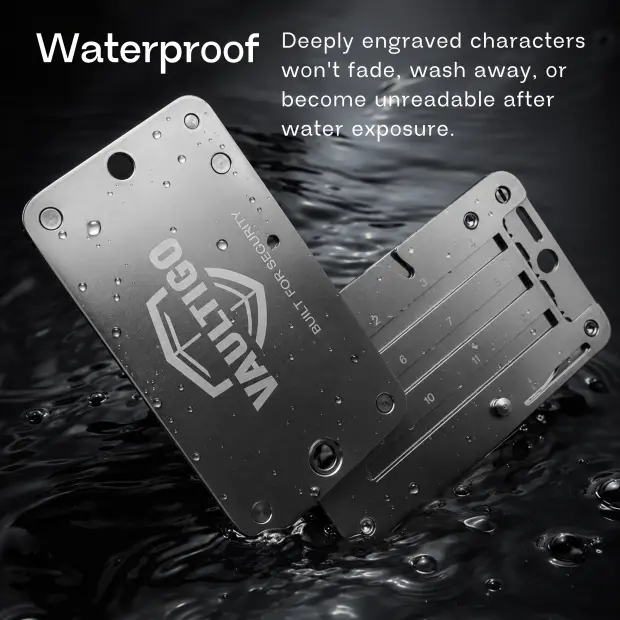
The VAULTIGO design also includes a physical locking point, allowing the assembled unit to be incorporated into a broader physical-storage plan. The product is currently described as using a water- and corrosion-resistant stainless-steel construction.
But that still does not make it a complete wallet-security solution.
A metal plate cannot protect you from:
- A malicious transaction you approve
- Phishing
- Someone discovering the completed backup
- Coercion
- A compromised or poorly generated seed
- A forgotten BIP39 passphrase
- Recording the wrong letters
- Incorrect word order
- Storing the wallet and backup together and losing both
This distinction matters.
Security products become dangerous when people expect them to solve risks they were never designed to solve.
One Thing I Would Never Do
I would not keep the hardware wallet and complete recovery backup in the same bag, case or obvious drawer.
It feels organized.
But from a risk perspective, it can turn two independent security layers into one failure point.
Someone stealing one container could obtain both.
A single physical accident could affect both.
A better setup usually asks:
What event could destroy or expose both of these at the same time?
Then separate accordingly.
CryptoSafeKit’s broader cold-storage guidance makes the same point: a durable backup is one layer in a larger self-custody system, not a standalone security guarantee.
The Other Mistake: Making the Backup Too Complicated
There is another extreme.
People can build recovery systems so clever that their future selves cannot understand them.
Hidden substitutions.
Homemade encryption.
Words reordered according to a secret pattern.
Missing words stored elsewhere.
Cryptic hints.
Five locations with incomplete fragments.
It may feel sophisticated today.
Ten years later, it may become indistinguishable from data loss.
A recovery system should be difficult for an attacker to obtain, but understandable enough for the legitimate owner to actually recover.
Those goals are not always the same.
Before You Trust Any Physical Backup, Test the Logic
I would verify a metal backup before treating it as finished.
That does not mean typing the recovery phrase into a random website.
Instead:
- Check every recorded character against the original phrase.
- Confirm every word position.
- Confirm the wallet actually uses the expected recovery standard.
- Verify that the four-letter representation uniquely maps back to the intended English BIP39 words.
- Keep the original temporary record until the metal copy has been carefully checked.
- Follow the hardware-wallet manufacturer’s documented recovery-verification process if you perform a recovery test.
And never send your phrase to the seller.
We do not need it.
Neither does Ledger.
Neither does Trezor.
Neither does Tangem.
Neither should anyone appearing in your DMs claiming to be support.
The Most Expensive Part of Self-Custody Might Be the Cheapest Object
This is the strange thing about crypto security.
You might own:
A $150 hardware wallet.
A $1,500 laptop.
A smartphone worth $1,000.
A portfolio worth considerably more.
Yet access to all of it may eventually depend on a recovery phrase written with a 20-cent pen on a piece of paper.
That does not automatically make paper wrong.
It just makes the risk allocation worth thinking about.
The device protects everyday signing.
The backup protects your ability to come back when the device is gone.
They deserve separate attention.
Why We Built the VAULTIGO 4-Letter Option
We did not want to build something that required users to upload recovery words, connect a device, install proprietary software or send sensitive data anywhere.
The idea is much simpler:
Take a valid standard English BIP39 recovery phrase that you generated privately, preserve the identifying characters physically, verify them carefully, close the backup and store it offline.
That is what the VAULTIGO 4-Letter system is intended to do.
Nothing more.
Nothing magical.
If you are interested, I have put the product details and our broader self-custody guides on CryptoSafeKit.com.
But even if you never buy one, I think the underlying question is worth asking:
If your hardware wallet disappeared tonight, how confident are you that your current recovery backup would still work five or ten years from now?
I’m Curious How Everyone Here Handles This
There seems to be no single consensus even among experienced crypto users.
Some swear by paper.
Others use engraved plates.
Some use letter-tile systems.
Some maintain two geographically separated physical copies.
Others use Shamir-based recovery or multisig instead of relying on one traditional phrase.
So I would genuinely like to know:
What are you using right now?
- Paper
- Metal backup
- Multiple physical backups
- Shamir / multi-share recovery
- Something else
And more importantly:
What made you choose it?
Share your setup philosophy in the comments—but obviously, never share your actual recovery words, passphrase, PIN, storage location or private keys.
I suspect there are some very different approaches here, and this is one of those topics where the comments may be more interesting than the article.
Security note: A metal backup improves physical recovery storage; it does not make cryptocurrency immune to theft, phishing, malicious signing, weak seed generation or physical compromise. Never enter a recovery phrase, private key, PIN or BIP39 passphrase into an unsolicited website, support form, cloud document or messaging application.






