
Publication in Russian on the Zen blog
https://dzen.ru/a/Zt1vl5KRdgfoSMkt
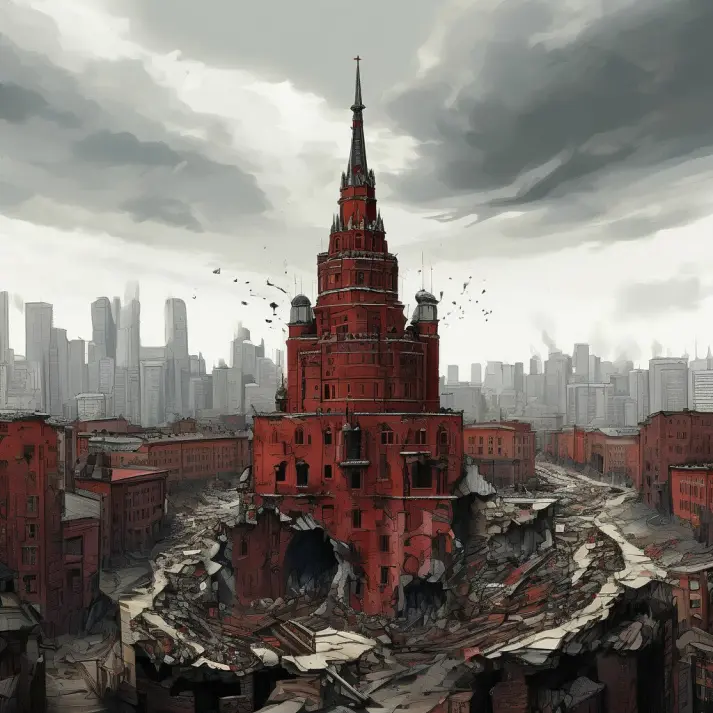
The mattress, stuffed with revenue, looked plump until the heavy canopy overhead collapsed.
Russia, as Moscow officially reports, lacks independent analysis and transparency, raising serious doubts about the accuracy and reliability of the financial figures presented. Consequently, these figures cannot be confirmed with certainty. However, it is possible to reasonably assess Russia’s economic and monetary stability using an indirect approach that uses the accounting equation, mainly taking into account oil and gas revenues. A simple mathematical model can be built based on market transactions that are valued according to generally accepted accounting principles, such as market price or book value, to obtain a more accurate picture. By analyzing these transactions, we can obtain reported revenue and a more accurate estimate of actual profit. Since profits form the basis for tax revenues, this approach allows for a more realistic assessment of Russia’s financial position. Moreover, by conservative estimates, Russia has taken on financial obligations that exceed the capacity of its National Welfare Fund. The financial difficulties are exacerbated by international sanctions, which have severely limited Russia’s ability to issue bonds and access external financing, in stark contrast to the mechanisms available in free democracies. The impact of these sanctions on Russia’s financial position supports the thesis that the country may be approaching insolvency or even bankruptcy.
I INVITE YOU TO THE TELEGRAM CHANNEL
UNCENSORED
https://t.me/shipshard

In this post I want to talk about something very important, why the Russian government is bankrupt today, this is something that everyone else in the world is missing, I have not seen anyone mention this and I invite you to speak up and correct me if I am wrong with these numbers and these data. The basic premise is that it is like you are in the uncanny valley where something is slightly wrong but you can’t quite put your finger on it. When I was a kid, I used to listen to shortwave radio because there was no internet or even computers when I was a kid, this was during the Soviet Union. They would always say that everything was great financially, everything was fine financially, the country had good revenues and a surplus. But I kind of knew that something was wrong and that it wasn’t true. And when up until the day of the collapse of the Soviet Union they were still saying that everything is fine, nothing is happening, the country has a surplus and so on, and this is very important, it is almost supernatural, it is like a parallel to today, when everyone is saying that everything is fine with the Russian budget, except that there is a small deficit this year. But let's look at the facts and the evidence that the Russian government cites, and you know that any claim that they make is not true, because THERE IS NO TRANSPARENCY AND NO INDEPENDENT VERIFICATION. For example, if a company does not allow transparency and verification in the United States, then it becomes clear that something is missing, something is wrong. So let's face it. Russia has 393 billion in projected revenues and 411 billion in projected expenses. Which leads to an 18 billion budget deficit. It's like everyone is blind. Let's continue, because there is also the National Welfare Fund of 140-something billion, but even that is a stretch, these numbers are wrong. Let's look at circumstantial evidence. People confuse oil and gas revenues with profits from oil and gas sales. And oil and gas revenues are down significantly now: sanctions are in place. The current revenue is 660 million a day. Multiply that by 365, which gives 240 billion projected for the year. And everyone knows that profit is only a small part of that revenue. However, the official Russian government is now stating that the expected profit from oil and gas in 2024 will be 113 billion. According to Western estimates, the profit for Russia is less than 100 billion, 50 billion to be exact. But let's say it's 75 billion in 2024, and it depends on the value of the ruble and if the price of oil stays and so on, which I'm skeptical about, but let's say it's an average of 75 billion in profit. Most people should know that income is different from profit, because it includes the estimated oil and gas portion of the budget in the form of tax revenues from revenues, which is 50%. Let's assume that the government takes 100% of the undistributed profits from the sale of oil and gas into Moscow's tax revenues, but if it's 50%, then double it, it turns out that Russia collects 145 billion from the total revenue from the entire economy, which does not correspond to the 393 billion in projected revenues. So instead of an 18 billion deficit, Russia has about a 266 billion deficit, which in one year wipes out the entire National Wealth Fund of 142 billion. That's a fact. But people report revenue as if it were profit. If you have your own business, you know that your sales are not your profit, and revenue is made up of profit, not the bottom line of your sales. In tax returns, they always look at these things, and not the total. So if they tell us that the government made 75 billion in profit this year, which is a stretch, as tax revenue and double it, that 50% comes from oil and gas, that's only 145 billion a year versus 411 billion in expenses. And I'm sure that these expenses are completely different because of the geopolitical event in Ukraine, so Russia is fudging the numbers, but I'm giving you the exact numbers based on the revenue between the parties and then converted into oil and gas revenue. The question is how can Russia finance this deficit? The reality is that there is no direct investment, foreigners can't buy, you can't buy Russian bonds. Domestically, some Russian guy with an average salary of $500 can buy bonds, but realistically, he can't afford it on his salary. Maybe a few rich people could buy bonds, but the reality is that no one in their right mind would buy Russian bonds, no one in the world would invest in the Russian economy. In fact, it's just physically impossible to finance the deficit that's been created. So the government has to print money to stabilize the ruble, and that's why there's this crazy inflation, on top of the wheat shortage, which is projected to be 70 million metric tons, compared to 120 million last year, so that's a significant decline, and it's only going to get worse, and that's not even taking into account the geopolitical event in Ukraine. So the entire country is in deficit, there's no way to generate enough tax revenue, the government can't issue it through bonds. And I'm pretty sure the National Welfare Fund, which is 142 billion, is almost depleted. You know, money is easy to spend and hard to earn. The government is wasting it, the economy is declining, and if Russia isn't bankrupt yet, it's on the verge of bankruptcy. That was happening in the Soviet Union when I was a kid. When smart people talked about collapse, they were always looked down on a little bit, so I say now: "Use your skills: critical thinking, objectivity, academics, just basic accounting. Simple accounting cuts through the Kremlin's bullshit." Because there is experience, facts and figures. There are good jobs and bad jobs. After a good job, you come home and sleep well. Moscow should not sleep well, because Russia is bankrupt. I don't know how the government is going to get out of this. They could print out their papers and that would give them a day or two before hyperinflation sets in, but explain to me how with oil and gas revenues, which are 75 billion, and 50% of the tax revenue, so 145 billion versus 411 billion in expenses, how can the government plug such a hole? If I'm wrong, then I want to know how the numbers in Russia don't add up? Moscow is bankrupt. Russia is insolvent, at least in the long term.
Лучшие книги в жанре Экономика
Учебники по экономике - книги и аудиокниги

Suppliers of bread, dairy products, chocolate and beer in Russia have already informed retailers about upcoming price increases of 40% next month, the business newspaper Kommersant reported on Thursday, citing price increase notifications from at least 13 companies. . The price increases, planned for August and September, are explained by a combination of high inflation and expensive loans, as well as rising costs for delivery, personnel, packaging and raw materials. A source in the retail market, who spoke to Kommersant on condition of anonymity, blamed the ongoing increase in interest rates by the Central Bank of the Russian Federation for the rise in borrowing costs. The source called the price increase notifications "atypical" and not due to seasonal factors.
As for revenues (we take Rosstat figures for oil and gas), these are tax revenues from oil and gas, most of which belong to the Russian government. But even my profit figures look extremely optimistic, especially when compared to the latest financial reports published by Gazprom, for example, which showed losses. I would assume that the gas business is a net loss (due to pipeline problems, etc.), so if all this money is only for the oil business, it again looks huge, considering the remaining customers and the discounts they are asking. As for the National Wealth Fund - these funds are spent or frozen, since no one is investing in Russia these days. I am still amazed that the government continues to pay and has the ability to pay for all the military expenses, but they are probably almost at the end of the story.
Printing money will not help to achieve success. The US can afford to print money because the US has a functional and strong economy. Developed European countries (i.e. not Romania or Bulgaria or, more recently, Hungary) can print money because their economies are also strong and functional. However, if you print money in a weak and somewhat dysfunctional economy, you will quickly kill it. Does Russia seem like a strong and stable economy to you? For money to do its job and make the economy work better, it must flow into the economy gradually and be used to increase the output of that economy, not simply finance the waste of resources that is war. Russia is currently in a bad position to develop its economy: access to technology is extremely expensive due to sanctions. So it is safe to assume that in a few months, especially in the industrial sector, output will be even lower than it is now. Printing money will not magically increase that output.
If you check Russia's monthly income statements, it all adds up. The Russian government is running the highest monthly deficit in its history. Even if we assume that they are fudging the data and making it look better than it really is, it still looks extremely grim. Russia's GDP has only grown because government spending has grown significantly, and that is NOT a good sign. Russia is simply emptying its social security fund and thus converting that money into artificially positive GDP growth. There is no turning back for the Russian economy; the country has already fallen off a cliff. However, I think the Russian government can extend its economic life by doing two things: further stealing from its people and Russian companies by raising taxes even more, and, of course, printing more money. The first will cause huge unrest among the population, and the second will only last a week or two before hyperinflation brings the whole thing down. It makes for a fascinating study in economic crises.
What have I been thinking about in the last few months? That many people were saying that Russia is so rich that it should win the war - and I remembered what everyone was saying in 1990. Now I expect history to repeat itself, just like after the Crimean War before that. In 1856, Russia went bankrupt and gives away land for money. This time it is no longer Alaska given to the US, this time the Far East around Vladivostok in Siberia is given to China for money. This is what I really expect in the coming years.
The oil and gas tax in Russia is calculated based on "expected" gas and oil sales based on a price of X in US dollars per barrel, where X is set in the budget. X is of course nonsense, unless you take into account the discounts that Russia gives to India or China. The National Welfare Fund is currently mostly (80%) filled with illiquid assets such as shares of national companies (Gazprom, Aeroflot, etc.).
I think the two biggest misunderstandings that lead to the very dumb indignation on the Internet are the misunderstanding of the difference between money and wealth and the difference between revenue and profit.
8.3% is the profit margin of integrated oil and gas companies, so people call revenue multiplied by 0.083 and that is profit. It all doesn't add up, even my 75 billion is a lot considering the inefficiencies etc.
I can add that Russia is a major gold producer and has about 2500 tons of gold in reserve (not counting the National Welfare Fund, which is monetary). Russia uses gold, in particular, to do business with the UAE, and this indirectly and partially supports the ruble. Gold allows the Russian Federation to buy time and support the war economy. This will not save Russia from bankruptcy, but it may take a little longer.
In the Russian economy, all the money is spent on unproductive purposes, and not reinvested. The Russian government is simply preparing a smoke screen, digging a deeper hole every day.
Remember the times when "everything was fine" in Russia, the late 80s, when thousands of people in the US suddenly started packing humanitarian aid for Russians, "Bush legs", cheap chicken - to save them from starvation. About two years ago, I talked to a Russian patriot. I suggested that no later than 2025, the West would have to send food aid to Russia. He replied that he would rather pass by than accept Western aid. Well, not everyone would object to such a solution to this problem.
At its core, Russia is a Potemkin economy. Read about the Soviet Union in its last year.
We hear about GDP and know it doesn't work, just like under communism, where chocolate production increased by 20% every quarter.
If you've ever done accounting, it should be transparent and independently verifiable; just because Russia makes a statement about numbers doesn't mean it's true.
Also consider the long-term cost of bringing home wounded soldiers. Russia promises medical care for both Russian and foreign soldiers sent to Ukraine. By any estimate, the number of disabled veterans returning home from Ukraine will be very large.
And to think that all that income went up in flames and contributed nothing to the nation.
I sympathize with the good people of Russia. Russia should be a free country.
I'll end with my own joke about the Russian economy:
RUSSIAN BUYER: How much is a Turnip?
RUSSIAN VENDOR: Two turnips!
I also wish schools would someday teach how to recognize propaganda.
Critical thinking is the single most important component of real learning. Yet we don't even begin to talk about it until college. That's a huge problem.
Author's video content.
In collaboration with CMCproduction & SmartREC video studios
https://www.youtube.com/c/ViolettaWennman
https://ok.ru/shipshard1
https://vk.com/shipshardvk
https://www.pinterest.ca/omegagirs/
https://dzen.ru/shipshard
https://t.me/shipshard
Publication in Russian on the Zen blog
https://dzen.ru/a/Zt1vl5KRdgfoSMkt
A wise ruler develops the economy in the country, while a cowardly dictator develops propaganda and repression.






