
Publication in Russian on the Zen blog
https://dzen.ru/a/aftAyIA08Tr-8n1K
The anatomy of political madness through the eyes of an idealist, satirist, and repentant technocrat.
All three films are about one thing: a man against a soulless government. Personal conscience is the only safeguard against a global catastrophe.
A dictator is born where they stop asking questions.
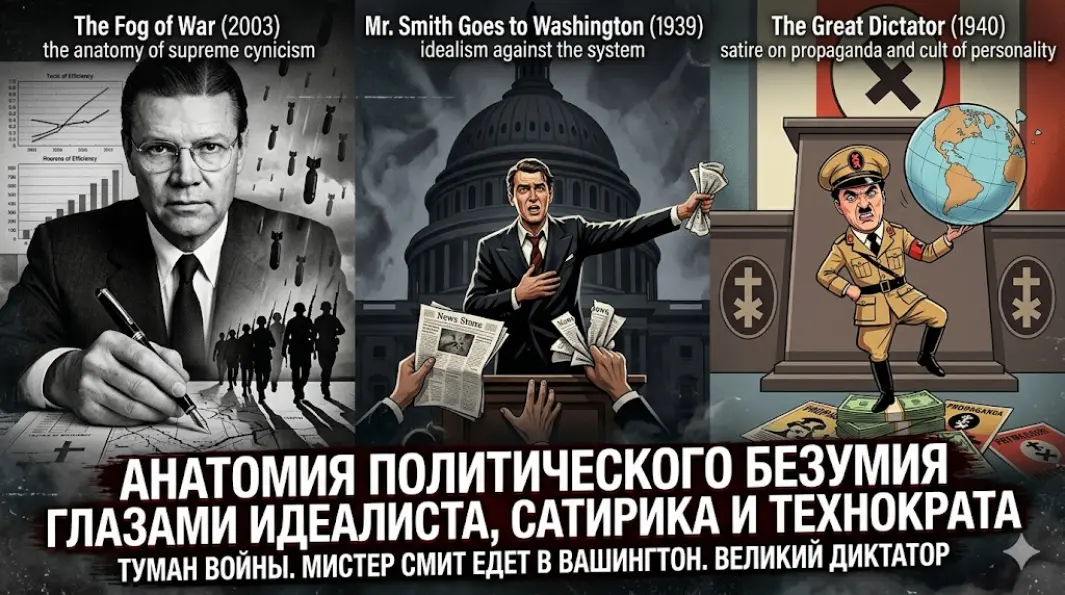
1. The Fog of War (2003). The anatomy of higher cynicism. Lessons from political and military decisions.
You just have to peel the skin off your illusions. If you still naively believe that the world is ruled by mad tyrants foaming at the mouth, turn off your phone and return to your kindergarten. The world is ruled by pure, sterile, mathematically calculated expediency. And Errol Morris' masterpiece "The Fog of War" (2003) is not just a documentary. This is a two—hour autopsy of the skull of the most dangerous creature on the planet - an intellectual in power.
In the center of the frame is Robert McNamara, the architect of the Vietnam War and a genius of logistics. An old man with an immaculate parting and the icy gaze of a retired predator. He's not making excuses. He puts the corpses on the shelves with the grace of a professor of geometry.
This film is a symphony of rational nightmare, performed to the hypnotic music of Philip Glass. McNamara turns genocide into statistics, and burned cities into performance charts. You will see how human life is transformed into formulas for the effectiveness of corporate management. This is the accounting department of a slaughterhouse, where scorched earth is used instead of numbers.
Why is this a masterpiece that will make you gnash your teeth?
Visual terror: Morris uses the camera as an interrogation lamp, hitting right in the face. You can literally feel this old man manipulating history right in front of your eyes.
Aesthetics of Destruction: The chronicle of war is mounted with frightening grace. Falling bombs look like raindrops on a windshield, and in this detachment lies the true horror.
Lessons Written in Blood: McNamara's 11 Lessons are not a code of honor, they are instructions for survival among cannibals, written by the main cannibal of the era.
The "Fog of War" is a mirror that humanity is afraid to look into. There are no monsters with horns. There are respectable gentlemen in immaculate suits who send millions to slaughter with a light stroke of an expensive fountain pen.
Stop feeding yourself fast food from superhero fairy tales and sugary dramas. Turn on this movie. Disinfect your own brains. Look at what absolute evil looks like when he has one hundred percent eyesight and a Harvard degree.
"The Fog of War" is proof that the most terrible crimes are committed not by madmen in a fit of rage, but by intellectuals in starched shirts who are simply too good at counting.
If you consider yourself a humanist, watch this movie to understand how powerless your morality is in the face of the cold logic of the state apparatus. We are all just variables in someone's very long equation.
Robert McNamara speaks calmly, almost academically, but behind this intonation you can hear the gnashing of bones of the 20th century. This is not just an official, but an accountant of death, who for decades has been balancing "necessity" with thousands of burned bodies. And the scariest thing is that he doesn't look like a monster. He looks reasonable. Logical. Convincing. This is exactly how evil works in the age of ties and presentations.
The film methodically destroys the myth of "rational warfare." Every decision, every strategy is not a chess game, but a roulette game where cities are at stake. McNamara talks about the effectiveness of bombing as if he were discussing logistics optimization. And at that moment it becomes clear: the most dangerous form of madness is madness clothed in the language of rationality.
This film asks a simple and uncomfortable question: if a new McNamara appears tomorrow, speaking in the same confident voice, will you recognize him? Or will you again mistake clarity for truth and calculation for wisdom?
Watching The Fog of War is like standing on the edge of a precipice and suddenly realizing that most of the decisions that changed the world were made blindly, by touch, in a thick moral fog.
And the most unpleasant thing is that this fog has not disappeared anywhere. It just changes shape.
2. Mr. Smith Goes to Washington (1939). A naive politician against corruption. Idealism is against the system.
Take off your pink glasses and smash them with a hammer on the marble steps of the Capitol.
If you naively believe that political cynicism, the corrupt press and lobbying are an invention of the postmodern era and dirty political technologies of the 21st century, wake up. You have been deceived. No one broke the system — it was originally designed as a meat grinder for idealists.
And if you still turn up your nose at black-and-white cinema, considering it naive and archaic, then Frank Capra's masterpiece "Mr. Smith Goes to Washington" (1939) will give your snobbery a crushing trip. This is not a sweet old fairy tale. It's a furious, gut-pounding political thriller wrapped in a high drama wrapper.
The main character, Jefferson Smith, brilliantly performed by James Stewart, is thrown into the center of this political brothel disguised as a temple of democracy. He is a provincial idealist, the head of the Boy Scouts with a pure heart and burning eyes. Political vultures choose him for the post of senator with only one goal: to make a headless puppet out of him, an obedient doll that will cover up their multimillion-dollar corruption schemes.
They thought they had brought a lamb to the slaughter. But they've brought the virus of absolute honesty into their sterile hellhole.
This movie will make your blood boil. Capra masterfully shows how Washington, this facade of white marble and pretentious monuments, eats a person from the inside. The Lincoln Monument here does not look like a symbol of freedom, but as a silent witness to a grandiose disgrace. The final 24-hour filibuster (Smith's incessant speech on the Senate floor) is the best dramatic fight in the history of cinema. It's a duel of torn vocal cords against a concrete wall of cynicism. Stewart doesn't play — he literally bleeds on the screen, losing his voice, consciousness, but not his pride. You will see how, in a matter of hours, the corrupt press, on the orders of the oligarchs, turns the hero into a nobody, mixing his name with dirt. Nothing has changed in many years. The manuals are the same, just the paper has been replaced by smartphone screens.
"Mr. Smith Goes to Washington" is a movie that takes you by the scruff of the neck and throws you face-first into reality. It shows that the crowd is cowardly, the system is ruthless, and those who swear allegiance to you from the stands are just lackeys on the payroll of shadowy puppeteers.
Stop feeding yourself serial garbage, where cynicism has been elevated to a cult for the sake of cheap hype. Look at what a real battle for human dignity looks like. Look at how one man, cornered, spat on and betrayed by everyone, makes the entire state machine shudder.
"I believe in people. I believe in this country. And I won't give up!" says Jimmy Stewart's main character, reminding that honesty is not a weakness. It's a weapon. And it's still firing.
Turn on this movie. And answer yourself the question: would you have the breath to shout the truth when the whole audience is covering their ears?
3. The Great Dictator (1940). Chaplin on the dictatorship. A satire on propaganda and the cult of personality.
Are you used to thinking that a dictatorship is marching columns, the cast—iron tread of history, and steel profiles on posters? The dictatorship is a farce. This is the hysteria of an offended dwarf who reached for the microphone and decided that his puppet theater was the fate of the world.
Charlie Chaplin shot The Great Dictator (1940) at a time when Europe was already choking on blood and America was still cowardly looking away. He did not wait for the story to dot the "I". He took a satire like a scalpel and ripped open the belly of a monster right on stage. It's not just a comedy. It's a challenge thrown in the face of global evil with a smile—but with a smile that makes the viewer's blood run cold.
In the center are two roles played by one genius. On the one hand, Adenoid Hinkel is a parody of Hitler, a grimacing clown with a hysterical barking voice. He waves his arms like a puppet and makes speeches similar to the ravings of a baboon who has been given a speaker's desk. On the other hand, there is a Jewish hairdresser who survived in the trenches, a simple man with kind eyes and shaking hands.
But the trick is that Hinkel is ridiculously funny. And this is the main weapon of the film. Chaplin shows that tyranny is not majestic, not terrible in its grandeur. Tyranny is ugly, ridiculous, and pathetic. The globe with which the dictator dances in a tutu is a metaphor that makes you want to laugh and puke at the same time. The whole world is a toy in the hands of a half—wit who can't even sneeze without malice in his eyes.
Chaplin strikes where the tyrant is defenseless — because of his absurdity. He rips off the mask of the "superman" and shows an ordinary, cowardly, psychopathic squishy. When you see Hinkel throwing tantrums over over-salted soup, you realize there were millions following these people. And this contrast breaks the pattern.
The last five minutes of the film are a separate manifesto. Chaplin steps out of character, looks directly into the camera and speaks in a human voice. He's not asking, he's demanding. He's not begging, he's ordering: "Soldiers! Don't give yourself to these animals who despise you, enslave you, control your life, who tell you what they are doing, how you should think and how you should feel!"
This is not a movie. This is a civil execution through art.
The "Great Dictator" is a mirror image of that era, which, like an infection, has not gone away. She just changed her clothes, changed her cap for a business suit, and the globe for the stock exchange. But the dance around the axis of power has remained the same. And the same grimacing figures are pulling their hands to the levers, whispering the same slogans, only in different voices.
Watch this movie. Look into Hinkel's eyes as he clenches his fists in impotent rage. Find out this brilliance — it still flashes in the news, at rallies, in the comments under posts. Only the scenery has changed.
Chaplin did the impossible: he made the world laugh at what the world feared the most. And that laugh was louder than the guns. Because satire has one superhuman power — it tears away from the tyrant his only support: the fear he inspires.
Remember: a clown who laughs at the king is always more dangerous than a soldier with a rifle. Because a soldier can be killed. And laughter is immortal.
Reviews of serious cinema by Violetta Wennman
I am studying at the Academy of Arts at the Faculty of Film and Arts Industry, I am a producer. And I'll tell you about a serious movie. If the movie is not serious, I will tell you how it got into this collection. Look at the truth before you become part of the lie.
I write and shoot. Join me
Author's video content
https://www.youtube.com/c/ViolettaWennman
Political trash
https://www.youtube.com/@Ship-Shard
I invite you to the telegram channel
https://t.me/shipshard
Highly Social on Zen
https://dzen.ru/shipshard
For goodies
https://dzen.ru/shipshard?donate=true
My hobbies are history, philosophy, psychology, music, economics, politics, and sociology. I write about this and much more. Professional model. She has performed at international music festivals (vocals, dancing, imitation of vocalists). I am studying at the Academy of Arts - the film and art industry, I am a producer and the owner of a video studio.
I am glad to see all of you in my blogs.

Stay with me everywhere. https://t.me/shipshard






