
Publication in Russian on the Zen blog
https://dzen.ru/a/ZrnaMI1wy3G3_Nb1
Marx wanted to create a fairer society.
Marx wanted to eliminate the injustices of capitalism and the exploitation of workers with a new theory based on Hegelian economic dialectic and the labor theory of value.
However, his theory had a major flaw that his critics did not articulate very well. His labor theory of value attempted to objectify value based on its relationship to the labor that went into it. It said that the value of a good or service is determined by the labor that embodies it, or the amount of socially necessary labor time to create the object or perform the service.
This differs from the classical economic view that value is subjective and based on supply and demand. This thesis seems theoretical, subtle, and certainly less tangible than the criticism of his desire to abolish private property. However, in practice, if any society tries to base an economy on anything other than subjective value, it will collapse. Value or price is the mechanism in an economy by which buyers and sellers reach equilibrium and convey information about people's subjective desires. If a good or service is valued by anything other than this market mechanism for determining market price, the structure of economic relations is destroyed.

I INVITE YOU TO THE TELEGRAM CHANNEL
UNCENSORED
https://t.me/shipshard
In this post we will talk about Karl Marx and I will explain it in a way that most people do not. I will tell you why his theory is both good and bad. Before we do that, let us try to understand who Karl Marx was. He was a 19th century economist, he did not always study economics, he studied philosophy, history, art, but eventually he came to economics. He came to the conclusion that economics was the most suitable subject for him because it deals with the material world, and most of our interactions take place in the material world. What was Karl Marx like? Was he objectively so bad that in the collective unconscious of today, most of the world thinks that yes, communism is bad? In fact, he was striving for something called fairness, justice - and this is the highest good, sunnah, he was concerned with human fairness and justice throughout the world, he wanted to make the world a better place. His intentions were good. What was the world like from which he came? Let's look around, if you ask somebody today if they are communists, what do you think about communism, their brain lights up red and says, "Leave me alone." But what was their world? Their world was in the 19th century, Europe, Eastern Europe, which was still feudal. The reality of being born in the 1800s and early 20th century was that there was some one man who, through inheritance or perhaps some favor done to the king many years ago, had large tracts of land and some capital. From that, all the people in the village had to work for him most of their days, scrubbing floors, creating wealth for him, growing crops. And he got the profits and enjoyed his life. Can you imagine your mother working most of her life for a man who had a house on a hill and that was her only existence on this Earth, just to serve and obey? Marx would have called that exploitation. Let's look at Western Europe, it wasn't any better there. What about the legions of children? You have children of eight and twelve years old. You send them to the coal mine and to the factory to work all day. That's their childhood. That's their only existence on this Earth. Marx would have called that exploitation. The worker creates value, the capitalist extracts that value in the form of profit, and that doesn't seem fair. Okay, you say, that's not relevant in the modern world, all that's over, we have child labor laws, feudalism is abolished. But is that really true? In the Soviet Union, communism failed and was destroyed, and it's only crazy countries like North Korea, maybe Cuba, where communism exists in its purest form. But in liberal democracies, the ideas of communism are starting to creep in again and again, and many people are thinking in terms of things like the Communist Manifesto, which talks about goals or free education, graduated taxation, centralized control of banking, and the abolition of private property. Every Western democracy has three of the four things achieved by now, and the last one is the abolition of private property, so the ideas are still relevant. What was Marx's main idea? The main idea of Karl Marx is that he created the labor theory of value, which means that any object costs exactly as much as the labor invested in it. People, workers, the proletariat - they build something, they create something or provide a service, this is the cost of this service or object. For example, let's look at a construction site. A construction site, several houses that belong to owners and are built by workers. For example, a builder earns 50 rubles an hour, and the house will be sold, for example, for 400,000,000 rubles. A worker working for 50 rubles an hour, his salary barely reaches the subsistence minimum, he can barely feed his family, and the owner lives a luxurious life, this does not seem too fair, but this is the world we live in, so the ideas of Karl Marx are still relevant. And ultimately, each of you can count on your fingers the fair bosses, or even fewer than those who want you to work late, sacrifice yourself or your weekends so that he can do some home repairs or go on vacation with his wife. As people, we are all equal and this is our only existence on this Earth, so this is a significant argument in favor of Karl Marx's labor theory of value, according to which the value of any object, product or service is equal to the labor or creative potential of the proletariat invested in it. A house costs 400 million rubles, ask yourself how much this house really costs? Karl Marx would answer unequivocally that it is the cost of the labor invested in it. So the builder can say that the true cost of his labor will be 400 thousand rubles. But we know that this is not true. What makes up the price, who determines it - the seller or the buyer? Many people say that the buyer knows and the seller sort of understands that this is the interaction of supply and demand, buyer and seller, therefore the price of any object in reality is determined subjectively by supply and demand. And if you know Adam Smith and his diamond water paradox, which proves that diamonds are infinitely more expensive than water, which has practical significance, and exactly the same in the labor theory of labor value, where the cost is determined by the amount of labor invested in it. And some objective measure is determined subjectively, if no one wants to buy this house, then the developer can reduce the price to 300 million rubles. And if everyone wants to move to a certain city, then the developer can raise the price to 500 million rubles. So, we see that this price, the cost, which is determined by the interaction of people, supply and demand, free will, free choice, who wants to pay for something and regardless of the labor theory of value. Let's go back to Karl Marx, this misunderstanding of price and value creates a system that will always collapse, like in the Soviet Union, where they built big factories and plants, you go to the market and people are starving on ration cards and the government has to resort to social engineering, treating people almost like cattle. Because of the labor theory of value, if I grow potatoes and I put them on the market, the government will say that the amount of labor that went into them means that these potatoes should cost 10 rubles a kilo, but I know based on supply and demand, if I go to the market, it doesn't matter how much labor I put in, what matters is that people want to buy or sell, and I make a profit based on that. And that creates a tremendous incentive. It's an incentive for people to be creative. Now people criticize things like plastic bag pollution, and of course there are greedy capitalists, but there are also people who think how to solve this problem and make money from this idea, they release bacteria into the landfill, solving the problem. Companies and people who produce organic natural products, their profit motive is great and is based on the positive and idealistic. It's called creative conscious capitalism. The profit motive has a lot of positive things for the world, but if you only see the world in black or red, then you misunderstand the idea of profit. Can you imagine if Google was a government company? Would there even be a search engine and all the things that this company created? And this is the same greedy profit motive that Karl Marx would call exploitation, theft of profit. He called for the abolition of private property, but even animals have territories, it's almost instinctive in us. So when we talk about self-interest, again as a critique of capitalism, we have to remember that it is enlightened self-interest, conscious self-interest, which is different from selfishness. And if we all act out of enlightened self-interest to make a profit, then the motives that are built into us are to improve ourselves. Marxist theory fails because when you try to make everybody equal, and all property belongs to everybody, it belongs to nobody, and people lose that instinctive evolutionary need to improve themselves, to strive, to create and to create, to do things that are surprising. Marxism is wrong because the labor theory of value allocates price and value incorrectly between buyers and sellers, and that causes the system to collapse. Think about it, if I bring a certain commodity to the market, if I feel the value of the commodity, or if someone objectively believes that this commodity is worth this much money, and I don't make any profit, that system will collapse. Take Venezuela as an example. It's not that they implemented socialist Marxist ideas incorrectly, it's that they implemented them correctly, and that's why their system collapses. The next time you're debating why capitalism is good and Marxism is wrong, try to understand how it is that socialism is a path to serfdom that is creeping into liberal democracies. And you can counter that with some arguments about the value of the labor theory, that the profit motive subjectively determines the pride and majesty of private property that people embrace. This is the theory of Karl Marx, and although he sought justice, he wanted to see this justice manifested in this world, but ironically, his ideas turned out to be more sublime than Christianity, which he criticized. Thank you very much for reading the publication.
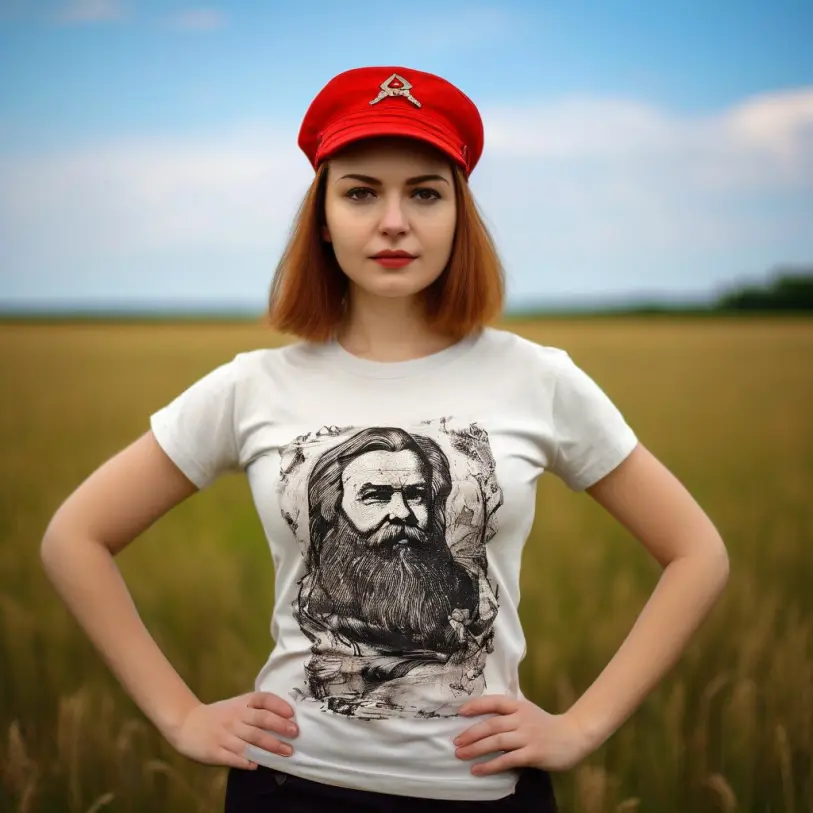
Economics is a topic that helps us see the world from a different perspective.
Marx had good intentions, but his economic theory had flaws that were contrary to the optimal healthy development of society.
However, the problem with capitalism as it exists today, in the United States, is that it is not really a capitalist country. A country that has a centrally controlled monopoly on the most important commodity, money, cannot claim to be truly free. This control and influence of non-neutral money creates more inequality and injustice than many people can imagine. It creates bubbles of power and control that are not related to the process of value creation.
If you take this line into account, there is an argument that capitalism and socialism can converge in the happiness of workers if and only if money is free, like the classical gold standard. I know this seems abstract, but there is some truth to it.
Now let's look at the idea that the Soviet Union grew quickly. I believe that if there had been a free market, it would have grown faster. Communism skipped the free market phase, it came out of feudalism, which was bad, but Russia never experienced true freedom. The world experienced a shift in production boundaries through innovation, but the Western countries with free markets grew faster. You can see this by comparing East Germany to West Germany before the fall.
Marx wanted justice, and his ideal may have been right, but the result did not work.
Marxism or any mixture of it does not work because of deadweight loss and the misallocation of resources and talent. This is not just a statement in an economics book, it is reality. All this industrialization was in vain, because the large state-owned factories were monuments to man's attempts to design society. The main reason for the failure is that the theory of value cannot be implemented. At a basic level, it is like going to a farmers market where potatoes are 10 rubles a kilo and carrots are one kopeck a kilo. Price and value are determined subjectively, otherwise the whole system will fall apart.
If we try to mix economic ideas, maybe it won't fall apart, but society will lose. Even in the US. If they didn't have such a big social government, they would already have a colony on Mars.
The best economic system is one that works with this evolutionary drive to survive and improve ourselves, and family members stay together and look after each other in an enlightened way.
Anything else will lead to unhappiness in society. The role of governments is to protect our freedoms, that's all! I firmly believe that Adam Smith's understanding of enlightened self-interest works best for the rich, the poor and the human spirit.
Freedom - Justice - Equality = Social Virtues.
I believe in the idea of justice. I believe the best way to achieve this is more freedom through a social safety net.
I think if society is willing to compromise, we could drastically reduce military spending. It drains our society and ironically reduces our willingness to defend ourselves because it holds society back. This means that because we spend so much money on conventional weapons, we are putting ourselves at a huge disadvantage in the future because we are not realising our potential in terms of education and technology, which are the real advantages.
Many people believe that they are successful in life because of themselves. This is pure ego. Yes, we are successful in the context of our culture. In a free society, there are countless people who have risen above poverty. This is what you do with your innate gifts, not with material gifts.
Once material security is achieved, it is a door through which people can do anything. In today's society, you can just log on to the computer and go to the library.
Many children in developed societies grow up as slackers. In contrast, in apartment buildings and villages, legions of children grow up playing chess and studying.
The material poverty of the East is less than the spiritual poverty of the East.
Once you have the basic food stuffs, which almost everyone in a free economy has too much of, the rest is to get the message - the idea of entrepreneurship - about classical education, not to concentrate society's energies on redistributing wealth.
I believe that people are inherently good. If people are inherently good, most of them will become altruists. Selfish genes evolve. Genes know that they cannot exist in a world of selfishness. Selfish people do not reproduce as often.
There are three basic social virtues: Liberty - Justice - Equality. Only justice is the highest good. You can never have too much of it. You can have too much liberty. You can have too much equality. But you can never have too much justice. This is what Marx wanted, and this is what Adam Smith wanted. They are two philosophies that take very different approaches.
That said, people have gone back and forth on where justice lies on the spectrum of freedom and equality.
I would have to agree with Friedrich Nietzsche's idea that society is an abstraction that does not exist. Rather, what does exist is a collection of people with free will, and society is the ultimate observable history. History must be written organically by people.
Marx was a quasi-intellectual, as is anyone who thinks he is right.
He was just a guy who developed some theory. But they were not logically consistent, and they did not address big issues like the socialist calculation problem or the labor theory of value.
Good luck to you. And remember, the best barometer of a society is its economy.
Карл Генрих Маркс – немецкий писатель, философ, социолог и экономист. Один из уникальнейших философов своего времени, идеи которого продолжают и будут актуальны еще долгое время.
Адам Смит - шотландский экономист и философ-этик, один из основоположников экономической теории как науки. Считается основателем классической политэкономии.
Фридрих Вильгельм Ницше - немецкий мыслитель, филолог, композитор, поэт, создатель самобытного философского учения, выходящего далеко за пределы научно-философского сообщества.
Ницше писал, что человек по-настоящему культурный, думающий, сильный, сам выбирает себе систему ценностей и не скатится в насилие и жестокость.

Author's video content.
In collaboration with CMCproduction & SmartREC video studios
https://www.youtube.com/c/ViolettaWennman
https://ok.ru/shipshard1
https://vk.com/shipshardvk
https://www.pinterest.ca/omegagirs/
https://dzen.ru/shipshard
https://t.me/shipshard
Publication in Russian on the Zen blog
https://dzen.ru/a/ZrnaMI1wy3G3_Nb1






