
Publication in Russian on the Zen blog
https://dzen.ru/a/afnYhNPSXXG6MlHN
A dystopia. A psychological story. History.
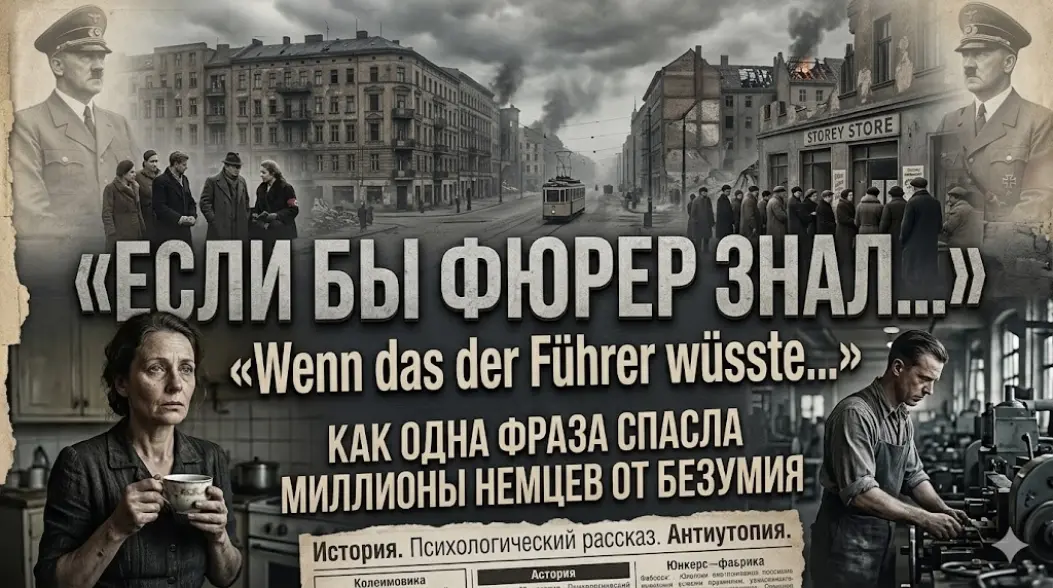
"If the Fuhrer had known": How one phrase saved millions of Germans from madness.
Why do people tend to justify the supreme power by blaming local officials? Let's look at the example of Berlin in 1943.
The preface.
"If the Fuhrer had known...": The story of a self-deception that helped millions stay sane.
Imagine: there is a war going on, the city is being bombed, a neighbor has been taken to no one knows where, the kitchen is empty, and on the radio there is the voice of an announcer broadcasting about a great victory and a brilliant leader.
And you find yourself thinking, "How come? This can't be happening. So the Fuhrer just doesn't know... if he only knew the truth, he would fix everything."
"Wenn das der Führer wüsste..."—"If the Fuhrer had known..." - it was not just a quote. It was a password for self-deception. A lifeline for the sinking psyche of an entire nation.
This short phrase, "Wenn das der Fuhrer wüsste..." ("If the Fuhrer had known..."), became one of the most powerful psychological anchors of Nazi Germany. Not an official slogan, no. Something worse: popular self-deception, legalized from above.
The secret of this phrase is not in its text, but in its function. She was the perfect tool for shifting responsibilities. This story is not just about Hitler. It's about you and me.
The prologue. Berlin, November 1943.
Martha Keller's kitchen smelled like burning.
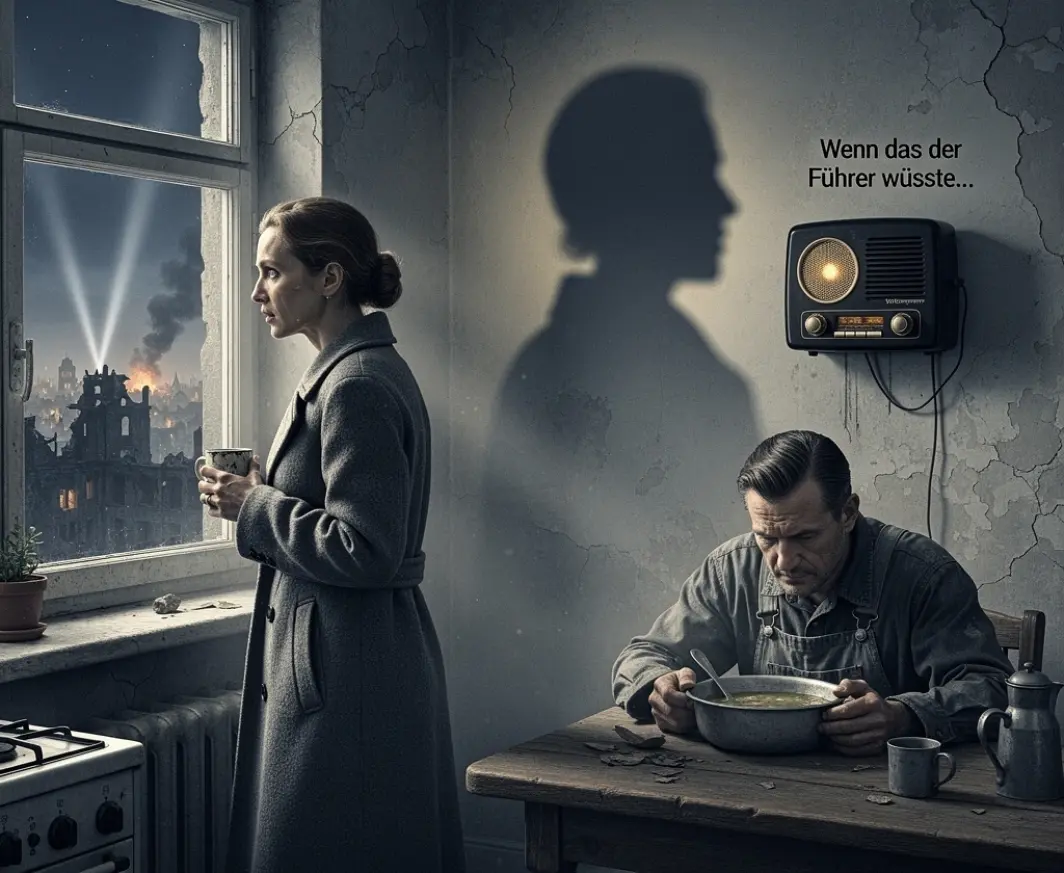
Not the usual smoke that had seeped into Berlin's pores, which was left behind by British land mines, turning residential neighborhoods inside out. It was the lonely, acrid smell of burnt rutabaga soup. Marta was distracted — she had been standing at the window for too long, wrapped in a worn wool coat, and looked out into the courtyard, where the November wind was blowing fragments of old newspapers across the gray asphalt.
The sky above the city seemed to be cast from rusty iron plates. Under this sky, in the semi-darkness of an unheated apartment, Martha cradled a mug of cold Ersatz coffee in her palms. Across from her, at an unpolished table, sat her husband Helmut.
They had been married for twelve years, but now Martha looked at him and saw only a shadow. Twelve hours a day, six days a week, Helmut assembled engines at the Junkers factory —steel hearts for cars that flew east and never returned. He came home gray with fatigue, smelling of fuel oil and cheap tobacco, and ate mechanically, as if he were continuing to follow conveyor instructions.
But on his face—and this scared Marta more than hunger and bombing—there were still times when the very expression she had learned to hate showed through. The expression of a man who believes.
— Have you heard about Carl Felker? Helmut asked, without looking up from the bowl of liquid gray brew.
Martha heard it. The whole house was whispering. Karl, the quiet accountant from the third entrance, who wore ridiculous horn—rimmed glasses and treated his mental anguish by feeding city pigeons, disappeared yesterday morning. Two men in gray felt hats led him out by the elbows. No shouting, no explanation. His wife Bertha then walked around the apartments, looking into the neighbors' eyes with a frightening, dry look, and asked if anyone knew where people were being taken in a gray car. No one knew. No one asked those two.
"They say he wrote a letter," Helmut continued quietly, and the spoon in his hand paused for a moment. — He complained about the rations. The fact that the workers in the workshops do not have enough bread, and the children in the rear are swollen with hunger. He wrote somewhere up. To the party cell. I thought they would help.
Martha put her mug on the table. The sound was dry and muffled, like a gunshot in a basement.
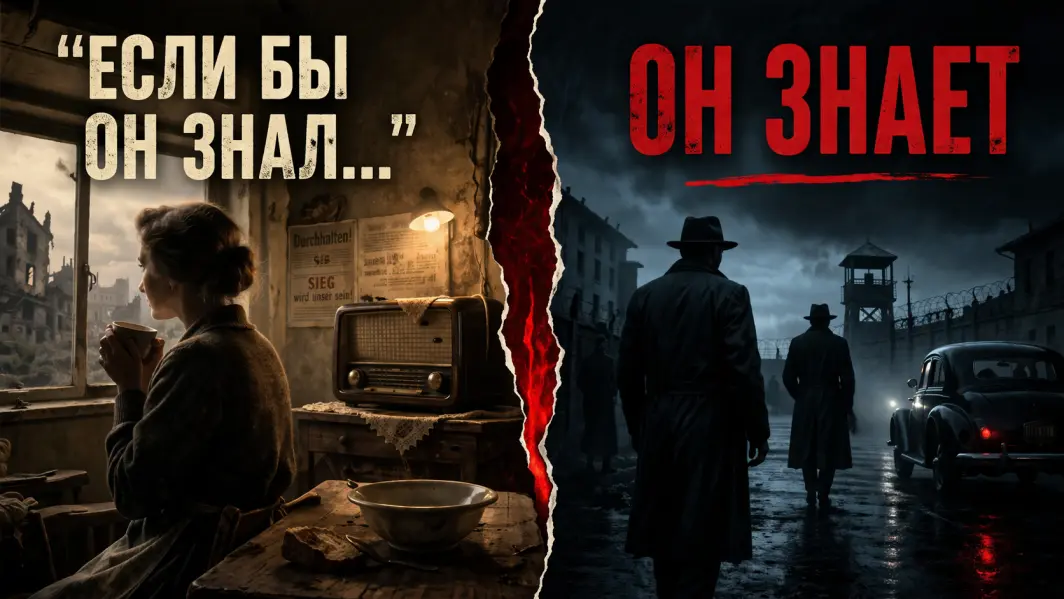
"If the Fuhrer had known...— she said.
The words came out of her mouth by themselves, obedient to years of habit. Martha was startled by how casual they sounded. They were pronounced in the same way in endless queues for potato peelings. That's what they whispered in the suffocating closeness of the bomb shelters, when the walls were shaking from the explosions. It was a formula, a half-question, half-prayer, a universal antidote to the oncoming madness.
If only the Fuhrer had known.
Helmut nodded heavily. Slowly, as if they were nodding in agreement with the weather forecast.
"He would have figured it out,— he said confidently. "He just doesn't know. They don't tell him.
And he went back to his soup.
Part one. The architecture of organized faith.
Helmut Keller believed in an organized way.
There was no religious awe, doubt, or mercy in his faith. It was a dry, mathematical belief in the train schedule: if the train is delayed, it does not mean that the rails lead nowhere. This only means that temporary difficulties have arisen on some stage.
For Helmut, the Fuhrer had long ceased to be a man of flesh and blood. It turned into the highest State Principle, into an impeccable starting point from which everything right flowed: order, the work of factories, the meaning of this protracted, bleeding war. If the world was falling apart, if the shops were giving turnip coupons instead of meat, and the neighbors disappeared at night, it means that the Principle was distorted somewhere at the bottom. Like the purest water that flows from a mountain spring, but becomes cloudy as it passes through rotten city pipes.
Marta remembered how, in nineteen thirty-nine, Helmut carefully wrote his first letter to the Reich Chancellery. He complained about the arbitrariness of the factory foreman and the deterioration of dinners. He sincerely believed that the leader of the nation would open this envelope, frown and immediately send the commission. The letter is gone. Nothing has changed. But Helmut just shrugged his shoulders.: "The bureaucrats intercepted. A thick layer of officials is hiding the truth from him." And he wrote the second one.
Martha didn't argue. Arguing with Helmut about the Fuhrer meant arguing with him about the right to life. After their eldest son Hans died near Minsk in 1941, Helmut's whole life was held together by a single, taut thought: it's not for nothing. The son died for a great cause. Hunger is for the sake of a future victory. If you remove the leader from this structure, the string will snap, and Helmut will simply crumble to dust.
Martha saw what happens to those who have this string snapped. She saw Bertha Felker's face, a face scorched from the inside, with only ashes left on it.
Part two. Golden pheasants in a wool fog.
On Sunday, Martha went to get bread. The queue stretched for four hundred meters along the dilapidated facade of the town hall. The November wind pricked my face with icy needles. In front of them stood old Frau Baumann, wrapped in three shawls, and behind her stood an unknown woman with swollen eyes.
— Have you seen it? Frau Baumann gasped, barely moving her blue lips. — Stumpfecke has arrived again. Straight to the deli in his black Mercedes. And his wife is with him. In a mink fur coat up to her toes. The face is full, round…
Stumpfecke was the gauleiter of their district. They were popularly called "golden pheasants" because of their luxurious brown uniforms, abundance of gold badges and the way they lived as if wars, funerals and cards did not exist at all.
— The mink! In the midst of such poverty! The stranger whispered angrily. — My husband has been at the front for three years, and I've been standing for two hours for frozen potatoes!
Frau Baumann shook her head sternly, pulling her back:
"Be quiet! The party bosses are completely overindulged, that's right. They came to power, they steal, they drink blood from the people. But what does the Fuhrer have to do with it? Everyone knows he lives modestly. He doesn't eat meat, sleeps on a camp bed, and doesn't bend his back for Germany. It's them — Stumpfecke and his ilk — who are entrenched around him and doing obscenity. If only the Fuhrer knew what kind of dirt they spread behind his back…
Martha listened to this whisper, and something inside her turned with a nasty creak.
She had heard this logic a thousand times. She used it herself as a life-saving shield. It was so convenient, so cozy: dividing the world into bad performers and a good ruler. A formula that requires no proof.
But today, for the first time, the formula failed. Martha suddenly thought: where did Stumpfecke get the Mercedes? Where did the cottage on the Wannsee and the furs for his wife come from? He doesn't steal them from the warehouse at night. He gets them. His position, his power, his right to burp his fill in the face of a hungry queue — all this is confirmed by a single signature. Up there. The thin, well-groomed fingers of the chief signed the mandate for this pheasant.
Martha was standing in line, and the wool coat no longer warmed her. She clearly realized that the phrase they consoled themselves with every day was not a lifeline. She was an iron cage, the keys to which they themselves had thrown into the well.
Part three. Crystal and censorship.
Martha tried to remember exactly when that cage had slammed shut.
Not in thirty-three, no. She remembered the thirty-eighth. Kristallnacht. The morning after the pogroms. Martha walked to work past the broken windows of Jewish shops. The sidewalk was strewn with shiny glass, like ice, and there was still a sweet smell of burning in the air — a synagogue was burning down around the corner. Passersby hurriedly averted their eyes, speeding up their pace. On the corner, a pharmacist quietly said, "It's the stormtroopers on the ground who overdid it. The Fuhrer could not order the burning of houses in the middle of Berlin. It was the fanatics who went too far, and now he has to deal with the world."
And Martha agreed then. And she repeated this when camps appeared, which "everyone knew about, but no one saw for sure." I repeated it when trains with wounded began to arrive from the east, whose eyes were full of inhuman horror.
And then their son Hans sent his last letter from the front. Censorship mercilessly smeared it with black ink, leaving only torn paragraphs. But at the very end, written in a hurried, jumping handwriting, one phrase survived.:
"Mom, what we are doing here in the east... is not a war. It's something else. Purge hell of devils, and they'll seem like babies compared to us. Don't ask me anything else."
Helmut then yelled at her. He said that the boy was tired, that his nerves were giving out under fire, that it was not worth paying attention to the words of a frightened soldier. And Martha agreed. Because admitting their son was right meant admitting that the world they live in is ruled by a monster. And it was physically impossible to live with this thought in Berlin on the forty-third.
Part four. Hook.
Bertha Felker came to see Martha on Thursday afternoon.
She entered silently, like a shadow slipping through an open door. Her silence was terrifying—it was the silence of a scorched field where not even weeds remained. Just ashes.
—They told me,— Bertha said in a dead voice, looking past Martha. — Karl is in Sachsenhausen. The camp near Oranienburg. For that letter about the ration. A party official handed him over to the Gestapo.
Martha froze with a rag in her hands. The air in the kitchen felt as thick as glue.
— Bertha… I'm so sorry…
"I'll write to the Fuhrer,— Bertha suddenly jerked her head up, and a mad, feverish light flashed in her empty eyes. The voice rose to a scream. — I will write to him personally! He must find out! Karl is not a traitor, he just wanted the workers not to die at the machines! If the Fuhrer had known that the Gestapo was imprisoning honest Germans for the truth, he would have ordered these executioners to be shot!
Martha stared at her, and an icy horror squeezed her throat. She saw more than just an unhappy woman in front of her. She had seen how this great, diabolical mechanism worked.
The phrase "If the Fuhrer had known" was not an accidental product of popular naivety. It was a carefully calibrated, ingenious architecture of thinking. The system deliberately created chaos, created departments, and encouraged the brutality of the lower classes so that the supreme ruler would always remain in a radiant halo of infallibility. It was a hook. The victim impaled himself on it, thinking that he was reaching for salvation. A man went upstairs with a complaint — and fell right into the jaws of the Gestapo. Because complaining about the system to its creator is the fastest way to shorten your life.
—Don't write, Bertha,— Martha said quietly but firmly.
"But why?" He's our leader, he's supposed to protect us!..
"Don't write,— Martha repeated, and she didn't have the strength to explain.
She couldn't say it out loud.: "Because he knows. He knows about Sachsenhausen because he built it. He knows about hunger because it's part of his calculation. He doesn't care about your Carl." To say that would be to commit mental suicide.
Bertha left, sobbing fitfully and clutching an empty bag to her chest.
Part five. A great epiphany.
Every evening at seven o'clock Helmut turned on the Volksempfänger, the "people's radio." A small black box on the wall was a must-have attribute of every apartment. Turning it off during broadcast hours was considered almost treason.
The announcer's voice filled the room, seeping through the speaker like suffocating gas.:
"Our valiant troops dealt a decisive blow to the superior forces of the Bolsheviks... The spirit of the German soldier is unshakeable… The Fuhrer personally directs the defensive operation at the headquarters without closing his eyes.… Everything for the front, everything for victory..."
Martha was sitting on the bed with her legs tucked under her. The radio spoke of the leader's concern, and before her eyes was an invisible but tangible picture. She did not know the word "Wannsee Conference", she did not know that a year before, fifteen neat men in formal suits with cognac and cold snacks had outlined a schedule for the destruction of millions of people, as if it were a logistical scheme for the supply of coal. But she felt it. Through my son's broken lines. Through Bertha's blank stare. Through trains that left full for the east and returned stuffed with used clothes.
"The Fuhrer cares about every German..." the receiver spewed.
"What if he knows?" thought Martha.
Not "if I knew" — subjunctively, cowardly, hiding behind an illusion. And affirmatively: he knows.
A system that has concentrated absolute power in one hand cannot afford the luxury of not knowing. For a dictator, not knowing means losing control. And control is the only thing he breathes for. This means that every death, every denunciation, every crumb of bread taken from a child is approved by his will.
Martha went to the window. Berlin lay in darkness at night, shackled by fear and disguise. Somewhere far away, the thud of the echelon wheels could be heard.
She looked at her sleeping husband, who was sighing heavily and hoarsely in his sleep, and for the first time in her life she uttered this phrase with a completely different, chilling intonation.:
"If the Fuhrer had known..." she paused, tasting the bitter taste of truth on her tongue. "He knows.
The radio was hissing softly. The world did not collapse. The walls didn't move apart. But inside Martha Keller, there was a frightening, absolute emptiness. The cage disappeared, leaving her alone with the icy wind of reality.
Part six. Soap and paper.
Helmut went to the factory in the morning. On the threshold, he habitually kissed Martha on the cheek and smiled wanly:
— They promised to give us an extra bar of soap at the trade union meeting. The Fuhrer is mindful of the needs of the workers.
He paused at the door and added, lowering his voice,
"By the way, they say in the courtyard that Karl Felker wasn't arrested for writing. A neighbor from the fifth saw some suspicious guy coming to him. They say Karl listened to enemy radio voices. The BBC. So there's... there's nothing the Fuhrer would have done. The law is the law.
Martha looked into her husband's eyes. There was no evil in them. They had only a desperate, deadly need to justify their faith, to add new touches of loyalty to the picture of the world, so as not to go crazy right now, on the way to the factory.
—Yes, Helmut,— she said softly. — If he listened to the BBC, then the Fuhrer will not help here.
The door slammed shut. Martha was left alone.
She sat down at the table, put a blank sheet of paper and a pencil stub in front of her. She could have written. Write everything he thinks. About Stumpfecke, about Sachsenhausen, about the obliterated cities, about the deception pouring out of the black box.
She knew what would happen next. The letter will fall into a tin box. The bag will fly to the office. An official with a bored face will write down her name, address, and her husband's place of work. A call to the Gestapo. Footsteps on the stairs.
And Helmut, turning pale during the interrogation, will babble: "If only the Fuhrer knew what kind of snake I have warmed on my chest."… He would have figured it out..." And Bertha Felker in her basement will sigh: "Martha was a good woman. If the Fuhrer had known why she was taken away, he would have let her go."
The mechanism worked smoothly. The lie was self-perpetuating.
Martha Keller looked at the blank sheet, slowly put the pencil aside, got up, went to the sink and began to wash the empty bowl of burnt rutabaga soup thoroughly, until her fingers hurt.
The epilogue. The anatomy of the diagnosis.
Martha Keller is an assumed name. But her silence, her fear, and her saving formula were absolutely real to millions of people.
The phrase "Wenn das der Führer wüsste..." died in May 1945 in the smoldering ruins of the Berlin Chancellery. But is the mechanism itself dead?
When Soviet and American soldiers forced residents of the surrounding German cities to pass through the gates of the liberated concentration camps so that they could see with their own eyes the mountains of emaciated bodies and ditches filled with human ashes, people wept, covered their faces with their hands and repeated a new formula.:
"We didn't know. We didn't know anything. (Wir haben es nicht gewusst).
An amazing metamorphosis of the same psychological defense. At first, the blame was shifted to the "bad boyars" under the "good leader," now to the "bad leader" under the "innocent people." The scenery has changed, but the function has remained the same: to absolve oneself of responsibility, to protect a vulnerable ego from the horror of complicity.
To acknowledge knowledge is to acknowledge one's personal contribution to the crime. To admit that your silence in the queue, your diligent work at the military factory, your cowardly averting your eyes from the burning neighbor's house — all these were the bricks from which hell was built.
People don't want to rewrite their lives. The truth costs them too much.
Therefore, in another country, in another century, in a completely different language, people with the same facial expression continue to whisper: "Our leader is wonderful, they just don't tell the truth to him... The environment steals, local officials go too far, but if you report to him, he will figure it out."
Listen to this familiar, soporific melody.
It's not a hope. This is not loyalty. This is a dull, rusty hook that is firmly embedded in the jaws of society. And as long as you believe that the evil at the top is just an "information error" and not a deliberately built, terror—breathing system, you continue to obediently wash your bowl, waiting for someone to come for you.
The Dark Art of Dystopia by Violetta Wennman
PARSING, SYMBOLS, MEANINGS.
WE ANALYZE, COMPARE, AND UNDERSTAND.
Welcome to a world where the future is already written.
I write and shoot. Join me
Author's video content
https://www.youtube.com/c/ViolettaWennman
Political trash
https://www.youtube.com/@Ship-Shard
I invite you to the telegram channel
https://t.me/shipshard
Highly Social on Zen
https://dzen.ru/shipshard
To buy caramels to ruin your teeth
https://dzen.ru/shipshard?donate=true
My hobbies are history, philosophy, psychology, music, economics, politics, and sociology. I write about this and much more. Professional model. She has performed at international music festivals (vocals, dancing, imitation of vocalists). I am studying at the Academy of Arts - the film and art industry, I am a producer and the owner of a video studio.
I am glad to see all of you in my blogs.

I'm waiting for you here so I don't get lost. https://t.me/shipshard






